Dr. Boukhanovsky, how did the institute come to be?
One can say that the foundation of the institute was the next logical step in a series of events: in recent years, ITMO University landed in the A+ group of the national AI ranking, the top 100 of the QS subject ranking in Data Science & Artificial Intelligence, and developed a national model for professional training in the field. These successes are the result of systematic efforts: since 2017, we’ve walked the path from separate research groups to first opening the NTI Competency Center in Machine Learning in 2018 and then the Research Center “Strong AI in Industry” in 2021. These centers brought together interdisciplinary teams and industrial partners; they laid the foundation for the new Institute of Artificial Intelligence, which includes joint corporate laboratories with Rosneft and Mosstroyinform, a youth laboratory of composite AI, the LISA laboratory, and other specialized departments. Today, the total number of staff at the institute is over several hundred people from all four ITMO schools.

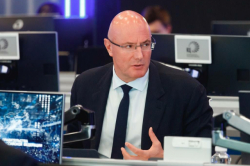
Alexander Boukhanovsky. Photo by Dmitry Grigoryev / ITMO NEWS
Which of ITMO’s strategic goals will the institute tackle?
ITMO is one of the top universities in Russia, which is a good and a bad thing at the same time. It’s a good one because we’ve done quite a lot. A bad one – because we’ve nearly reached the limit of our natural evolution. That’s why the university needs a new mechanism of boosting its development in the next decade. One possible solution could be a sovereign AI – one that’s not just created at ITMO, but used by our teams in their work. Thus, AI becomes a driver of transformation of science and education while ITMO research groups in various fields get an advantage – access to technologies and resources straight from their developers.
I believe that by 2030, ITMO may no longer adhere to separate subject areas – instead, they will all be united within the single ecosystem, AI-Inspired Science. This is a necessity explained by the fact that even now the use of AI in science has sped up the R&D cycle by 1.5-3 times. That’s why very soon we can expect the scientific community to divide into two parts: those who successfully use AI and those who don’t know how to do it and thus are doomed. What’s more, we are already seeing fierce competition among AI-using scientists, competition stemming from technological capabilities. And the winners will be those who use the most cutting-edge AI. I believe that soon the best exact sciences (physics, chemistry, biology, medicine) in Russia and globally will be concentrated around AI research centers producing new means of optimizing findings. That’s why the creation of an AI institute at ITMO is a strategic, even an existential, decision that will allow us to anticipate the future.

An AI professional development course at ITMO. Photo by Dmitry Grigoryev / ITMO NEWS

Alexander Boukhanovsky's lecture at an AI professional development course at ITMO. Photo by Dmitry Grigoryev / ITMO NEWS
How is the new institute different from the university’s existing departments and similar initiatives in the country? What are its unique competencies?
The key difference from similar departments at ITMO and elsewhere is in the fact that our institute employs an open full-cycle innovation system in AI, from fundamental studies to implementation and sales.
Importantly, the institute wasn’t born out of a mere merger of relevant departments – instead, it’s a strategic “holding company” that brings together the structures that are successful in their fields and allows them to solve fundamentally new problems. The Institute of AI doesn’t interfere with the inner structure of its departments but focuses them on different aspects of a single problem: AI development at ITMO. At the same time, the institute welcomes staff and students from other ITMO schools; we don’t set any limits on where you teach or where you study.
What are the institute’s activities most focused on – innovation, research, or education? How will you reach a balance between these areas?
The main goal of the new department is to create a unified strategic platform for the development of AI as a cross-cutting technology of national importance. We focus on the synthesis of scientific and innovative activities: from generating fundamental knowledge to its implementation in real economic sectors. ITMO’s schools are responsible for education, whereas we form an environment where education naturally grows out of research. For instance, ITMO students can join our projects or complete internships and practical training. Additionally, our scientific development is reflected in our professional development programs because these days it’s not enough to produce a technology – it’s important to teach users to work with it.
One of our key ambitions is to create a strong professional AI (AGI); an AI that is capable of acting like a university graduate – it will have fundamental professional knowledge, combine it, and continuously learn as it solves new tasks at the human level. The key challenge here is to develop a training system; that is, an AI capable of designing and training professional AI systems. This meta AI has to be able to reproduce the human mechanism of studying a new subject: analyzing literature, watching video lectures, solving practical cases, etc.
AGI will be able to challenge its scientific contemporaries, including those who only use AI for partial automation, such as for writing articles or conducting select experiments. We believe it’s possible to transform the entire process of scientific and engineering work by creating a new canon and new requirements for professional training. The feasibility of this approach has already been demonstrated for projects in chemistry, materials science, clinical medicine, oil and gas engineering, and urban planning – the first prototypes of such systems will be unveiled at ITMO before the end of 2025.
How will the institute introduce its solutions into the real sector of the economy? Are there already any industrial partners or ongoing projects?
Our institute can boast a large list of partners and clients, among which are major oil and gas companies (Gazprom Neft, Tatneft, Rosneft), urban planning organizations (Mosstroyinform, Rocket Group, Ametist), banks (primarily, Sberbank and Alfa-Bank). Moreover, we are developing solutions for the government.
What is the institute’s management system like? What principles lie at the core of its strategic decisions and how is the responsibility divided between the managing bodies?
The Institute of AI is a federative system that has to be sustainable. That’s why, unlike other ITMO structures, it’s managed by a board of directors. Each director is not only a PI, but first and foremost a leader who’s already successful in a cross-cutting field that is crucial for the institute’s development. For instance, in fundamental research that turns into A* publications or scientific fundraising. Thus, this director is responsible for the entire institute’s strategy in this field. All of these separate elements of strategy are then brought together by a “board of equals” within joint decision making.
While the board can be considered our legislation body, the executive body is the Center for Project Activity Coordination. Its task is to ensure and manage the execution of the board’s decisions at all institute departments, as well as optimize anything related to project management, finances, staff, partnerships, infrastructure, and community. In other words, the center takes on all the administrative duties and gives other departments more freedom to pursue research and innovation activities.