NTO is a national team engineering contest for school (grades 5-11) and university students with over 40 tracks in different fields, from big data and machine learning to virtual reality technologies.
In the track Intelligent Robotic Systems, participants solve practical tasks in the field of physical AI, such as teaching robots to avoid obstacles and navigate new environments. This season, Yandex became the technological partner of this track for the first time. The tech giant provided educational prototypes of their delivery robots that met the regulations and difficulty level of the competition’s tasks. All robots are equipped with lidars, cameras, wheel encoders (rotation angle sensors), and rangefinders – in short, everything necessary to solve problems close to real-world logistics and industrial automatization.
This year, the track’s finals welcomed a record number of participants: 50, compared to last year’s 30. The teams had to solve a complex engineering task: develop an autonomous navigation system that would allow robots to explore a maze, create a map of the pathways, and find all ArUco markers on its walls. These are the skills that allow actual delivery robots to navigate unknown spaces, drive around people and obstacles, and find their destination via a QR code on the door.
Participants had to find a balance between the cost of the sensors they used and the accuracy of localization. Teams could choose only one of the three available approaches: wheel odometry (counting wheel rotations), lidar with odometry (measuring distance to walls using a laser rangefinder), or visual odometry with a camera (scanning the space and remembering landmarks).
There were three rounds in the contest, which got progressively more difficult. First, robots had to just detect their markers in the starting cell. Next, they needed to navigate a maze from a known starting point. And finally, the hardest task: robots had to autonomously localize themselves, navigate their environment, and find all the special markers. At the detection of each marker, the robot had to turn towards it, put out its ID on the screen, and then finish its route in a given cell. Additional points were given for successful navigation in the maze, while collisions and duplicate IDs were penalized.

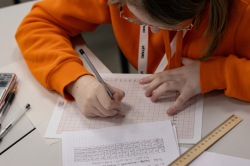
NTO in Intelligent Robotic Systems. Photo by Dmitry Grigoryev / ITMO NEWS

NTO in Intelligent Robotic Systems. Photo by Dmitry Grigoryev / ITMO NEWS
Each team had five minutes to present their solutions. The final grade was made up of two parts. First came the practical demonstration, where participants reported on the amount of markers identified by their robots and the accuracy of its maze map, as well as explained their choice of navigation method. Second, the jury evaluated the code quality, solution architecture, task distribution within the team, and the correctness of how localization, mapping, and path planning algorithms were implemented. The finalists’ solutions were assessed by experts from Yandex who work in pre-university education and robotics.
“This year, 1,400 school students from 70 Russian regions took part in the selection round – the competition’s reach keeps growing. For the finals, we prepared a new task that is genuinely relevant for the industry. Importantly, students had to not just meet all the conditions, but also independently evaluate the efficiency of their solutions. By collaborating with Yandex, we can introduce school students starting from 7th grade to physical AI, which is a new and exciting field at the intersection of IT and engineering. Our experience of organizing the track shows our efficiency, and in the future we are planning to continue and expand partnerships in this field,” says Alexey Itin, the head of ITMO’s Admissions Office.

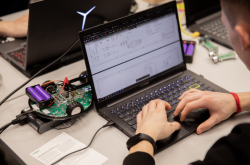
NTO in Intelligent Robotic Systems. Photo by Dmitry Grigoryev / ITMO NEWS

NTO in Intelligent Robotic Systems. Photo by Dmitry Grigoryev / ITMO NEWS
To conclude the finals, the jury selected three individual winners and nine runners-up, as well as the winning team. The majority of winners came from Moscow (11 students). NTO diplomas offer school graduates the opportunity to enroll in robotics programs at the country’s leading engineering universities, including ITMO, without entrance exams. An additional special prize from Yandex – three radio-controlled delivery bots – was awarded to another team that performed well at the contest.