At the hackathon, participants had 8 hours to create an AI assistant for a head of tech and AI at a company. The assistant’s main function is to form a grounded position based on reports, operational metrics, and financial data; a position that can resist pressure from the company’s stakeholders. At the same time, the assistant needs to account for the managerial interests of the entire company. Teams worked with the same set of data – from finance and unit economics to model and operational metrics; additionally, participants had access to an AI tool environment with infrastructure provided by Cloud.ru. One key feature of such assistants is their ability to resist pressure from top managers in the context of role conflicts or inconsistencies in data. For example, in one of the developed solutions, the assistant recommended postponing product scaling because unit economics metrics didn’t show it was advisable, even though there was pressure from business representatives. As an organizer of the hackathon, ITMO brought together the leading AI mentors in the country, active members of the AI Talent Hub community, and the best Master’s students and graduates of the Artificial Intelligence Master’s program; these experts assisted the teams in their work.
“We shifted the focus from developing tools to designing decision-making logic. The teams were tasked with developing not an automation bot, but a business assistant that can form an opinion and ground it in data and economics. The main goal of the hackathon was to show the participants the possibilities and limitations of AI,” shares Dmitry Botov, a co-founder of AI Talent Hub and head of the Master’s program in artificial intelligence at ITMO.

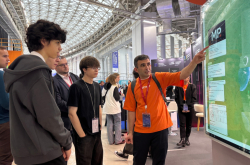
Hackathon participants. Credit: Doubletapp
The best solution was suggested by a team of top managers from PSB Finance, T-Bank, and WILIX. They were able to develop two assistants during the hackathon, but chose to present the simpler and more efficient one of the two. Its main strength is its low use of tokens (units of computational power). The developers shared that with further updates on functionality, their project will be able to process a wider variety of cases.
“Such an assistant could take on a great part of the processing of incoming context for decision making. In theory, it can replace some intermediate management, but humans will be responsible for the final decisions, because it’s likely impossible to offload all possible decision-contributing factors to the assistant. There are a lot of things that escape its grasp, such as chatter that occurs by the watercooler or at meetings, where the emotional content is important. However, I would really like to give it a try. Though such systems do have many complex aspects in their work, and take some getting used to, it’s all worth it if it proves efficient. A consultation with such an assistant is an additional review of all the factors that may be challenging to keep in mind,” says Dmitry Aloyan, a member of the winning team, the general director of WILIX, and the head of Yonote and Loop.

Dmitry Aloyan, a member of the winning team, the general director of WILIX, and the head of Yonote and Loop. Credit: Doubletapp

Hackathon winners. Credit: Doubletapp
The hackathon was held as part of Snow BASE, a closed event for top managers in data and AI. One of the co-founders of Snow BASE is Cloud.ru, who provided computational resources, including virtual machines Cloud.ru Evolution and tokens for big data processing from the Evolution Foundation Models catalog and OpenRouter platform. For the hackathon, a team from ITMO’s AI Talent Hub community developed an AI agent that evaluated the solutions submitted by participants via stress tests, as well as the interface and additional functionality suggested by the teams. 70% of evaluation was conducted by a multiagent system in real-time, with the results posted to a leaderboard. The final verdict was made by a jury made up of experts from the hackathon’s partner companies: Yandex, Sberbank, X5 Tech, and Cloud.ru.