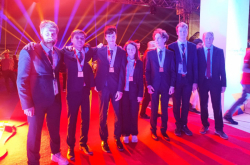
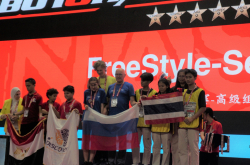
NTO is a national team engineering competition for school (grades 5-11) and university students that includes over 40 tracks: from quantum engineering and genome editing to VR technologies and robotics. The olympiad aims to give students the chance to receive applied knowledge, develop engineering thinking, and choose a high-tech career. NTO winners also enjoy perks when applying to universities: depending on their track and the chosen university, they can either enroll without exams or receive 100 points in the corresponding Unified State Exam (USE).
Participants need to pass several selection stages: first, they have to solve problems (in math, informatics, physics, chemistry), then complete engineering tasks, and finally, at an in-person final round at a partner university, teams get several days to develop a functioning device or software complex that will be tested on-site. Unlike at online stages, where the experts evaluate ideas and basic solutions, in the finals it’s important to demonstrate a working prototype.
This season, ITMO hosted six of the olympiad’s tracks:
- Intelligent Robotic Technologies;
- Big Data and Machine Learning;
- Aerial Robotics;
- Virtual Reality Technologies;
- Infochemistry;
- Software Engineering in Financial Technologies.
These tracks were chosen because ITMO implements educational programs within all of them. Importantly, the university didn’t just act as a host, but also provided the contents of the tracks: ITMO lecturers developed problems, designed testing grounds for some tracks (mazes with markers), and evaluated participants’ solutions.
One feature of the tracks held at ITMO was the involvement of industrial partners – major Russian tech companies; four tracks were supported by Yandex, Sberbank, Klever COEX, Sveza, and Digital Technologies Academy.
In total, the six finals brought together over 400 participants from Moscow, St. Petersburg, Kazan, Novosibirsk, Vladivostok, Khabarovsk, and other cities in Russia, as well as Belarus and Kazakhstan. The selection rounds of these tracks attracted around 5,000 school students.
Within these six tracks, the jury selected over 60 winners and runners-up. School graduates who win the NTO in their 10th and 11th grades get the opportunity to enroll at their chosen university without exams or with 100 USE points in the corresponding subject.

NTO at ITMO. Photo by Dmitry Grigoryev / ITMO NEWS
From delivery robots to AI in chemistry
Intelligent Robotic Systems (with Yandex) – 50 finalists.
Within several days, participants of this track developed an autonomous navigation system that enables robots to explore a maze using special markers. In the end, the jury awarded three winners and nine runners-up. The best-performing team received three remote control delivery robots from Yandex.
Winners in the track will be able to enter ITMO’s program Robotics and Artificial Intelligence without exams.
Big Data and Machine Learning (with Yandex) – the most populous track, with 115 finalists.
In this track, participants had to solve a real-world product case: they developed a recommendation system based on the data on users’ favorite products. Such systems predict which products a user might be interested in– this technology lies at the core of recommendation features on social media and marketplaces. Thus, participants learned to work with algorithms that help people find interesting items among a great number of options. For this task, Yandex provided participants with access to their cloud resources, a testing platform, and a real dataset. As a result, the jury selected 28 winners and runners-up.
Winners in the track will be able to enroll in the following programs without exams:

NTO at ITMO. Photo by Dmitry Grigoryev / ITMO NEWS

NTO at ITMO. Photo by Dmitry Grigoryev / ITMO NEWS
Aerial Robotics (with Klever COEX, Sveza, and Digital Technologies Academy) – 49 finalists.
Participants of this track tested educational drones that had been unveiled by the educational and industrial drone-specializing company Klever COEX not long before the finals. Using a thermographic camera, participants detected defective insulators on power line poles and heat leaks from residential buildings, then visualized the results on a web map for a mock client. Apart from solving computer vision tasks, participants designed their own payload – a rotating camera and thermal imager – to allow the drone to autonomously land on wires, clean them, or monitor from different angles. The testing ground with mockup houses and power line poles was built with support from the company Sveza, while the tasks were developed by Digital Technologies Academy. The jury selected 12 winners and runners-up, with the best-performing team receiving merch and certificates.
Winners in this track can enroll in the following ITMO programs without exams:

NTO at ITMO. Photo by Dmitry Grigoryev / ITMO NEWS

NTO at ITMO. Photo by Dmitry Grigoryev / ITMO NEWS
Virtual Reality Technologies – 54 finalists.
Participants of this track were tasked with developing a training hot-air balloon simulator. In order to make it more realistic, the students included formulas to describe how the balloon sways in the wind, changes height depending on the heat, and reacts to the pilot’s commands. The jury evaluated not only the correctness of the program, but also ease of control, game mechanics, and visuals. As a result, 13 finalists earned the right to enroll in a university of their choice without exams or with 100 USE points in the corresponding subject.
Winners in this track can enroll in the following ITMO programs without exams:

NTO at ITMO. Photo by Dmitry Grigoryev / ITMO NEWS
Infochemistry – 52 finalists.
Here, teams built neural network models to predict material properties, such as drug toxicity or alcohol concentration in ultrasound devices. For this task, students in each team were assigned the roles of chemists, programmers, and mathematicians. Chemists described molecules with formulas, programmers wrote code to process this data, and mathematicians selected neural network architecture. As a result, the model would predict the necessary property given only a chemical formula, with no experiments necessary. For instance, teams trained an algorithm to determine if a new substance is toxic for cells depending on its atomic structure. 12 winners and runners-up were chosen in this round.
Winners in the track will be able to enter ITMO’s program Infochemistry without exams.

NTO at ITMO. Photo by Dmitry Grigoryev / ITMO NEWS
Software Engineering in Financial Technologies (with Sberbank) – 59 finalists.
In this track, participants developed an educational web investments simulator based on real data from the Moscow exchange. Students developed a prototype dashboard where users can assemble a virtual investment portfolio from blue chips (the major, most liquid stock on the Russian market), monitor their dynamics in close to real time, and test its sustainability on stress cases from prior market crises. For this, participants configured quote retrieval, visualized key asset metrics, and implemented an educational mechanic demonstrating the principles of resource allocation and risk management. As a result, 13 winners and runners-up were selected, with the best team receiving branded merch from Sberbank.
Winners in this track can enroll in the following ITMO programs without exams:
You can learn more about applying to ITMO on the university’s admissions website. On July 11, you will get to ask your questions about various programs and the application process at ITMO Family Day, a graduation day and festival in one to be held in the 300th Anniversary of St. Petersburg Park.