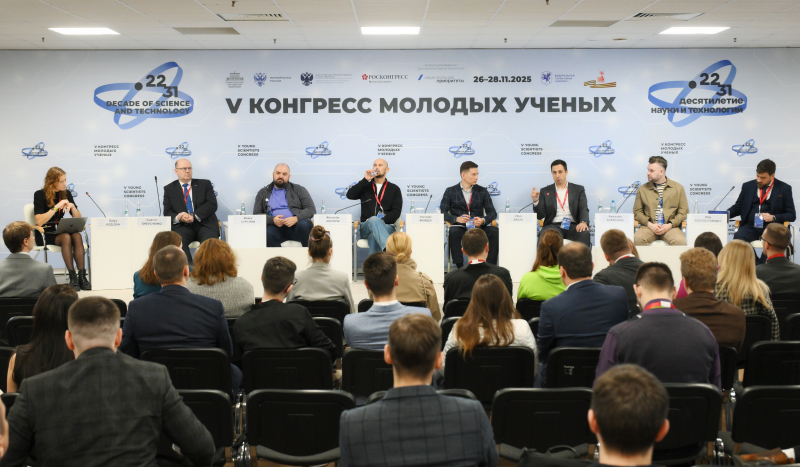
The discussion was moderated by Daria Kozlova, the Director for Strategic Development at ITMO and the director for education at Yandex. She outlined the ultimate goal of the session – to find a mutually beneficial model of PhD training by moving away from conventional practices and toward experimental approaches.
The experts reviewed the model’s objectives, the distribution of intellectual property (IP) rights, and the role of a third-party mediator in partnership. They agreed that:
-
industrial PhD programs promise to significantly reduce the competition for talents between educational and business units;
-
an efficient partnership is built on trust and direct interactions without any intermediaries except in co-financing cases.
On other topics the experts’ views differed.
Industry: PhD programs as investment in strategic human resources and breakthroughs
Companies primarily see the new format as a tool for solving business tasks. As noted by Stanislav Moiseev, the head of the Research and Development Center at T-Technologies, a specialist’s ability to tackle research-intensive tasks has a greater value for the industry than their academic degrees; for future IT and AI experts, the experience of working at a large company and their project portfolio might be more decisive than their education. A contrasting view was offered by Alexander Kurochkin, the head of the Faculty of Digital Transformation at Gazprom Neft. According to him, specialists need to think outside of the box and be able to conduct in-depth research to solve strategic business tasks (e.g., exploitation of hard-to-develop reserves) – and these skills are trained in academia. Alexey Shpilman, the managing director and the head of the AI Center for Science at Sberbank, added that investing in industrial PhD programs is a way for companies to support motivated employees who want to combine work with university studies.
Speaking on IP rights, Stanislav Moiseev explained that businesses will never give up their rights because they view data and technologies used to produce a product or study as assets. According to the industry experts, having a third party that will mediate between universities and companies will only complicate their communication and add more bureaucracy; however, if they act as a co-financing source (e.g., they cover 50% of costs on a graduate’s salary), their role changes drastically and therefore can be more useful.

Stanislav Moiseev, the head of the Research and Development Center at T-Technologies. Photo by Ekaterina Chesnokova / Congress of Young Scientists

Alexander Kurochkin, the head of the Faculty of Digital Transformation at Gazprom Neft. Photo by Ekaterina Chesnokova / Congress of Young Scientists

Alexey Shpilman, the managing director and the head of the AI Center for Science at Sberbank. Photo by Ekaterina Chesnokova / Congress of Young Scientists
Academia: scientific rigor and tandem leadership as the core
The academic community proposed focusing on the scientific aspect of PhD training, particularly maintaining high research standards. As underlined by Vladimir Shevchenko, the rector of the National Research Nuclear University MEPhI, industrial PhD programs should not be viewed as second rate and their requirements should be the same as those of other programs in order to avoid degrees being devalued. This stance is also taken by Skoltech, which proposes higher publication requirements for its scholars that are set by the Higher Attestation Commission and implements tandem university-company leadership, shared Alexander Safonov, the Senior Vice President for Development at Skoltech. Vitaly Bagan, the Vice-Rector for Research at Moscow Institute of Physics and Technology, confirmed the high efficiency of the model; he believes that two leaders, from a university and a company, can ensure dual control and students’ engagement in real-world projects. At the same time, as Vladimir Shevchenko suggested, it is crucial that all those who act as supervisors have academic degrees, while the role of a corporate expert consultant who helps adapt student research to business needs remains separate.
As for IP rights, Oleg Rozhdestvensky, the head of the Office of Technology Leadership at Peter the Great St. Petersburg Polytechnic University, noted trust plays a more essential role for both parties than any legal document and it serves as a foundation for building strong and productive cooperation. Vladimir Shevchenko voiced another fundamental approach; in his view, PhD theses must be either fully transparent and based on open-source data or undergo a corresponding security procedure in case they contain state or commercial secrets.

Vladimir Shevchenko, the rector of National Research Nuclear University MEPhI. Photo by Ekaterina Chesnokova / Congress of Young Scientists

Alexander Safonov, the Senior Vice President for Development at Skolkovo Institute of Science and Technology (Skoltech). Photo by Ekaterina Chesnokova / Congress of Young Scientists

Vitaly Bagan, the Vice-Rector for Research at Moscow Institute of Physics and Technology. Photo by Ekaterina Chesnokova / Congress of Young Scientists

Oleg Rozhdestvensky, the head of the Office of Technology Leadership at Peter the Great St. Petersburg Polytechnic University (SPbPU). Photo by Ekaterina Chesnokova / Congress of Young Scientists
The roundtable discussion “Postgraduate Studies with an Industrial or Manufacturing Focus? A New Concept for Training Skilled Professionals” was held as part of the 5th Congress of Young Scientists, which took place at the Sirius University of Science and Technology on November 26-28. ITMO experts attended 10 events within the event’s business program. This year, the major event for Russian science and technology brought together over 8,500 participants from 100 countries. Its program featured more than 250 business, cultural, and sports events.