Please introduce yourself to our readers.
My name is Yamame Askour. I am a pharmacist by background, originally from Syria, and currently living and studying in St. Petersburg, Russia. I hold a Bachelor’s degree in pharmacy, and I am pursuing a Master’s degree in industrial biotechnology.
What first sparked your interest in this subject?
It grew from my pharmacy studies, where I became fascinated by how biology is used to produce medicines, vaccines, and other essential products on a large scale. I realized that biotechnology is where science meets real-life impact.
Was there a specific moment that made you realize biotech was the right path for you?
Yes, studying pharmacology and biochemistry made me curious about how drugs are developed beyond the laboratory and manufactured efficiently and safely. That curiosity pushed me toward industrial biotechnology as a field that combines innovation, biology, and practical application.
What does industrial biotechnology mean to you personally?
To me, industrial biotechnology means using biological systems to create sustainable, efficient, and scalable solutions that improve human health and quality of life. It is about transforming scientific knowledge into products that people actually use.
Which areas of industrial biotechnology excite you the most?
I am particularly excited about pharmaceuticals and bioprocessing, especially the development and production of biologically derived medicines. I am also interested in sustainable approaches that reduce environmental impact.

Yamame at a museum in St. Petersburg. Photo courtesy of the subject
How has living in a new country shaped your perspective so far?
It has made me more adaptable, independent, and open-minded. It also taught me how to navigate different systems, cultures, and ways of thinking, which I believe is essential for a scientist in a global field.
Have you noticed any cultural similarities or contrasts between student life in Syria and here?
While the academic systems are different, I find that students everywhere share similar ambitions and challenges. One major contrast is the teaching style and resources, but the motivation to learn and succeed is universal.
Have you found a spot in St. Petersburg that you can call your favorite?
Yes, I enjoy walking near the Neva River and spending time in the historic parts of the city. These places give me a sense of calm and inspiration.
Have you tried Russian food? Which dish do you like the most?
Yes, I have. I especially like borscht and pelmeni – they are comforting, especially during cold weather.
Did you have to cope with the Russian winter?
At first, it was challenging, but over time, I learned how to adapt by dressing properly and embracing indoor activities. The winter atmosphere in Russia is unique and beautiful in its own way.

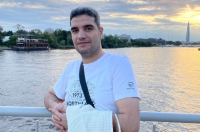
Yamame in St. Petersburg. Photo courtesy of the subject
Looking ahead, what kind of problems do you hope to solve with industrial biotechnology?
I hope to contribute to solving healthcare and sustainability challenges both locally and globally, particularly in improving access to safe and effective medicines through innovative biotechnological solutions.
If you could explain your field to a high school student in one sentence, what would you say?
Industrial biotechnology is about using living systems to create useful products that improve our lives and protect our planet.
Finally, what advice would you give to students from Syria who are considering a future in biotechnology?
I encourage them to believe in their abilities, stay curious, and not let challenges limit their ambitions. Biotechnology is a global field, and dedication, continuous learning, and resilience can open many doors.