Please introduce yourself to our readers.
I am an avid ornithologist and photographer with a Bachelor’s degree in genetics and a Master’s degree in biodiversity. Since my high school days, I have been actively involved in studio, portrait, and wildlife photography, and I have also held an exhibition dedicated to wildlife photography. In addition to this, I have published eight research articles, including four in international Q2 SCOPUS-indexed journals, spanning the fields of astrobiology, zoology, and ecology.
You’ve already completed a Master’s in biodiversity at Tomsk State University and are now pursuing a second Master’s in industrial ecology at ITMO. What motivated this shift, and how do these two fields connect for you?
Previously, I completed a research internship at the Indian Institute of Technology, Kharagpur, India, where I worked on the bioremediation of mine soils using hyper metal accumulator plants and microbes. That experience pushed me to think more deeply about the practical and simulated aspects of soil ecology, food technology, and even the possibility of growing plants on Mars and exoplanets. These ideas naturally led me toward industrial ecology, and I plan to explore and implement some of them during my studies here.
Why did you choose ITMO University for this next stage of your studies?
As one of Russia’s top-ranked technical universities, ITMO offers programs with a strong industrial and practical approach to biotechnology and ecotechnologies. What attracted me most was its multidisciplinary structure, which bridges modern industrial needs with academic ecological sciences.

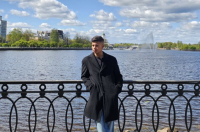
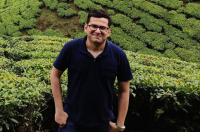
Soham with his friend in Russia. Photo courtesy of the subject
How does studying in Russia compare to your experience back in India?
Higher education in Russia emphasizes practical and applied learning much more than the heavily theoretical and conservative, memory-based education system I experienced in India.
St. Petersburg and Tomsk are very different cities. How has your student life changed between the two?
The culturally colossal city of St. Petersburg feels far more picturesque and internationally exposed compared to the petite city of Tomsk. The longer summers and shorter winters in St. Petersburg also tend to support greater positivity and productivity for international students.
When you’re not buried in research papers or datasets, how do you like to unwind?
I enjoy traveling, exploring new parts of the city, and photographing wildlife. Cooking with friends, practicing different languages, and maintaining physical exercise are also important parts of my routine. Beyond that, I have a strong interest in evolutionary biology, comparative linguistics, and metaphysical philosophy.
What advice would you give students who are considering switching fields or pursuing a second Master’s abroad?
Second Master’s degrees are relatively common in Europe and the global North. They can be highly complementary and help bridge gaps between the ever-expanding fields of science and technology.

Soham with his friends in Russia. Photo courtesy of the subject
Finally, if you had to describe your academic journey so far in one sentence, what would it be?
“Nothing can be more improving to a young naturalist than a journey in distant countries.” – Charles Darwin