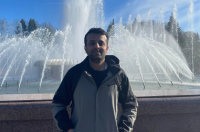
Please introduce yourself and tell us a bit about your hometown.
My name is Abu Bakar, and I am a Master’s student at the Faculty of Artificial Intelligence Technologies, studying big data and machine learning at ITMO University. I am originally from Pakistan, from the city of Multan, often called the “City of Saints” because of its rich Sufi heritage. Multan is also known for its extremely hot summers, where temperatures can reach around 46-50°C.
What first drew you to big data and machine learning?
Interestingly, before joining this program, I worked as a graphic designer for three years. Since my Bachelor’s degree was in computer science, I always had a strong technical foundation. What eventually drew me to big data and machine learning was the desire to return to my technical roots and work on more complex, analytical problems. I realized that the future is heavily driven by data and AI, and I wanted to be a part of that.
In one sentence: what does data mean to you?
Data is the world leaving receipts, and I love reading them.
What excites you more: building machine learning models or analyzing complex datasets to find hidden patterns?
For me, it’s a two-step thrill: first, I enjoy analyzing messy data to uncover the hidden story, and then I enjoy building the model that turns that story into a prediction.
Do you think AI is developing faster than society can regulate it?
I would say yes. AI is moving at the speed of math and computation, while society moves at the speed of human debate and institutions. The gap between what we can build and what we know how to govern is widening. That is why we need more technically grounded people in the conversation, so we can translate capability into practical guardrails.

Photo courtesy of the subject
What has been the most challenging concept in your Master’s program so far?
Mastering the mathematical foundations behind machine learning, especially optimization and the statistical reasoning that makes models work. Coming from a background where I previously worked as a graphic designer, transitioning into such mathematically intensive concepts was demanding at first. However, it became rewarding once I started seeing how these ideas directly control how models learn, generalize, and sometimes fail when working with real data.
Has studying in an international environment changed the way you collaborate on technical projects?
Absolutely, because you cannot rely on shared assumptions. You quickly realize that math and code are the closest things we have to universal languages. At the same time, international students tend to be incredibly driven. When you move across the world to study something as complex as AI, you develop a mindset where you are ready to learn and adapt to almost anything. Sometimes I joke that if our project group were suddenly told we needed to learn how to fly a plane by tomorrow, someone would already be reading the pilot’s manual.
When you’re not coding or working with datasets, how do you recharge?
Honestly, it’s a mix of completely unplugging and finding different ways to be creative. To recharge, I enjoy cooking my favorite dishes from Pakistan, catching up on sleep, or resetting my space by cleaning and rearranging my room. Beyond that, the city itself is incredible. I spend a lot of time exploring museums, palaces, parks, and even stadiums. Sometimes I also relax by watching Netflix. And when I still want to be a bit productive, my design background kicks in, and I actually find it relaxing to sit back and design presentations for my coursework.
Do you see yourself more as a researcher, an entrepreneur, or an industry specialist in the future?
I see myself moving toward becoming an applied researcher. I enjoy working at the intersection of theory and real-world problems, understanding the mathematical ideas behind machine learning while also building systems that can work with real data. For me, the most exciting part is turning research ideas into practical solutions.

Photo courtesy of the subject
How would you like your work to impact people back home in Pakistan?
I want to build a stronger technological capacity back home in Pakistan. Data and AI have the potential to completely transform areas like education, healthcare, and infrastructure. If the skills and knowledge I’m gaining now can eventually help create smarter systems for my country or even inspire more students to enter these fields, that would be the most meaningful impact I could ask for.
Finally, any advice for students in Pakistan willing to study at ITMO?
My biggest advice is don’t wait until you feel “ready;” just apply! The jump into a very different academic environment like ITMO can feel huge, especially coming from Pakistan. On the technical side, respect the fundamentals, especially mathematics and clear problem-solving. More importantly, be ready to unlearn, relearn, and adapt. You’ll be surrounded by talented people from all over the world, which can feel intimidating at first, but if you bring resilience and consistency with you, the growth you experience will make the journey absolutely worth it.