The national contest is held in 24 subjects and annually attracts over 6.5 million talented school students from all over Russia. In each subject, the contest has four rounds: school, municipal, regional, and federal. Winners and runners-up of the final, federal, round can enter top Russian universities without exams when applying to programs corresponding to the contest’s subject.
For years, ITMO has been the host of the computer science contest as one of the leading IT universities that regularly tops employer rankings. At the university, the contest is organized by Andrey Stankevich, the dean of ITMO’s Information Technologies and Programming Faculty and the head of the national contest’s Central Methodology Committee on computer science.
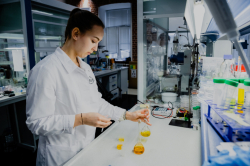
In 2026, the university hosted the regional rounds in three subjects: computer science, ecology, and, for the first time ever, physics. ITMO’s Faculty of Physics organized the experimental round for students in grades 10 and 11. In it, the participants had to solve a problem by performing an experiment; they worked with special equipment, including specially prepared “blind boxes,” a multimeter, rulers, and other tools. A total of 150 students took part in the regional round of the physics contest.

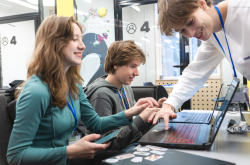
The regional round of the national school student contest in physics at ITMO. Photo by Megabyte Media

The regional round of the national school student contest in physics at ITMO. Photo by Megabyte Media

The regional round of the national school student contest in physics at ITMO. Photo by Megabyte Media

The regional round of the national school student contest in physics at ITMO. Photo by Megabyte Media

The regional round of the national school student contest in physics at ITMO. Photo by Megabyte Media

The regional round of the national school student contest in physics at ITMO. Photo by Megabyte Media
For the computer science contest, ITMO hosted four tracks: programming, AI, robotics, and information security. While the information security and robotics existed as tracks in a different subject, the AI track was introduced this year. Depending on the track, students had to, for instance, write code, develop a control system for a robot’s movements, or repel a cyberattack. 685 students participated in all tracks of the computer science contest. All tasks were prepared under the guidance of Andrey Stankevich and Artur Ignatiev, an employee at the Reseach Center “Strong AI in Industry.” Additionally, the CTF team of ITMO’s Faculty of Secure Information Technologies (ITMOteam) developed the tasks for the practical stage of the contest’s municipal round, as well as a platform for the contest.
The ecology contest that brought together 235 school students was organized by ITMO’s Faculty of Ecotechnologies in collaboration with Talent Academy. In it, students defended the projects they prepared in advance within seven fields: Hydrobiology and Hydrochemistry; Recycling and Environmental Education; Applied Ecology and Ecotechnology; Urban Ecology; Plant Ecology; Animal Ecology; Conservation Areas and Eco-Paths; Human Ecology and Health.
“For us as a university, it’s important that school students from our region perform well at all rounds of the national contest. We are interested in the quality of school education, as it directly affects the level of our applicants. That’s why we don’t only host the contest’s rounds, but also help school students prepare for them – and it’s a rewarding process: for years, ITMO’s been the number one St. Petersburg university among contest winners,” shares Alexey Itin, the executive secretary of ITMO’s Admissions Office.

The regional round of the national school student contest in ecology at ITMO. Photo by Megabyte Media

The regional round of the national school student contest in ecology at ITMO. Photo by Megabyte Media

The regional round of the national school student contest in ecology at ITMO. Photo by Megabyte Media

The regional round of the national school student contest in ecology at ITMO. Photo by Megabyte Media

The regional round of the national school student contest in ecology at ITMO. Photo by Megabyte Media
At ITMO, school students can prepare for the national contest in computer science, physics, ecology, chemistry, and AI. For this, the university organizes special classes, summer and winter schools, where students are taught by leading lecturers and former contest winners now studying at ITMO. This year, ITMO’s Faculty of Secure Information Technologies also held a two-day camp where students could prepare to the computer science contest by practicing advanced dynamic programming, studying data structures, and solving practical tasks.

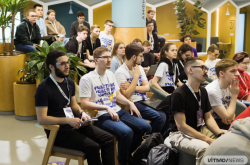
The regional round of the national school student contest at ITMO. Photo by Megabyte Media
Winners and runners-up of the regional round will proceed to the final, federal, round of the contest; they will also receive 7 additional points when applying to ITMO. The final round in computer science will be held in Moscow (March 22-28), in ecology – in Vologda (March 28 - April 2), and in physics – in the Yamalo-Nenets Autonomous Okrug (April 5-11). Winners and runners-up of the final round will receive diplomas giving them the right to enroll at leading Russian universities, including ITMO, without exams in the corresponding programs.