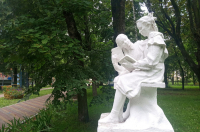
Prince Lev Myshkin
-
The Idiot by Fyodor Dostoevsky, 1869
Penned as the epitome of Christian ideals, Prince Myshkin is often seen as daft and eccentric by the novel’s other characters. And yet, thanks to his adept social intelligence, lack of selfishness, and honesty, he sparks these same qualities in many of the people he engages. If not an optimist per se, Myshkin is definitely one of the most positive characters to be encountered in Russian literature.
“I don’t understand how one can walk by a tree and not be happy at the sight of it! Or to speak with a man and not be happy in loving him? There are so many things at every step so beautiful.”
Konstantin Levin
-
Anna Karenina by Leo Tolstoy, 1878
Though not the titular character, Levin is arguably the central, most crucial one in the entire novel – and, according to some, the author’s alter ego. Struggling to understand the meaning of life throughout the story, at one point Levin realizes that it cannot be found through thinking; it can only be found through living. Finding purpose in personal happiness, kindness, and contentment in what one has instead of worrying about what one lacks, Levin presents an outlook on life that could still find resonance today.
“He felt himself, and did not want to be anyone else. All he wanted now was to be better than before.”
Vasily Tyorkin
-
Vasily Tyorkin. A Book About a Soldier by Alexandr Tvardovsky, 1942-1945
Written and published throughout World War II, Vasily Tyorkin is a poem about a soldier who goes through the war, and as such, it became one of the most significant literary pieces of the time. In this character, we discover optimism in the flavor of bravery, perseverance, and readiness to keep going even in the darkest of times – and it is these features that made Tyorkin so loved on the frontline.
“Up gets Tyorkin, dusts the snow off
With a most superior air.
‘No use groveling on the ground, lads,
That won't get you anywhere.’”
Ostap Bender
-
The Twelve Chairs (1928), The Little Golden Calf (1931) by Ilya Ilf and Yevgeny Petrov
The first antihero on this list of exemplary people, Ostap Bender is a conman, though a very lovable one. Thanks to his analytical mind and quick thinking, he can turn any situation to his advantage. Always optimistic and energetic, he treats everyone he meets equally – ready to rid them of their money one way or another. Despite his heists and questionable enterprises, we can’t help but let him into our hearts, and gladly keep him there.
"Out of two hares we should choose the fattest one."
Natasha Rostova
-
War and Peace by Leo Tolstoy, 1867
Naive and trusting, full of love and ready to sacrifice everything for the sake of others, we can see why it’s claimed that Natasha Rostova embodied an ideal woman for Leo Tolstoy. Throughout the epic novel, Natasha experiences love and loss, grows and changes tremendously – and yet we always witness her vitality and the love that guides her actions.
“Sonya, how can anyone sleep? See how lovely it is. How wonderful the world is! Wake up, Sonya! There never has been a night like this. Look at the moon. How simply perfect. Come here, my dear. Come. Do you see?”
Want to discover a light-hearted side to Russian literature? Look no further than this article for additions to your reading list.