To start off, please tell us a bit about yourself: how did you discover urban planning and why did you choose it as a career?
I was born in Cairo in a family of professors. We often traveled to the countries of the Middle East and Europe and these journeys had a great influence on me. I always found it interesting to observe people and the different spaces – to study how cities, streets, and homes are set up. For my family, this was quite a novel obsession – until then, we never had any architects or designers. So, when I began to seriously consider my future profession, my parents couldn’t tell me where to start and which direction to choose.
Luckily, my father knew a professor who gave me some useful advice. He spoke with me about my interests and hobbies – and suggested that I apply to an architecture school. To me, this was a true revelation; until then, I didn’t really understand what, where, and how you should study in order to start designing buildings and cities. In the end, I enrolled at Cairo University in the architecture department. When I finished my Bachelor’s studies, I was the second-best student out of 122. I got my Master’s degree in Cairo, as well, and then I went to University of California, Berkeley to work on my PhD thesis.
Were there any differences in the educational systems?
In Egypt, it was the classic setup: the lecturer speaks, the students listen, and debating or offering your own opinion was not a common practice. At Berkeley, the atmosphere was completely different: students were encouraged to express their ideas and defend their stances. This was a radically different approach that impressed me greatly.
And what did you do once your studies were over?
After getting my PhD, I returned to Egypt and began to teach and conduct research – all while working on consulting projects at my design studio. 40 years later, I continue to combine these three lines of work.
What are some of the most prominent projects you’ve been able to work on throughout your career?
In Egypt, I worked at my design studio, specializing in cultural objects, such as museums and theaters. I also worked on tourist towns and resorts in Sharm El-Sheikh, Hurghada, around Lake Qarun, and other unique nature spots. Besides that, our team developed several library concepts for small cities – our aim was to turn them into real cultural points of attraction. Among the projects that I had the privilege to design are: Wadi Degla Environmental Protectorate Research and Visitor Center, the Upper Egypt Children’s Library, the Cultural and Social Center in El Qanater El Khayreya, the Mummification Museum in Luxor, and a museum of musical heritage. For some of the projects, I’ve received professional awards.
Mummification Museum in Luxor. Credit: Michiel1972 / Wikimedia Commons / CC BY-SA 3.0
We also designed an entire neighborhood of cultural institutions in an area called Agouza in the south of Cairo. We had won a project competition by the Egyptian Ministry of Culture. The complex consists of buildings dedicated to traditional arts, folk theater and dance, as well as a museum of traditional costumes and crafts. The main theater has the capacity for 700 people, as well as performance and rehearsal halls with lighting and acoustics equipment.
Then, I moved to Bahrain and then to Qatar. This really affected the nature of my work and projects. First, I worked as a professor at the University of Bahrain. Then, after I moved, at Qatar University and Hamad Bin Khalifa University (HBKU). Per regulations, I didn’t have the right to open my own design studio – so, I began to consult agencies, developers, and government bodies. This was a very interesting experience – especially when Qatar was preparing for the 2022 football cup. Our team was able to literally reinterpret Doha: we examined from square one how such a large number of guests could be received by the city and which spaces they required. By the way, this was when I had first visited Moscow, which had hosted the World Cup four years prior. That trip allowed me to study the Russian capital’s experience.
Which solutions did you propose as part of this large-scale project? And how did you develop them?
All of our solutions were based on the concept of heritage. This means that each action and each invested dollar must go towards not only what happens today, but the future as a whole, too. Doha does not serve the event, but the event should serve Doha and leave behind it positive changes and benefits to Qatar.
I was part of the Supreme Committee for Delivery & Legacy. Our task was to create a well-rounded experience for the guests. It all had to be designed so that the visitor would feel that they are in a special place and will enjoy a unique experience in Qatar. For this purpose, we developed a comprehensive document that outlined everything: from security, hotels, and sporting facilities to how people will spend time before and after the matches and how they’ll get around the city.
Another key task was the construction of eight stadiums. These are landmark buildings that form the look of the city and cannot be hidden. So, we consciously spread them around the city so that in each area, it would become the core of future development. The stadiums have long ago stopped being simply football venues – they host concerts, festivals, and public events. We wanted their energy to be part of the city’s overall development.
At the same time, we wanted to establish a balance between legacy and modernity. For instance, the Al Thumama Stadium is inspired by the gahfiya (also known as taqiyah – Ed.), which is traditional Arab male headwear that protects the wearer from the sun. The architect, Ibrahim M. Jaidah, saw in that symbol the opportunity to create a space for gathering. Another example is the Al-Bayt Stadium, shaped like a traditional tent. This, in turn, calls back to the Bedouin culture, which is still an important part of life in the region. At the same time, these buildings still reflect a modern architectural aesthetic.
Al Thumama Stadium. Credit: Adnen1985 / Wikimedia Commons / CC BY-SA 4.0
We understand that it’s important to honor the past. But we are also living in the age of artificial intelligence and high technology. Our task is to strike the balance between preserving our identity and being open to new opportunities. For us, that is what a dynamic heritage is – to respect history, but not be afraid to speak the language of modernity.
Staying on topic of the future: how, in your opinion, will cities evolve further? Which tendencies will we observe?
It used to be that the economy revolved around agriculture: we’d collect the harvest and sell it – and that was the origin of economics. When the industrial age came, factories and transportation hubs emerged, while cities grew bigger.
Today, we live in an age of data and digital revolution, where the main growth factor is the economy of knowledge. Major companies like Google don’t make any physical products and yet they have a GDP higher than many nations. Value is created not from land or manufacturing, but ideas, innovations, and intellectual labor.
At the same time, many people are not anchored to one place. They are mobile and move around a lot, making it critical for cities to create environments that would attract specialists and make them want to stay. In Russia, for instance, people often move between major cities like Moscow and St. Petersburg, which are actively investing into innovations, technologies, and education.
As for the Middle East – I’ve taken part in various surveys that examined what exactly attracts specialists who are engaged in intellectual work. They only need a laptop and can thus work from anywhere in the world, but they choose places with good urban environments – green spaces, developed public transit, comfortable infrastructure. For example, a survey of employees of innovation centers and research institutes has shown that 82% of the respondents value convenient public transport. The reason is simple: to them, the commute provides time to calmly think about their ideas, whereas in a car they have to keep their attention on the road. So, speaking of the future of cities, I believe that their success will depend on how well a city is able to bring in and retain talent.
Another important aspect is cosmopolitanism. Cities need to become more open to cultural diversity. Walking around Nevsky Prospekt, I notice how many people from around the world there are, and that’s wonderful.
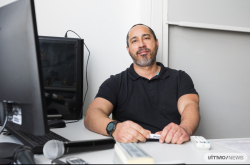
Ali Alraouf exploring Vasilyevsky Island. Photo by Dmitry Grigoryev / ITMO.NEWS
Finally, there’s interaction with nature. Where once trees and flowerbeds were used merely for decoration, today cities have to create living environments in which people can truly interact with nature. In St. Petersburg, you’ve got great parks where whole communities can gather, and you’ve also got green areas and playgrounds in the courtyards. This is the approach that, in my opinion, will define the future of successful cities.
You recently had the opportunity to personally explore the urban development of St. Petersburg – after joining the ITMO Fellowship program. What was the reason you decided to come and join the team?
I’ve known about ITMO for a long while, but never imagined I’d get the chance to collaborate with the university. I am very grateful to Irina Shmeleva, an associate professor at ITMO’s Institute of Design & Urban Studies, who recognized that I can offer students a new perspective on architecture and invited me to join the program.
At the Institute of Design & Urban Studies, the lecturers teach students to think flexibly, as architecture and urban planning are dynamic processes that quickly change in response to technologies and the economy. This is a perspective I can agree with. At the same time, the experts here are on par with the world’s best in terms of knowing how to use modern geographic information systems and AI in urban planning.
At ITMO, I held an open lecture titled Global Urbanism: How Gulf Cities Are Reshaping the Middle East for the staff and students. I talked about the way that Arab megapolises are combining futurism, culture, and identity and how major events like World Expo and the FIFA World Cup are changing those cities’ landscapes. I also led a lecture course titled Problems, Challenges and Aspirations of Modern Cities and Citizens for Master’s students of the international track in urban studies, under supervision of Irina Shmeleva. Together, we looked for ideas on how to develop St. Petersburg, while the students themselves presented their projects. For one of the tasks, they had to walk around the city and communicate its spirit through photos. This task allowed them to look at the Northern Capital from a different angle.

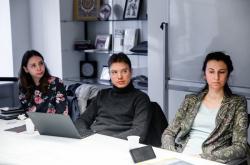
Open lecture Global Urbanism: How Gulf Cities Are Reshaping the Middle East. Photo by Dmitry Grigoryev / ITMO.NEWS

Open lecture Global Urbanism: How Gulf Cities Are Reshaping the Middle East. Photo by Dmitry Grigoryev / ITMO.NEWS

Open lecture Global Urbanism: How Gulf Cities Are Reshaping the Middle East. Photo by Dmitry Grigoryev / ITMO.NEWS
And did you find our city to your liking?
St. Petersburg is an incredible city. It is in itself a living exhibition of its own history. Every building here tells you something about the economics, culture, and architecture of different eras, while today’s museums, galleries, and coffee shops resemble the palaces and revenue houses of the past. I would definitely like to come back here once again.