Car wheels, electric engines, aircraft and nuclear power plant turbines, household appliances, and many other devices are not monolithic and consist of many parts. Their components are mechanically bonded, which results in friction during operation and consequently their rapid wear. Therefore, researchers are seeking ways to enhance traction and make contact smoother.
Physicists and material scientists study the parameters of terrain layout and textures to better understand the adhesion between smooth and rough surfaces. In particular, they measure reliefs using physical methods; these could be atomic force microscopy, profilometry, or satellite measurements, depending on the scale of the object under study. However, these approaches fail to determine some essential traits of reliefs that are vital for some surface and material properties. Examples include lateral (the direction of roughness) and multiscale characteristics (roughness at different levels of zooming). One solution are mathematical tools, which can be used to identify these features based on data. However, these methods only work with surfaces of a specific scale: either nano-or micro-sized (e.g., nanoparticles) or macro-level (e.g., satellite images of the Earth) objects.
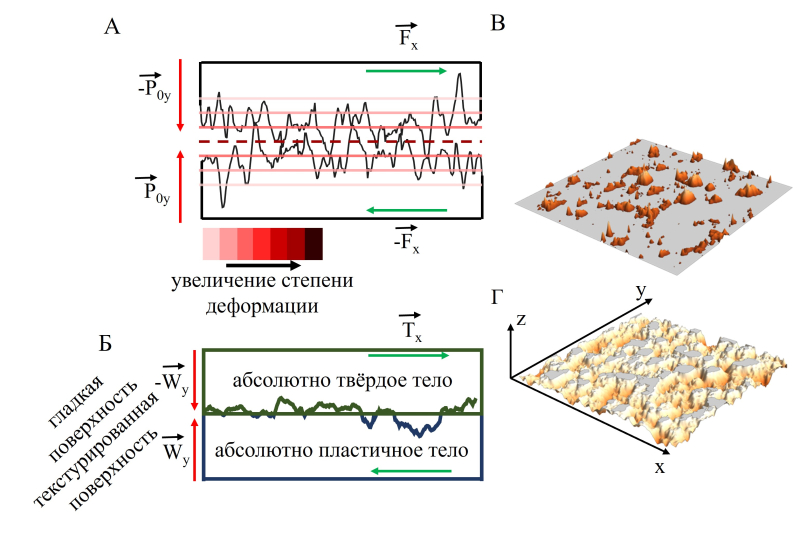
Schematic of the model, the thought experiment, the method, and the algorithm: А.) the contact mechanism of two textured surfaces that illustrates the conditions of static or sliding friction; Б.) the concept thought experiment that simulates the contact between a textured, flexible body and a liquid body; В,Г.) the work of the algorithm demonstrated with an elevation map. Illustrations courtesy of Aleksandr Aglikov
ITMO physicists created a new algorithm that can analyze the parameters of relief surfaces of almost any size – from nanoscale textures of thin polymer-based films to macrosized data on the topography of the planet’s mountain ranges. The model uses surfaces’ data to demonstrate how they will interact and answers one of the major questions in physics: when do two rough bodies placed next to one another start to slip? For that, the model analyzes elevation maps of surfaces (from nanometers to kilometers in scale) and calculates the number, as well as the geometric and topological features of the contact areas.
Specialists load elevation data into the model as a square matrix, where each pixel represents an elevation at a specific point. Then, the program calculates the difference between the highest and lowest points and divides this value by a specific number of pressure levels. As the final step, it determines how a surface relief will interact with another surface at each of these levels.
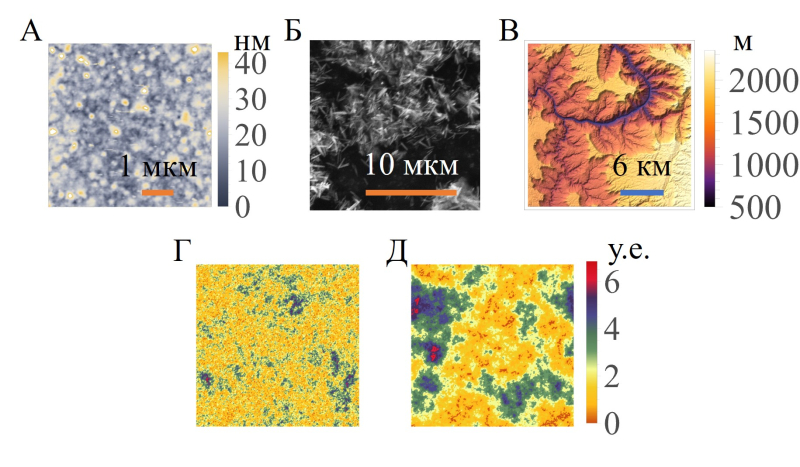
The relief of А.) polyion assembly; Б.) ZnO microcrystals; В.) the Grand Canyon; Г, Д.) synthetic reliefs. Illustrations courtesy of Aleksandr Aglikov
The researchers tested their method and compared their results with those of atomic force microscopy (e.g., a semiconductor silicon plate, polymer films, films made of bacterial raw materials, and thin films of tungsten dioxide), scanning electron microscopy (microcrystallites of transition metal oxides), synthetic reliefs, and topological data of various areas: the Karelian lakes, the Grand Canyon, Mount Ararat, and Mount Fuji.
“We have not only proposed a novel method for calculating key features of relief surfaces, but we also made a discovery: all surfaces evolve in a similar manner irrespective of their scales or nature, measurement tools, or the relationships between the numerical, geometric, and topological parameters of the relief contact areas. What it means is that all surfaces – be that Mount Fuji or the nanostructured surface of brass – obey the same laws and respond to compression the same way. Our hypothesis will allow us to rapidly and accurately predict surface interactions across various fields – from microelectronics to geology,” says Aleksandr Aglikov, an author of the paper and an engineer at ITMO’s Infochemistry Scientific Center.
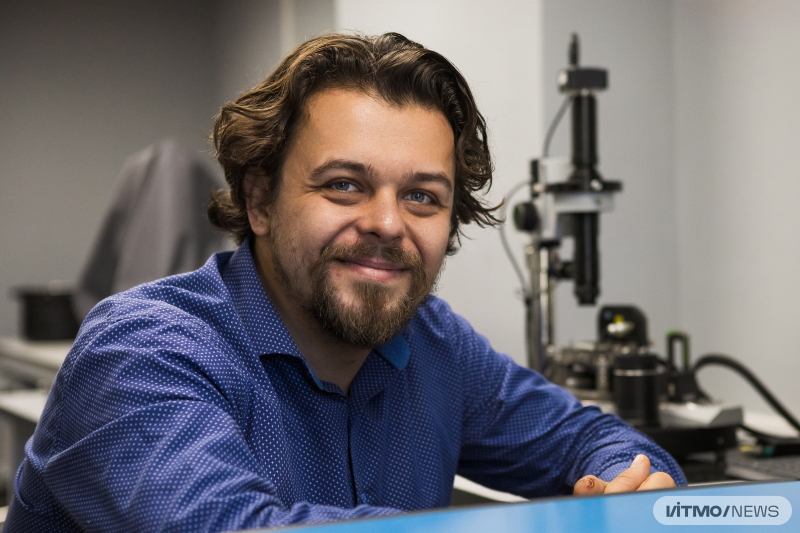
Aleksandr Aglikov. Photo by Dmitry Grigoryev / ITMO NEWS
The new model can potentially shed more light on friction, wear, and deformation of objects, which will allow scientists to produce more wear-resistant surfaces and durable devices, as well as thoroughly study the Earth’s surface. Namely, it can provide answers for how riverbeds are formed, which tributaries they include, and where they take water from. The finding can also be beneficial for space studies; for instance, to compare craters on various space bodies and define how similar the impacts were.