This is perhaps the most obvious question for a scientist, yet I cannot help but ask: when did you first become interested in science and why did you choose to make it your career?
I’ve always liked science, but my first loves were biology and math, not chemistry. When I was in school, I simply didn’t have a good teacher to make me excited about the subject. It all changed when I was preparing for my university exams. In Chile, you must take a single admission test for all universities. So, in the last year of high school it’s common for students to prepare for this exam in addition to their regular school classes by taking courses at specialized institutions. It was in one of these places that I met an excellent chemistry teacher who helped me awaken my interest in this wonderful science. As a result, I enrolled at the Faculty of Chemistry & Pharmacy of the Pontifical Catholic University of Chile.
What is the academic process like at Chilean universities? Is it similar to what the Russian system is like?
From what I understand, in Russia, Bachelor’s studies last three or four years, and students are far more interested in developing technologies for the industry. I’ve had the opportunity to observe a few research projects that had clear practical applications. In Chile, this level of studies is usually five years long, with the final year dedicated entirely to writing a thesis. In that year, students pick what they’ll be doing for the rest of their life and what direction their career will take. There are two options: go into applied research, enroll in Master’s studies, and acquire skills and knowledge for industry work – or focus on science, go straight into PhD studies after getting a Bachelor’s, and then work in a laboratory.
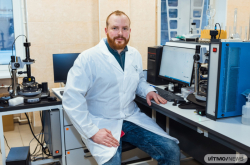
Ivan Martinez at ITMO University. Credit: Dmitry Grigoryev / ITMO.NEWS
So, you jumped right into PhD studies after completing your Bachelor’s. Looking back, are you satisfied with your choice?
Indeed, I decided to continue studying at my alma mater. I loved – and still do – working in a laboratory, generating new ideas, analyzing data, and conducting research. Science makes me feel like I’m doing something good for society. And that feeling keeps me motivated.
But, of course, not everything works out right away – or at all. For instance, at the start of my PhD studies, I got the chance to work with a very unorthodox person, a professor who had always proposed daring and complex ideas. One of our tasks was to develop semiconductors for organic solar cells. We were trying to synthesize an antiaromatic system – without getting into too much detail, it’s important to say that this is a highly unstable system that’s hard to create and even harder to integrate into a solar element. We worked on it for almost two years and even in that time we still couldn’t accomplish our goal.
Nevertheless, our work wasn’t in vain. We synthesized an organic compound that proved useful in creating a chemical connection between metals and reagents; this connection is crucial to producing organometallic catalysts for the polymerization of ethylene. In science, this happens often: the more novel and risky the idea, the more likely it is to fail. But every result can still have its use. I try to see failures positively – each one always contains the opportunity to discover something new.
At some point, you decided to branch out into teaching. Did this also help you grow as a scientist?
I’ve always liked teaching and still do. After finishing my PhD, I became a coordinator in chemistry at Bernardo O'Higgins University. In other words, I was a lecturer who put together the schedule and curriculum for that subject for the entire university, assembled the teaching team, and provided them with all the necessary equipment. At the start of my scientific career, I knew well how to conduct research, publish articles, and win grants. Teaching was an opportunity to learn about another side of academia: not just doing research, but transferring your knowledge to others. In my first two years, it was difficult to establish a routine, but eventually I struck a balance between research and teaching. Then, I took on new responsibilities: first, I was placed in charge of the biological and chemical science Master’s program; then, I became the chair of the chemistry and biology science department at Bernardo O'Higgins University.
Ivan Martinez. Credit: Dmitry Grigoryev / ITMO.NEWS
What sort of research are you working on now?
These past four years, I’ve been working on filtration membranes for seawater desalination. In Chile, this is a particularly relevant issue. We have these massive copper mines that require a great deal of water, and the only nearby source is the sea. Many regions of the country also experience a lack of clean water, so desalination is an issue of the mining industry as well as of public life and health.
Modern desalination technologies have a lot of drawbacks. The biggest is their cost. The pores in these membranes are so miniscule that a great deal of pressure must be applied before the water can flow. This makes the whole process very expensive. Besides, the membranes themselves have a short lifespan, meaning they must be changed often – and that’s another source of expenses. We’re working on materials that could effectively hold back the most problematic ions of seawater while also functioning at a relatively low pressure. We’re experimenting with different membrane properties in order to, on the one hand, increase their selectivity and, on the other, improve their penetrability at low pressure.
Desalination membranes. Credit: Dmitry Grigoryev / ITMO.NEWS
And what research fields in general are important for Chile?
Together with Argentina and Bolivia, we possess the world’s largest deposits of lithium. The government recognizes the strategic value of that metal for the national economy and invests a lot of resources and efforts into relevant research – from methods of identifying and purifying lithium to its integration into batteries.
Another important industry for Chile is salmon farming; just like Russia, we’re one of the largest exporters of that fish. This, too, has its challenges. Oftentimes, salmon farms use antibiotics in production – but the more you use them, the more likely the fish are to develop antibiotic resistance. The drugs can also remain in the fish and present harm to human health. Thus, there’s a lot of focus on methods of removing antibiotics from salmon and development of new, safer medical products.
This September, you came to ITMO to teach and engage in research. How did you first hear about the university and what drew you to this collaboration?
Bernardo O'Higgins university, where I work, is a partner of ITMO. Last year, our rector and the dean of my faculty visited Russia to meet the administration of your university. They also signed an agreement that allows any lecturer or researcher from Chile to visit ITMO through the short-term track of the ITMO Fellowship program.
The decision to spend a month on the other end of the world wasn’t an easy one, but I spoke to my wife, who is also a chemist, and we decided that this would be a great opportunity for professional development. Moreover, when I was looking at the work of ITMO’s various research groups, I found one that suited me the best. Dr. Elena Krivoshapkina, the head of the Applied Materials for Energy Technologies lab at ITMO, is developing various nanoparticles that could potentially be integrated into filter membranes in order to remove heavy metals such as cadmium and chrome, or monovalent ions of sodium chloride.
The trip to ITMO and participation in ITMO Fellowship gave me an opportunity to not only work on research in a promising field, but also conduct a lecture series for students. My classes were on the subject of adsorption: how it works in terms of physics and chemistry, what adsorbents exist, and where they’re used.
At a lecture by Ivan Martinez at ITMO University. Credit: Dmitry Grigoryev / ITMO.NEWS
This is your first time in Russia, isn’t it? What surprised you the most here – in the city and at the university?
When I first got to ITMO, I was amazed by the beauty of the campus itself. The interiors of the laboratories are pleasing to the eye and the bright classrooms create a friendly atmosphere where you want to spend more time. But comfort also comes from people. Russians sometimes perceive themselves to be very serious, but I was surprised to see how friendly and creative they are.
What are your plans now?
Right now, I’m working with Dr. Krivoshapkina’s team and within six months we’re going to publish an article on the results of our research into nanoparticle-based filter membranes. In the future, I plan to continue our partnership and invite my colleagues from ITMO to Chile.