Contents:
- Information and cyber security
- Participants
- Tasks
- Changes this season
- How to prepare
- Benefits for winners
- Opportunities for infosec enthusiasts
Information and cyber security
This field is relevant throughout various IT domains and generally ensures the so-called the CIA Triad: confidentiality, integrity, and availability of data. Infosec specialists perform a variety of tasks, such as:
- detect vulnerabilities and prevent threats;
- analyze incidents and restore data after leaks;
- engage in secure development to protect code and apps;
- conduct digital investigations (forensics);
- encrypt and decrypt data (cryptography);
- protect hardware (smartphones, laptops, processors, etc.) and AI systems.
These experts work with critical infrastructure (such as banks or airports) and services like the Gosuslugi portal.
In order to excel in the field, specialists need to have a firm fundamental training, knowledge of programming basics and languages, operating systems, and computer network theory. More specific knowledge depends on their specialization.
For instance, pentesters (“white hat” hackers) have to detect vulnerabilities before those are exploited by hackers, while AI security experts need the knowledge of ML and large language models; digital forensics experts must be able to retrace attacks and analyze traffic, logs, and memory dumps; and hardware security specialists should be familiar with physics, circuit engineering, and low-level system programming.
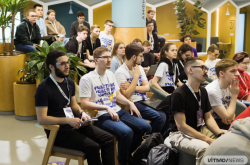
Photo by ITMO Mediaportal
Participants
The competition is open to Bachelor’s, Specialist’s, and Master’s students in both offline, hybrid, or online programs.
Registration for the competition is open until November 11. Simply fill out the form on the official website and choose the tracks you want to pursue; you can choose as many tracks as you like. To complete the registration process, you’ll have to upload a scanned copy of your student ID or a certificate confirming your student status.
There are no strict requirements: the organizers welcome participants with basic knowledge of computer science, programming, and applied cybersecurity – or with experience at CTF tournaments.
Tasks
Participants should expect highly applied tasks developed and verified by practicing IT and infosec specialists of ITMO’s Faculty of Secure Information Technologies, with support from experts from companies in the field, including Positive Technologies, Gazinformservice, Т.Hunter, and CyberEd.
There are three rounds in the track:the first two – selection and semifinals – are held online, while the finals take place at ITMO. Each round lasts 4 hours. For Bachelor’s and Master’s students, the tasks will differ in difficulty and number of steps to solution.
As per the contest’s rules, the tasks cannot be revealed in advance, but the participants can read up on topics featured in last year’s tasks – generally, there is an overlap.
Selection round. Last year, participants had to solve eight theoretical and practical tasks in cryptography, number theory and coding theory, reverse engineering, network traffic analysis, steganography, forensics, vulnerability discovery, and exploitation in web applications.
Semifinals. Last season, participants were offered six theoretical and practical tasks in the format of a CTF tournament – each answer was submitted for automatic checking to the Yandex Contest system. Participants had one attempt to complete the tasks that were focused on vulnerability discovery and exploitation in web apps, forensics, reverse engineering, and computer algebra.
Finals. This round included eight theoretical and practical tasks and proceeded in two stages. First, the participants solved a written test and then completed CTF-like tasks on Yandex Contest. For this round, applied cryptography was added to the list of topics from the semifinals.
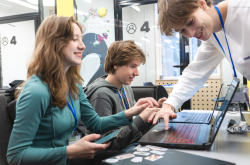
A CTF tournament. Photo by ITMO
Changes this season
Structurally, the tasks haven’t changed, but the organizers will add questions on the security of AI systems and hardware. There will also be more tasks focused on finding and exploiting vulnerabilities in web apps.
How to prepare
Look through previous years’ tasks and recommended reading. General task descriptions, requirements, and demos of tasks for both selection and final rounds are available on the contest’s website – they should be your first step. Tasks for Bachelor’s and Master’s students are posted separately.
Watch the contest’s webinars. There, experts explain the tasks of last year’s selection and final rounds and highlight the important parts.
Join IT Space. This is an open community started by students and graduates of ITMO’s Faculty of Secure Information Technologies. Here you’ll find announcements of events in the field, as well as get access to a special online training ground and topical lectures and solve problems with other students.
Solve tasks at CTF tournaments. You can pick the tournament to join based on its format (Jeopardy or Attack Defense) and difficulty level at CTFtime; you can also use the portal CTF News and events by IT Space to prepare for the contest.
Benefits for winners
Participants of the I Am a Professional contest can join the It’s Your Call! forum, which will take place at ITMO. The event will feature workshops on all IT fields as well as meetups with career consultants and HRs of major companies, including cybersecurity enterprises. Among the experts will be representatives of ITMO’s Faculty of Secure Information Technologies and the track’s partner employers: Positive Technologies, Gazinformservice, T.Hunter, and CyberEd.
All medalists, winners, and diploma holders of the contest will get the following:
- A diploma and an opportunity to enroll at Russia’s best universities tuition-free and without exams;
- An opportunity to intern at leading Russian companies;
- Access to the I Am a Professional career portal with job and internship postings, career consultations, and all kinds of online events from partner companies.
Apart from that, medalists also get monetary prizes: bronze medalists – 100,000-150,000 rubles; silver – 150,000-200,000 rubles; and gold – 200,000-300,000 rubles.
A CTF tournament. Photo by ITMO
Opportunities for infosec enthusiasts
ITMO offers several relevant educational programs that offer new knowledge in the field and new career prospects thanks to the community of young talents, practicing specialists, and cybersec experts.
Online Master’s program Cybersecurity (in collaboration with Positive Technologies). In the program, students become well-rounded cybersecurity experts by learning about the methods and technologies used by attackers and defenders in cybersecurity. The program offers two specializations: AI in Cybersecurity – on future threats and cybersec system development; and Modern Security Operations Center (SOC) – on analyzing infrastructure and vulnerabilities for threat deflection.
Master’s program AI Systems Security. Students master AI systems testing and validation methods, as well as study ML and AI algorithms in order to ensure their information security.
Master’s program Information Security. Students learn to build comprehensive information security systems and identify classes of malware and network segments with critically low levels of protection. In the program, there is also a choice of three specializations: Computer System Information Security (in Russian and English); Cryptographic Methods of Information Security (in Russian); Analytical Management of Information Security (in Russian).
Master’s program Unmanned Systems Security. In this program, students get acquainted with different types of autonomous vehicles (aerial, ground, and water) and learn how they are designed and operated. Over the course of their studies, students develop software and hardware for functional security.