Electric vehicles are becoming more and more popular around the world. The International Energy Agency reports that in 2024, global sales of electric cars passed 17 million – that’s over 20% of all new cars sold. Compared to traditional vehicles, electric cars are considered safer for the environment and urban areas, as they produce fewer harmful emissions and generate less noise. However, electric transport cannot yet be regarded as fully eco-friendly due to the complexity of mining materials for and recycling lithium-ion batteries, which power much of modern electronics, including many electric vehicles, as well as wind and solar power stations, smartphones, and medical equipment.
Today, lithium for batteries is usually taken from underground saline water deposits, but this process pollutes and drains water resources. A greener alternative is to recover lithium from used lithium-ion batteries instead of mining it. Right now, this is done through electrochemical techniques like absorption and precipitation. The problem is that these methods react not only to lithium but also to magnesium, which makes the process less efficient. That’s why scientists are looking for new ways to recycle batteries and extract lithium more precisely.
Credit: malpetr / photogenica.ru
Scientists from ITMO University, the National University of Singapore, and Guangdong University of Technology have created a special membrane made of MXene and cellulose that can extract lithium from complex solutions with more than 90% efficiency. It can be used to get lithium from saline solutions (e.g. salt lakes) or old batteries. What makes the membrane unique is that its properties change with temperature: by heating or cooling the cellulose component, it is possible to adjust the material’s properties and control nanoscopic channels that selectively adsorb lithium ions while excluding magnesium ions. The process is also energy-efficient because it works through simple electrical heating and doesn’t require much energy.
The researchers didn’t pick MXene and cellulose by accident. MXene is a two-dimensional material made of titanium, nitrogen, and carbon, and cellulose can change how much water it holds. Thanks to that, scientists can adjust how the membrane reacts to different ions. MXene also conducts electricity – a key property that helps the membrane extract lithium ions effectively.
“Our colleagues from China and Singapore created the membranes, and we tested how well they work,” says Ivan Moskalenko, an associate professor at ITMO’s Infochemistry Scientific Center and one of the study’s authors. “To check the membranes, they used solutions with different ions: lithium, sodium, magnesium, and potassium. Then we used quantum chemistry methods to calculate how effectively the membranes absorb lithium. The results turned out great: the technology can extract 90% of lithium ions from saline water and 98% from brine made from recycled lithium-ion batteries. This method works better than many other membrane technologies and is about as effective as extracting lithium from solid minerals like spodumene, but it uses much less energy.”

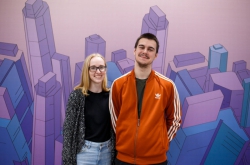
The team of Dr. Daria Andreeva, the lead author of the study, at the National University of Singapore. Photo courtesy of the research team

The team of Dr. Daria Andreeva, the lead author of the study, at the National University of Singapore. Photo courtesy of the research team
The research team's colleagues abroad have already started using the new technology at an industrial facility in Singapore.
Translated by Evgeniya Sotnikova