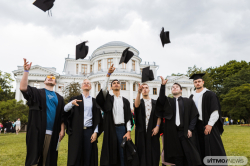
The educational program has proven successful: its graduates enjoy high employment rates on the labor market. In 2025, 95% of students managed to land a job at an IT company before their actual graduation; 46% of them – as mid-level specialists or higher at bigtech companies, major product companies, and startups.
As noted by Alexander Mayatin, the executive director of ITMO’s Information Technologies and Programming Faculty and the head of the Software Engineering Bachelor’s program, the key to the program’s success is a systematic and comprehensive collaboration with industrial partners.The industry is in dire need of mid-level specialists and higher who are ready to get on with the job immediately. However, as new IT roles continue to emerge, universities can’t always update their educational programs to meet and anticipate the ever-changing demands of the market.
The solution, as it turned out, is to include industry experts in the design and implementation of programs, making them joint educational projects. The approach requires a constant dialogue and collaborative work on educational programs – this includes defining roles and competencies that could be fine-tuned to students’ needs and interests, using infrastructure, teaching methodologies, business cases, and other resources provided by both parties, and involving experts in the classroom.
One example is the Software Engineering program; it is supported by over 20 partners, including Yandex, Sberbank, Alfa-Bank, T-Bank, Avito, and other leading bigtech companies. As of now, 107 out of 130 of the program’s lecturers are practicing IT specialists who by working at the university can not only share current knowledge with students, but also obtain teaching experience. As for students, this is a chance for them to complete the junior path at university, simultaneously complete internships, and thus advance to a mid-level job faster.
The national RuCode.Award was established in 2025 by Moscow Institute of Physics and Technology. It is supported by the Russian Ministry of Science and Higher Education as part of the federal project Popularization of Science and Technology. The award recognizes achievements in implementing and promoting AI technologies in science and education. This year, the contest received more than 700 applications from 23 regions; 53 nominees were selected to present their initiatives to the expert board.