The task for the contest’s final round was centered on AI in robotics and was developed by Yandex’s autonomous vehicles team. At the contest, participants had to train an AI model to construct static obstacle maps, like those used by self-driving cars in cities and on circuits, via images. 30 best teams advanced to the finals; they were joined by ITMO’s team AI Capybara, which entered the round as last year’s winner.
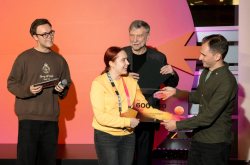
The solutions were first tested with Yandex Contest – a testing system used, for instance, at the national olympiad for school students in computer science – and then evaluated by experts from Yandex and HSE University. The most accurate model was submitted by Daria Ledneva and Timur Ionov, a Master’s and a PhD student, respectively, at ITMO’s Institute of Applied Computer Science; as a result, the team became AIDAO’s two-time winners and brought home one million rubles.
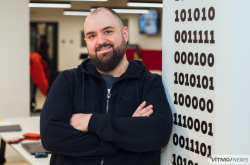
“We hit the right note during AIDAO’s first season; however, these two wins are completely different. Last year, we were ‘chasing’ other teams, but this time, we were the ones being ‘chased.’ I believe our success hinged on teamwork. Our solution is built upon a combination of predictions by different models, which helps it interpret images from cameras more accurately. The AI model transfers data onto a map that provides a top-down view of obstacles on a road. We trained our model to see not only clear but also blurred boundaries of obstacles, and so it proved an IoU (Intersection over Union) threshold of 0.564 – that’s how we topped the leaderboard,” says Daria Ledneva, an AIDAO winner and a second-year Master’s student at ITMO’s Institute of Applied Computer Science

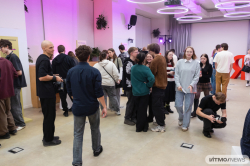
The international AIDAO. Photo courtesy of Yandex’s press office
Apart from ITMO, the top five also includes teams with students from Moscow Institute of Physics and Technology, Skoltech, Lomonosov Moscow State University, the Financial University, Far Eastern Federal University, and St. Petersburg State University of Aerospace Instrumentation. The contest’s prize pool of 2,650,000 rubles was divided between the top five finishers.
As for the qualifying round, the task was developed by the Laboratory of Methods for Big Data Analysis (LAMBDA) and QRate – a manufacturer of secure communication systems based on quantum technologies. There, participants dealt with an algorithm that helps correct errors in quantum key distribution (QKD) systems to make them more reliable and secure for users. These technologies are essential for secure data transfer in various sectors, including finance, state services, and even research.