Space is a complex, dynamic, nonlinear system. This means that the smallest changes in the initial conditions can lead to unpredictable results. That’s why universe-wide astronomical events are like the weather – you can only predict them for the immediate future. For this purpose, researchers use various mathematical models. One of them is the Hénon-Heiles potential, which helps researchers study the movement dynamics of stars around a galaxy’s center through computational and analytic methods. This means that it’s possible to not only calculate the conditions by which a periodic star movement will turn into a chaotic one, but also explain why that will happen. However, in physics, mathematical modeling is always based on assumptions that make mathematical description possible in the first place. Such assumptions inevitably lead to loss of information about the system under study, and it is not possible to conduct experiments on real cosmic objects and verify the conclusions of the research.
Researchers from ITMO’s International Research and Educational Center for Physics of Nanostructures have discovered that the classic Hénon-Heiles potential can be implemented in combination with the movement of atomic ions inside specially developed traps. Thus, ions can take on the role of stars in astrophysical experiments that now become possible inside the lab.

Visualizing ion trajectories in 4D phase space of velocity and coordinates. Image courtesy of Semyon Rudyi
“With the Hénon-Heiles potential, we can get a system of differential equations, the subsequent analysis of which helps us explain why, under which conditions, and how the movement patterns of space objects change from periodic to chaotic. However, a mathematical model can offer only an approximate answer. Thanks to our work, it will be possible to study one physical system through another, that is, to model the universe, study astrophysical processes and vary them by modeling space objects with ions, nano-, and microparticles inside the trap. This way, we can create a more or less realistic space system in the lab and get answers about how and why the movement of stars relative to the galaxy’s center – and how the galaxy itself can change,” says one of the paper’s authors Semyon Rudyi, who heads a lab at the International Research and Educational Center for Physics of Nanostructures.
Semyon Rudyi. Photo by Dmitry Grigoryev / ITMO NEWS
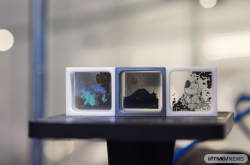
To model astronomical events in the laboratory, scientists will design a new type of particle trap. At its core are two glass substrates with electrodes made of indium tin oxide. This design makes it possible to achieve the desired electric field distribution for observation and analysis of ion motion using optical methods.

A complication of ion trajectories in the trap and a transition to chaotic movement as the system's energy increases. Image courtesy of Semyon Rudyi
“This possibility of using the Hénon-Heiles potential from astrophysics for tasks related to nonlinear nanoparticle dynamics came as a pleasant surprise. Usually, the physical laws that work for the macroworld do not apply to the microworld and vice versa, because atomic ions can behave like quantum objects. In this study, we stayed in the realm of classical physics, which means we can claim that chaotic systems that seem different actually obey the same laws and can replicate each other,” explains Dmitrii Shcherbinin, the head of the study and a senior researcher at the Laboratory “Nonlinear Optics of Condensed Media” of the International Research and Educational Center for Physics of Nanostructures.

Dmitrii Shcherbinin. Photo by Dmitry Grigoryev / ITMO NEWS
This study was supported by the Russian Science Foundation grant No. 24-79-00225.