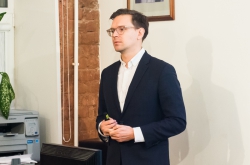
– How did you come up with the idea to develop an AI app that helps read classical literature?
– I got my school education at a school where they taught us literature at a very deep level. We had an excellent teacher, and we often analyzed philosophical ideas in books together. After school, I focused on IT, joined a technical university, went to work for an IT corporation and began working with LLM-solutions. In such an environment, I had no one to discuss literature with. Still, I continued to read it, became enticed with Dostoevsky, and decided that I want to understand his ideas better. This was no easy task, especially without the help of a teacher: I didn’t understand many references, and had to constantly google, read lectures, and search for additional research. Eventually, I understood that it would’ve been great to have an LLM-assistant that will do it for me and answer any questions that may arise.
– But this is what you can use ChatGPT for. Or is this approach false for classical literature?
– At first, I tried it, but it turned out that it didn’t work too well: in order to get the answers you need, you have to stop reading, write a prompt, and explain the context. What’s more, I noticed another problem: ChatGPT has only superficial knowledge of classical literature, and often relies on low-quality data that it finds in the top of search results.
Another obvious problem is that neural networks make things up. For example, I’ve been discussing Crime and Punishment with ChatGPT, and it gave me a quote about Luzhin that it attributed to Leonid Grossman. The quote didn’t make much sense, and sounded very inflated. The LLM said that it was from the book Life and Works of Dostoevsky dated 1946. The thing is, Grossman’s book is named simply Dostoevsky, dates to 1962, and the quote was made up by the network. So, can ChatGPT even be trusted in such matters?
LLMs as they are can not contemplate complex ideas – there is scientific proof to that, for example this study undertaken at Cornell University. That is because without good verified research and expert opinions, the LLM simply browses the net for any items that it comes across and hence gives answers based on materials created by people who don’t possess sufficient knowledge.
That’s why I decided to expand on my experience with LLMs by adding RAG based on real expert materials. I wanted to make it so that for every specific query, the LLM would give a summary of what real researchers have already thought and talked about, not just something that is the quickest to pop up on the internet.
Credit: readintuition.online
– So how does your service work?
– At first, I selected the materials myself: I used the sources recommended by my school teacher. Now I get help from a graduate of the Russian Literature program at Herzen University who’s very good. She selects lectures, articles, and podcasts based on her experience and the recommendations of her professors. As of today, we offer services for 20 works of literature, including Crime and Punishment, Anna Karenina, The Cherry Orchard, Dead Souls, Oblomov, and others. We offer 40 supplementary materials for each book, and when a user selects a word or a paragraph via the assistant and asks a question in relation to them, the system searches for relevant info in these materials.Then it is prompted to the LLM, and it, in turn, generates a reply based on this info.
What’s more, the reader can go further and look at the source – for example, the original lecture from where the info was taken.
– Won’t using such help lead to us forgetting how to think for ourselves?
– We are already getting dumber because of AI, since it completes some of the cognitive tasks for us. AI gives summaries, automates tasks, and writes code. But similar things happened with physical labor: we’ve become inactive, we sit at offices and rarely hold something heavier than a mouse. Then again, we’ve started to do sports a lot more: purposely strain our muscles in order to be strong and healthy.
Maybe something similar will happen when AI does routine tasks for us. In this case, we’ll need something to train our intelligence with – and I see such potential in my app called Intuition.
As of now, people don’t read classical literature because it is boring, incomprehensible, and complex. What we are trying to do is help make it less difficult and democratize literature. If people start reading books that are more complex, even with the help of AI assistants, we will definitely become smarter. Not the other way round.
Credit: readintuition.online
– Does your app have any counterparts around the world?
– We don’t have one in Russia, at least for now. One of the first similar solutions, Rebind AI, appeared in the USA. Time called it one of the best inventions of 2024. This platform makes it possible to read Western classics with AI-generated commentaries that are based on 20-hour interviews with professors, philosophers, and culture scientists. There were other modest attempts, but also on the American market. For example, the Bookreader app that is not available in Russia. Then again, it has the same limitations as ChatGPT: its analysis is not based on expert materials but the instruments and operating principles of common LLMs.
Two days after I spoke about my app at vc.ru, Andrej Karpathy, one of OpenAI’s founders and AI evangelist, shared his Reader3 on social media. You can use it to upload a part of a book and chat to an LLM about it. But once again, its replies aren’t based on an expert opinion.
Credit: readintuition.online
– How many people use your app? And – in your experience – what do people think of such solutions?
As of now, we did a pilot launch at the Mejdometya book club led by Elizaveta Mukhamedshina, a philologist and teacher of literature. She has twenty-five thousand followers on social media.
People react differently. Those who haven’t tried it yet are skeptical. And this is understandable: I also had a negative experience of discussing books with ChatGPT. And those who’ve tried are grateful, they write that they’ve discovered something new and deep, even if they’ve already read Crime and Punishment three times.
And we still experience mistakes. For example, one user wrote to us that he couldn't pass the onboarding and make full use of the app. We read comments and aim to solve problems quickly.
– How do you currently develop your service? Do you provide content for free? And do you plan to change your business model in the future?
– As of now, we add books on request: users write us which books they want to read with the app, and we add them for free. We also add books ourselves, so our library is gradually growing. For now, I pay for the equipment and LLM generation from my own money. But to support, scale the app and hire new experts, we’ll have to monetize, either by paid subscriptions or payments for every book. Nevertheless, I want the app to remain free for as long as it’s possible. I think it’s important to have a service in Russia that helps better understand our cultural code via classical literature.
Credit: readintuition.online
– Do you think such solutions will be of interest to major players on the book market? And why don’t they already use them?
– I’m sure they will. Russian users still have to fully recognize the demand so that major players would respond. Also, you have to account for the fact that people who read serious literature are usually conservative and aren’t ready to trust AI, especially after experiencing ChatGPT’s superficial analysis.
As for those who actively use AI, such people rarely focus on classical literature. For now, these target groups almost never intersect. When they will, major companies will see that this is the niche that they have to fill. I’m sure that sooner or later, we’ll see such solutions emerging in Russia.
– What are your immediate plans for the app’s development?
– We plan to upload all the main works of classical literature to our library, and allow users to add books themselves. We also prepare spoilerless answers on books’ plots. Sometimes, people aren’t looking for a complex philological explanation but rather something basic, like why a character went somewhere, or said something.
I also strongly believe in visualization. In the future, our app will have interactive maps that would show where a novel’s events take place, how its characters move around, and which places are important. For example, that can be a map of St. Petersburg with Raskolnikov’s route. Or diagrams showing the relationships between the characters of War and Peace: how they are related, who loves whom, who hates whom, and how their relations change as the plot develops.