How to start participating
Start as a school student. I am from St. Petersburg and I’ve always studied here. In sixth grade, I transferred to school No. 777, where I focused on math, informatics, and physics. This school is partner of NTO (National Technology Olympiad), so starting from 7-8 grades students are offered to try their hands at the contest. That’s how I learned about it and decided to look into it.
I started actively participating in the ninth grade and I chose two tracks that I found most interesting: Big Data and Machine Learning and Artificial Intelligence. The contest wasn’t easy so I didn’t make it on the list of winners on my first try. However, I didn’t despair and focused on understanding the contest’s format better. Moreover, I was interested in solving non-trivial tasks and getting new experience; the opportunity to enter a university without exams also appealed to me. So I decided to try and it paid out: next season, my team and I won in the track Big Data and Machine Learning, and I earned the right to enter any engineering university without exams. I continued to compete, however, because I wanted to try my hand at a new competition and win prizes. In the 11th grade, I won in the same track once again.
How to prepare
Balance theory and practice. My experience in the ninth grade showed me that it’s not enough to work through tasks from previous NTO seasons – you have to gain practical experience alongside it, too. I gained it at machine learning and AI hackathons, such as Digital Breakthrough by AI Academy and the national competition in AI for school students.
At hackathons, I learned to quickly navigate different architectures and approaches, choose the best solution for a specific task, and write code. Also thanks to these competitions, I met other motivated students and invited them to join my NTO team. Thanks to that, in 10th grade I came to the competition much more prepared.

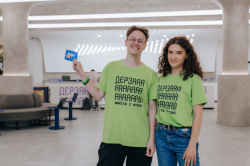
Konstantin Sigalov (center) with his team at NTO's track Big Dat and Machine Learning. Photo by ITMO Mediaportal
How to get the format
Study the contest’s structure. The tracks Big Data and Machine Learning and Artificial Intelligence have similar structure that remains from year to year: there are two stages and then the finals held at the organizing university. The track Big Data and Machine Learning is held at ITMO; in 2024, it was held in partnership with Yandex and VK, and in 2025, they were joined by the All Cups IT contest platform. In the first stage, I solved individual tasks in the engineering field (machine learning) and subject field (math and informatics). We had almost three months to solve the problems of this stage.
Assemble a strong team and share responsibilities. For the second stage, you need a team of 2-3 participants in the same track. We had a month to solve several problems on algorithms and machine learning online. The algorithms tasks were quite difficult, we needed an out-of-the-box solution. We spent quite a lot of time tackling the problems together and this allowed us to proceed to the finals.
Learn to manage your time. In the finals, I solved five individual tasks in math and informatics in a few hours, and spent the remaining three allotted days on solving the team case. In 2024, this was about developing a recommendation system for videos on a social media platform; in 2025, we had to write an algorithm to evaluate the popularity of social media posts to determine which posts become popular and why. In both cases, we were given a dataset, evaluation criteria, and a basic solution that we needed to improve.
NTO is the type of contest where you need to sacrifice something to do it all. Often, it was sleep. I remember how in the 2025 finals, we were constantly writing code and almost never slept in order to run as many tests as possible. In 2024, it was easier: we had more time to solve the problem and fewer competitors. As a results, in 2024 we came first, and in 2025 – second.

The Big Data and Machine Learning track at NTO in 2025. Photo by Dmitry Grigoryev / ITMO NEWS
How to use your NTO win
Choose the university you want to apply to. It doesn’t have to be located far away. Choose something that will fit you. I considered several options, including ITMO. This university is in St. Petersburg and I’ve lived here my entire life, so it felt like the best choice for me.
Assemble a portfolio and prepare for the interview. In order to land a spot in a top program, you need to show your strengths from the start. For AI360: ML Native, I prepared a portfolio with a letter of motivation and my professional achievements: my experience of developing projects, participating in hackathons, and winner diplomas from different competitions. This was enough, but several of my groupmates were additionally invited for interviews with the head of the program. They were asked about their motivation to study in the program and the fundamentals of AI, so I recommend reviewing this topic.
AI360: ML Native is the first Bachelor’s program in Russia that trains top AI developers who will work on new fundamental ML models, architectures, and algorithms. The program is implemented by several top universities – ITMO, MIPT, HSE University, and Innopolis University – and supported by Yandex and Sberbank. All students receive a 40,000-ruble stipend over the four years of their studies.
My friends who study in this program at MIPT and HSE University enjoy it as much as I do. Our classes are held not just by lecturers, but also by AI researchers and developers from partner companies – often within elective or special courses. For instance, they talk about real-world cases from their work and together, we come up with solutions. We also participate in applied and research projects and present our work at major conferences. For me, it’s a great opportunity to visit new cities and countries, as well as meet new people. In the future, I’d like to do research in AI.

Project defenses at the Big Data and Machine Learning track at NTO in 2025. Photo by Dmitry Grigoryev / ITMO NEWS
Continue participating in contests as a university student. Unlike school competitions, those for university students are often held internationally. This means you can try your hand at more complex tasks, meet fellow students from different countries, and even win a monetary prize. For instance, in my first semester my team and I joined AI Challenge, an international competition in AI for youth and children, organized by Sberbank and AI Alliance. We took third place for solving a case by Central University and won 400,000 rubles. A month after that, I went to the finals of Yandex Cup in Istanbul, where I came first in the track Machine Learning / Juniors; I won 400,000 rubles and the opportunity to go through a simplified employment process at Yandex.