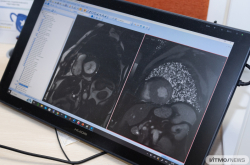
MRI is a safe diagnostic tool that uses a strong magnetic field and radio waves. It is considered one of the most effective methods for detecting diseases in the joints. However, the procedure is quite lengthy (20-40 minutes), which leads to high loads at hospitals. Thanks to the new technology, the procedure will be made more accessible as it will be accelerated without any quality loss, while also increasing the capacity of medical organizations.
At the core of the new technology is AI reconstruction of images. Imagine hearing the beginning of a familiar phrase. Based on your experience, your brain can fully reconstruct its ending. Similarly, an AI algorithm trained on thousands of MRI scans “knows” the correct anatomy of a joint. In this case, the knee joint model was trained on 1,500 studies, including DICOM images and “raw” k-space data. Thus, the algorithm doesn’t “draw” blindly but reconstructs a quality image from limited data based on a medical database.
The algorithm learns to reconstruct real anatomic structures based on patterns detected on a multitude of images. This brings the risk of it “hallucinating” details down to the minimum. Reconstruction quality is measured by technical parameters. During internal testing, the model demonstrated the structural similarity index measure (SSIM) of 0.815, which is comparable to the results of international analogs at a similar development stage. The next step is clinical validation involving radiologists; this stage will define the applicability of the new solution in medical practice.
Apart from reconstructing images, the technology includes an automated screening module. This module checks the reconstructed image for pathologies, such as damaged cartilage, meniscus, or ligaments.
“There are two approaches to AI reconstruction in MRI: one based on raw data (k-space) and another based on the resulting images (DICOM). We work in both directions to create a solution compatible with machines by different manufacturers. This is crucial for implementation at real-world clinics, where the available machines may vary,” shared Alina Miller, a Master’s student at ITMO’s Institute of Applied Computer Science.
At the first stage, the researchers tested the AI technology on knee images from the fastMRI open-source dataset. This study indicated that the AI-reconstructed images are close to standard MRI in quality. Thus, the new solution accelerates the MRI process by four times. Moreover, the system has an integrated pathology detection module that was verified with the MRNet benchmark.
“We devote more effort to the model that rebuilds images based on raw k-space data, while international analogs primarily rely on the resulting DICOM images. In the latter case, the reconstructed images turn out worse in quality than those based on raw data. Moreover, this approach leads to artifacts, which can affect the quality of images,” shares Yulia Malova, a project manager at Genotek.

An MRI scan. Image courtesy of the researchers

An image reconstructed by the AI. Image courtesy of the researchers

Incomplete data used to reconstruct the image. Image courtesy of the researchers
The project was initiated by Genotek, who provided internships to students and already had a concept for an AI-for-MRI technology. A team of four students from ITMO’s AI Talent Hub program joined the project: three ML engineers and a project manager. Since October 2025, they’ve been working on image reconstruction using various AI architectures and developing a pathology detection module.
This is the first complex solution of this kind in Russia. Internationally, analogs include Stanford fastMRI, which aims to speed up MRI by up to 10 times using AI; CS-SuperRes, which brings down the scanning time by 57% without quality loss; and DNN reconstruction, which makes scanning 41% faster on machines by different manufacturers.
Presently, the solution is at the stage of reproducing basic models. In the future, the research team will present the results of reconstruction and detection to practicing radiologists to receive their clinical feedback. Based on this evaluation, the team will decide on their next steps.