Chemists use special sensors to precisely analyze the composition of seawater. These sensors measure the amount of calcium and potassium ions and other substances. In general, standard metal (platinum) or carbon electrodes are used for the purpose; however, such electrodes often have low sensitivity and their readings can be muddled by other substances, such as seaweed, that also produce various chemical elements and affect the measurements. Another option is to develop sensors using complex nanoparticle-based structures, polymers, or other materials. However, this method has its drawbacks: such sensors require modifications that are too complex and expensive.
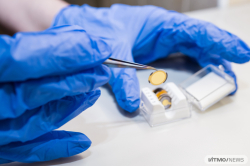
Scientists from ITMO University have developed a new approach to creating sensors for calcium ion development. They’ve extensively simplified their construction and presented two prototypes based on MXene, a 2D material from titanium carbide. It demonstrates high electric conductivity and can also act as an ion transporter. Sensors made from this material are very compact: the electrode size does not exceed 1 cm in length and 3-4 mm in thickness. Thanks to their composition and size, the sensors have high sensitivity. The minimum volume of substance required to detect calcium is 100 microliters, which is just a few drops of liquid. Most similar solutions are larger, and therefore require a greater amount of substance for analysis.
In their study, the researchers demonstrate two electrode types: a solid one on a glass substrate and a flexible one printed on plastic. While the solid electrode is fit for lab tests, the flexible one opens opportunities for practical use: in wearable electronics, IoT devices, and other applications. In the future, similar sensors can be made on paper or textile. Both types of sensors can be used in complex media, such as seawater and milk, where they can selectively and precisely identify calcium ions. Importantly, other ions present in the substance (e.g., magnesium, sodium, or potassium) essentially do not affect the measurements.
The production of the novel MXene-based sensors is simple: the researchers need only to print a thin layer of the material on glass and then layer an ion-selective membrane on top. This membrane is sensitive only to a specific type of ions, depending on the ionophore. The resulting electrodes are placed into a solution; a multimeter is used to measure the difference in membrane potentials, which is then used to calculate the amount of calcium ions in the solution.

Measurements produced by printed electrodes on samples using a digital multimeter. Photo by Dmitry Grigoryev / ITMO NEWS
The team has calibrated the sensors on standard calcium ions and tested them on samples of mineral and seawater and milk. Then, the results were compared to statistical data – the error margin turned out to be minimal.
Among the applications of the new sensors are environmental monitoring, food industry, and medical diagnostics.
“In this work, we demonstrated that MXene is a promising material for next-gen affordable, flexible, and highly sensitive sensors. Our devices can be adapted for the detection of any other ions by simply changing their membrane. Thanks to its miniature scale, the solution will be of interest to commercial clients, such as water filter and food producers,” shares Evgeny Smirnov, the head of the study and a senior researcher at ITMO’s Infochemistry Scientific Center.

Two of the paper’s authors, Evgeny Smirnov and Ilya Korolev. Photo by Dmitry Grigoryev / ITMO NEWS
By the end of 2025, the team is planning to create a tool for multiplex ion analysis that will be able to detect several types of ions (sodium, potassium, ammonium, calcium, magnesium, iodine, chlorine, etc.) in just one drop of solution. According to the team’s expectations, the system will be suitable for solutions with a substance concentration from 0.1 moles per liter (a concentrated solution comparable to brine) down to 0.00001 moles (a highly diluted solution an order of magnitude below physiological concentrations).
This study is supported by the Russian Science Foundation.