LEDs are widely used in all kinds of devices: for example, smartphone screens, optical sensors, lasers, and fiber-optic communication systems. However, LEDs based on conventional semiconductors change their states between “on” and “off” by means of electricity. The process takes up to several milliseconds, which is insufficient to conduct optical studies and develop ultrafast optical devices.
The switching time can be sped up with more advanced phase-change materials that ensure a rapid, reversible, and stable transition between amorphous (no electricity) and crystalline (with electricity) states.
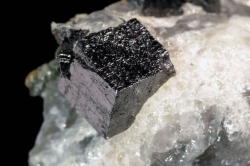
Among such materials are chalcogenides, i.e. chemical compounds formed from Group 16 elements (S, Se, and Te) and metals. By transitioning between phases, these compounds can transform their optoelectronic properties in mere nanoseconds, altering their refraction factor and therefore becoming electrically conductive. Nevertheless, the integration of chalcogenide compounds into LED architectures is hampered by abundant defects in their crystal structure that cause radiation leakage and reduced light output.
Another difficulty lies in building internal current pathways that determine the pattern and location of lights. Templates for each individual scheme are currently produced through lithography and chemical milling; these methods are expensive and time-consuming and don’t allow specialists to change the scheme post-production and design devices with custom lightning patterns.
Researchers from ITMO’s Faculty of Physics, along with their colleagues from the the Laboratory “Materials and Devices of Active Photonics” at the National Research University of Electronic Technology (MIET) and Kurnakov Institute of General and Inorganic Chemistry, managed to produce an all-optically switchable platform for LEDs by integrating a phase-change chalcogenide alloy into an LED.

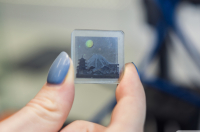
Triangle-shaped LED emission. Photo by Olga Kushchenko / ITMO’s Faculty of Physics
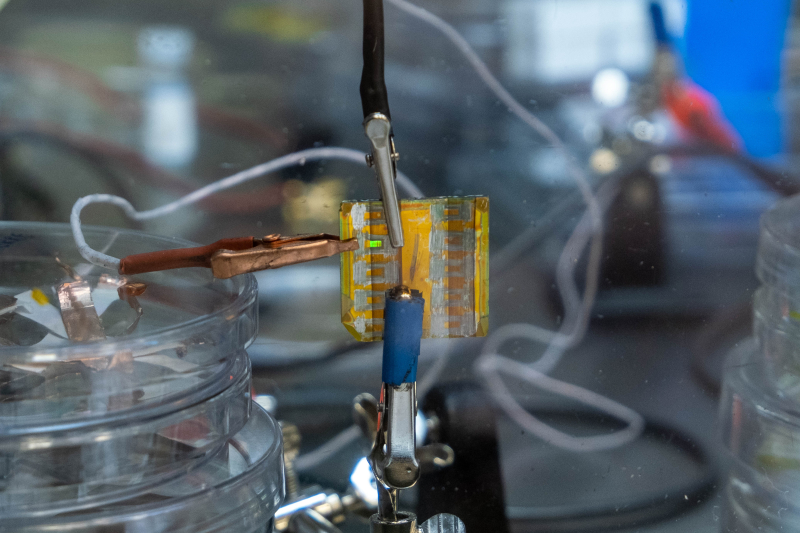
The platform offers a 10-ns switching time and contains a chalcogenide alloy of germanium, antimony, and tellurium, responsible for the phase transition and switching between on-off states, and a luminescent perovskite made of lead cesium bromide and electrodes. The system operates as follows: when exposed to a laser beam, the chalcogenide alloy enters the crystalline phase, making the LED light turn on; in case the process repeats and the phase is switched to amorphous, the light will not be activated even if powered. Consequently, the LED receives a steady supply voltage, while the transition between states is governed by laser pulses – and its speed is faster than that of electronic signals.
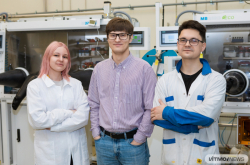
“Traditional setups use a switch to control LED states; it supplies the current to or removes it from LED lights, making them turn on or off, respectively. However, this system is rather sluggish and suffers from overloads because of constant voltage changes in electrical circuits. On the other hand, our approach allows for ultrafast phase transition, while maintaining a stable voltage in the system. This results in a greater speed, as well as stability and service life of a device. The transition is made rapidly – in just 10 ns,” explains Olga Kushchenko, the first author of the paper and an engineer at ITMO’s Faculty of Physics.

Olga Kushchenko. Photo by Dmitry Grigoryev / ITMO NEWS
Moreover, the platform will have a positive impact on device production; complex conductive paths can now be “painted” with a single laser, which makes the process as simple as coloring.
“We found an optimal thickness for the chalcogenide alloy that mitigates the radiation reduction caused by material defects, while maintaining switching between insulating and conducting states. Now, a lighting pattern can be created by simply directing a laser to a specific spot of the chalcogenide layer; only the laser-affected point will enter the crystalline phase and light up when powered. By directing a laser to specific spots, one can “draw” any lighting pattern – as if they were coloring. At the same time, the chalcogenide alloy is a nonvolatile material, meaning that laser-illuminated areas will remain in the same phase even if the radiation source is removed. If you want to change the pattern, you can direct the laser again to the same spots, making them go to the amorphous phase (with no current) and thus undo the pattern. Thus, our technology makes the process more functional and simple,” says Artem Sinelnik, the study’s team lead and a researcher at ITMO’s Faculty of Physics.

Artem Sinelnik. Photo by Dmitry Grigoryev / ITMO NEWS
The platform will pave the way for optically-switchable LEDs and as a result, ultrafast light sources for screens, sensors, and systems for data encryption and transmission, for example potential optical computers.
The scientists will continue to improve the platform’s stability and performance, as well as luminescence efficiency, by experimenting with its architecture: for example, adding new intermediate layers or introducing changes in synthesis or perovskite composition.
The project is supported by the Russian Ministry of Science and Higher Education (grant FSER-2025−0011) and the Russian Science Foundation (grants No. 25−49−00103 and No. 25-79-10137).