The company develops sensors that continuously measure the main physicochemical parameters of lubricants in real time, making it possible to detect hidden problems and promptly monitor the condition of lubricants in various types of equipment. The project helps companies in the mining, transportation, agriculture, and energy sectors reduce costs related to equipment downtime and major repairs, which can reach millions of rubles.
Usually, the condition of lubricants is analyzed manually by taking samples. However, this method only provides an instantaneous snapshot and may fail to detect critical changes in engine oil, such as any contaminants that are filtered out before analysis. These errors lead to excessive oil consumption, sudden equipment breakdowns, high repair costs, and unplanned equipment downtime.
According to the developers, the company’s solution eliminates these risks by offering 24/7 real-time oil monitoring and AI analysis, which ultimately helps detect problems at an early stage and prevent equipment failure. The sensors are embedded into probes that are immersed in the lubricant and measure viscosity, density, dielectric permittivity, water content, and oil temperature. Importantly, the sensors operate at various temperatures – from -30 to +100 degrees Celsius. This means that they can be used in extreme conditions, particularly in the Far North.
The team of Pedictive Sensorics: Kirill Plugin, Efim Shneiderman, and Evgeny Kolodezni at the event. Photo courtesy of the team
Kirill Plugin, the founder and head of the startup and the head of product development and prototyping at ITMO University’s Research Center “Strong AI in Industry,” says that the project’s competitive advantage is the company’s proprietary application of AI. According to him, globally there are only a couple of companies that offer similar solutions, but even the leading one in the field, the British TanDelta, doesn’t use AI to interpret data and predict malfunctions.
Kirill started developing this project in late 2023 in collaboration with Evgeny Kolodezniy, an associate professor at ITMO’s Institute of Advanced Data Transfer Systems. Kirill was responsible for the business aspect and IT development, and Evgeny – for hardware and new sensor technologies. In 2024, the team joined the ITMO Accelerator and was ranked first among its residents, having come in with an existing hardware solution and the first successful prototypes. At ITMO Accelerator, with the assistance of experts and mentors, the team improved their marketing and promotion strategies.
The company’s first clients came in 2025. Currently, the team has implemented over a dozen successful solutions, including for such clients as Gazprom Neft, the auto plant Smolmash, and Trade Logistic Company. In total, the company has installed 15 sensors that are operated in the Russian Far North, at seaports, and at heavy industrial sites. In the near future, the company is planning to sign its first commercial contracts for mass production.
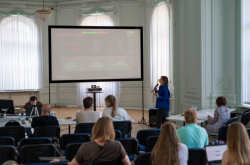
Kirill Plugin presenting the startup at Moscow Startup Summit. Photo courtesy of the team
From May to September 2025, the startup’s team took part in the IT accelerator Sber500, an international program that helps startups grow, attract investments, and launch pilot versions with support from Sberbank, international entrepreneurs, and experts. This year, the program received around 2,000 applications, with 150 teams from different countries selected by the jury to proceed to the accelerator. Over the course of the program, the participants worked with Sber500’s experts: attended lectures, developed product strategy, and attracted investments. Based on the results of this work, the jury selected 25 best teams to present their projects at a demo day during the Moscow Startup Summit. Predictive Sensorics was among these 25, having reconceptualized their market strategy, tested hypotheses, and improved their investment presentation over the course of the program.
“Presenting our project at the finals of Sber500 meant that we got to show our project to the heads of major corporations and investment funds from Russia and other BRICS countries. We plan to reach profitability by the end of 2026 and by this time we want our orders to total 70 million rubles,” shares Kirill Plugin.
This recent achievement isn’t the only one under the team’s belt. In 2024, the team won the Start-1 competition by the Foundation for Assistance to Small Innovative Enterprises and the pitch sessions held by Rosselkhozbank. In 2025, the project became a resident of Skolkovo and received the status of a small innovative enterprise.