Disrupted youth
Although Georgy Pogarev is now remembered as a major expert in assembling, aligning, and controlling optical devices, he grew up in a family with no background in science. The future researcher was born in 1915 in Petrograd (the former name of St. Petersburg) into the family of a post office worker. After finishing seven years of school in 1930, he enrolled in a factory school under the Optical and Mechanical Plant, which specialized in training optical technicians, mechanics, and assemblers. Later on, this plant, along with several other related factories, was transformed into the Leningrad Optical Mechanical Association (LOMO).
Having finished the factory school, Pogarev went straight to the factory – there, he worked as an adjuster of optical devices. However, he did not give up on his studies, and in 1935, he was accepted to LITMO’s Optical Department. When the war broke out, he was a senior assistant at the institute’s Department of Military Optical Devices, which he joined in February 1941.
In a second, his life swifted from quiet laboratory work to an immense burden of responsibilities and tasks that no university can prepare for. During wartime, Pogarev became first the deputy head and then, almost immediately, – in June 1942 – the head of the optical assembly workshop at the military repair facility.
“Those who were in the besieged Leningrad during the grim years of the war remember well how young engineer Georgy Pogarev had to face challenges that tested his civil and professional maturity. Calm, collected, and always willing to help, he did a lot to keep the facility running smoothly day to day. It'd be also quite appropriate to recall that in the spring of 1942, when his supervisor Prof. Aleksandr Zaharevskiy couldn’t walk, Pogarev, weakened himself, sled him to an evacuation point and thus saved his teacher’s life,” recalled Georgy Pogarev’s colleagues in the university’s newspaper from September 29, 1975.

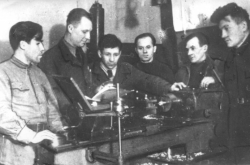
A meeting at LITMO’s assembly hall in 1946 (Georgy Pogarev – furthest to the right). Photo courtesy of ITMO’s Historical Museum
Endless labor
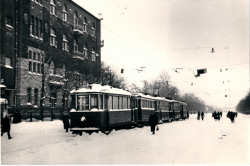
By the late summer of 1941, the front had closed in on Leningrad. The Nazi forces from Army Group North advanced towards the city – but failed to overcome its defense, shifting their strategy from a quick assault to a long-term blockade of the city. The last train with food arrived in Leningrad on August 28, and on September 8, 1941, one of the most tragic chapters of the Great Patriotic War began – the 872-day Siege of Leningrad. On that day, the city suffered from a massive artillery bombardment; the Badaev food warehouses burned to the ground and with them – 3,000 tons of flour and 2.5 tons of sugar.
While the city’s residents fought against hunger, its defenders fought fiercely on the frontline. There was a shortage of everything – and for everyone. As later recalled by Andrey Veselov, who headed the university’s wartime restoration and repair team, the biggest burden fell on artillery; there were heavy losses in both manpower and equipment, specifically optical devices.
In 1941, the Military Council of the Leningrad Front decided to establish a facility for repairing optical devices at LITMO (now ITMO). The university was not evacuated until March 1942. The facility was opened at the sites of the academic and industrial workshops where senior students and graduates worked.
Upon evacuation, the work on the facility was led by young engineer Georgy Pogarev and his wife Marina who had themselves recently graduated from LITMO. Later, soldiers who had experience working with optical and other precision instruments, i.e. devices used to measure, control, analyze, and adjust physical characteristics with minimum error, were assigned to the facility from military units.
“Their [the Pogarevs] organizational skills helped keep our small community united. We worked almost day and night and even sometimes slept there, next to our workplaces. All despite bombing and artillery attacks outside. One day a missile destroyed a part of our institute's building on Griboedov Canal Embankment, and just behind a surviving wall, our brigade kept working despite the danger,” recalled Andrey Veselov, who worked at the facility during the war and specialized in repairing binoculars.

Konstantin Leshchev, an optical device expert, adjusts equipment at Pulkovo Heights in 1942. Photo courtesy of ITMO’s Historical Museum
Everything for victory
Most often, the facility’s optics workshop headed by Georgy Pogarev had to deal with binoculars; however, there was not enough equipment for these kinds of repairs. Then, the Pogarevs designed a new collimator for aligning binoculars of various types – from trophy to pre-revolutionary ones – in their “free” time, when most employees had a couple of hours to sleep. Following this, the facility’s performance increased significantly, and the quality of its products improved, as well. As for its other specializations, the facility also repaired optical sights for anti-aircraft guns, restored anti-aircraft and artillery shells, and dealt with binocular finders and stereoscopic tubes for command posts. There were no spare parts for damaged devices so the facility had to produce them themselves.
Apart from their activities in the rear, the Pogarevs also went to the forefront – for instance, they repaired devices and educated soldiers on their maintenance in Kolpino. Their “trips” took place under hostile fire as the shelling was relentless during that time.
“Everyone worked; they didn’t mind time, worked without days-off and vacations, and tried to ignore famine and bombs. We were a close-knit family where everyone had to help each other. These were the darkest days of the siege. There were no vehicles, gas, or water in the city; it was trapped in the cold. We had no electricity, but those who still could, continued to repair devices. For all of us, the facility became our home, and many lived in its spaces and slept at the workshop, too,” recalled Georgy Pogarev.
In winter, the workshop’s employees built portable stoves that not only saved them from the cold but also united people; everyone came together at a stove, dreamed out loud about the victory, boiled water, and dried bread.
According to Mr. Pogarev, at that time, the institute also had equipped bath and laundry facilities; and in early 1942, the wives of the professors, Anna Churolovskaya, Kamilla Titova, and others, organized a hospital for the weakened lecturers, staff, and students who remained in Leningrad.
On their own, the staff repaired the buildings after bombings and collected firewood for the workshop; to do that, they tore down wooden houses at the city’s outskirts and went to harvest timber. They did everything they could to find food for themselves – for instance, they cultivated the collective gardens in Rybatskoye (often under fire from German mortars), Strelna, and Aleksandrovskaya.

The siege’s veterans (Georgy Pogarev – third from left). Photo courtesy of ITMO’s Historical Museum

A plenary session of the Conference of the Scientific Society in April 1952 (Georgy Pogarev – fourth from left). Photo courtesy of ITMO’s Historical Museum
After the war
The repair facility worked steadily through the war and returned thousands of optical devices back to the front's service.
After the war, Georgy Pogarev started working as a senior lecturer at the institute’s Department of Optical Devices. In 1950, he defended his PhD in optical device alignment and then, in 1967, his DSc. Later on, he was appointed the head of the emerging Department of Optical Device Design and Production. He was a professor at the Department of Optical Information and Measurement Systems up until 2001, almost until his death.
For his selfless service during wartime, he was awarded the Medal “For the Defence of Leningrad” and the Medal “For Valiant Labour in the Great Patriotic War 1941-1945.”
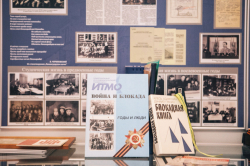
The information for this article was supplied by ITMO’s Historical Museum. The museum stores archive photographs, documents, and newspapers, as well as memories of the university’s staff, including from wartime. You can find the materials at the museum’s website. If you’d like to share the story of your family, please email its staff at museum@itmo.ru.