When compiling their annual ranking, Clarivate experts take into account the papers that rank in the top 1% by citations for their field(s) of research in the Web of Science citation index. This year’s list includes 7,131 scholars from over 60 countries – all of whom have authored the most cited papers over the past 11 years. “Highly Cited Researchers demonstrate significant and broad influence in their field(s) of research,” states the website. According to Artem Oganov, Clarivate’s ranking is the hardest list to get onto, with not many scientists managing to succeed.
Anton Korobeynikov is a bioinformatics specialist; his interests lie at the intersection of computational methods, high-performance computing, and mathematical methods in biology. The scientist headed, inter alia, a team that developed SPAdes (Saint Petersburg Assembler) – a genome assembler that is still used worldwide. His most cited papers are devoted to this subject.
A genome assembler is a specialized piece of software that can reconstruct the initial sequence of a genome in any organism (a virus, a bacterium, a fungus, a plant, an animal, or a human) using raw materials collected by sequencers. The only caveat is that genomes still cannot be read in one go even today; they have to be collected piece by piece, much like jigsaw puzzles. But unlike them, a genome may have sequences that repeat themselves 10, 20, or even 100 times, along with flawed sequences; and there is no final image for researchers to look at during the process. SPAdes is the solution to the problem.
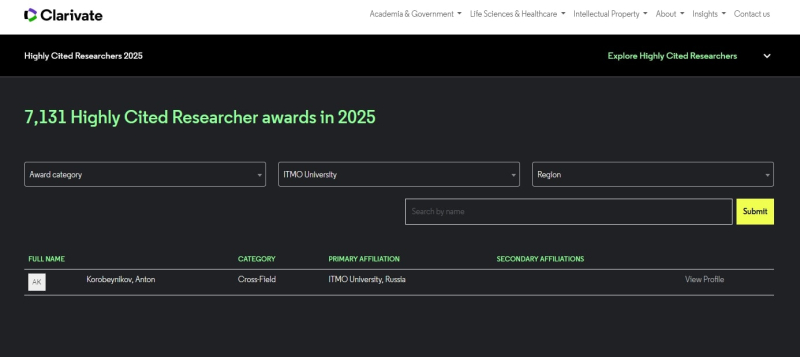
Credit: clarivate.com
“I’m happy to be on the list, but it’s in fact an achievement of a whole team of people. As far as I know, some of my colleagues have been included in this ranking some time ago, too. So, I hope we will continue to make breakthroughs regardless of whether we get ranked or indexed,” notes Anton Korobeynikov.
Aside from the ITMO researcher, the ranking also features chemists Maxim Molokeev from the Kemerovo State University and Artem Oganov from the Skolkovo Institute of Science and Technology, Vladimir Romanovsky, a life sciences specialist from the University of Tyumen, and Karem Mahmoud, a nuclear physicist from the Ural Federal University.