Profile
Responsibilities: a research leader at ITMO’s Adaptive and Nonlinear Control Systems Lab.
Research team: 23 people.
Projects: the team develops monitoring and control methods for engineering systems: from electromechanical systems to mobile robots and robot manipulators. Among their projects are navigation and control systems for mobile robots, physical AI for robot control, and robotization cases for ITMO’s industrial partners (e.g., Diakont, Gazprom Neft, and Sberbank).
Research needs a team
I have loved science since I was a kid. I enjoyed watching sci-fi Back to the Future-esque movies but I’ve never pictured myself as a serious scientist in a white lab coat.
In high school, I started thinking about what to study next and went with what I was best at: mathematics, physics, and computer science. I was looking for a place where I could not only study math or computer science but also solve practical problems and pose research questions. ITMO University was just that kind of place in St. Petersburg. Technical systems management lies at the intersection of two fields: it may seem too applied for mathematicians and too research-based for engineers, but it’s exactly the field where ideas can become reality. As for robotics, I got into this field later on, after I earned my PhD and completed my first robotic projects.
I first got seriously involved in science when I was a third-year Bachelor’s student at ITMO. I began studying technical systems management and developed a compact algorithm based on differential equations to assess signal frequencies. Such technologies are needed for disturbance compensations – for instance, they are used to adjust marine vessel control systems, avoid ship rolling, or reduce camera shake or narrow-band interference in electrical circuits.

Alexey Vedyakov. Photo by Dmitry Grigoryev / ITMO NEWS
My interests have expanded over time: for one, I started assessing the states of various technical systems, mostly electromechanical ones. To manage them more accurately and efficiently, one needs to determine various parameters of electromechanical devices; however, it is not always possible or convenient to measure all the required values via separate sensors. For that, our laboratory developed an entire class of methods based on electrical signals that can estimate the magnetic flux, speed, and position of electromechanical systems. Compared to the sensor-based method, in which mechanical motion must be converted into an electrical signal, our approach proves to be more reliable since it deals with electrical signals directly. Moreover, our method makes technical systems management more affordable, eliminating additional costs on separate sensors and other equipment. For this study, I mainly specialized on engines, drones, and robots.
Our methods helped us build virtual sensors that have improved the reliability of electric motor control systems at the company Diakont.
Apart from research, I also enjoyed sharing my expertise – it helps deepen my own understanding of the subject. Back when I was a student, I helped juniors prep for automatic control competitions: I taught theory and explained how to solve tasks. I continued to tutor even after I graduated.
Then, I completed my Master’s and PhD in automation and control and became a postdoc in 2015. Because of all the research projects I was involved in, I decided to stay at my alma mater and started putting together a team – the same year, I became a supervisor and in five years got my first PhD student. This was the natural next step for me; I understood that if I wanted to do science and achieve my goals, I needed a team. But first, I had to train it – so, I began to take in students who would then start their PhDs and could join me in my research endeavors.

Alexey Vedyakov and his team. Photo by Dmitry Grigoryev / ITMO NEWS
Navigation for robots and physical AI
Globally, our team works on projects in three main fields: modern control systems theory, mobile robotics, and robot manipulators.
Today, control systems are used almost everywhere – from cars to spacecraft. They help account for and compensate for disturbances, delays, and uncertainty within the control loops of technical systems, which is especially crucial for high-precision tasks such as chip production or surgeries. As of now, we’re running several projects in this field: for example, one of my PhD students is working on a method for evaluating non-linear dynamic systems. This is theoretical research that can be applied to various tasks: from process management in chemical reactors to the control of electromechanical systems. Another student focuses on dynamic formation control of multiagent systems; this approach is crucial for when a team of robots or drones needs to reconfigure, synchronize in motion, and avoid collision without centralized control.
We use mobile robots primarily for mapping and localization tasks. For example, we train mobile robots – like delivery robots or robotic cleaners – to navigate efficiently both indoors and outdoors. Typically, one data source – be that a camera or a motion sensor – isn’t enough for this task; control systems need both data types. For the location information to be displayed correctly, data from the camera and sensor needs to be combined and synchronized. To do so, we optimize factor graphs from various sensors and reconstruct the most likely trajectory of the robot.
Another project focuses on a navigation system algorithm for various purposes. For simultaneous localization and mapping, we, for instance, use neural networks capable of memorizing visual features of the environment, spatial relationships, and multiview appearances of objects. We trained these networks to recognize previously seen locations and estimate the robot’s position on the map it uses for navigation. Thanks to that, even if the system fails or restarts, the robot can quickly determine its location and build the right route based on photographs.
We also have several projects dedicated to physical AI for robot manipulators. We study different ways we can train a model more efficiently so that we don’t have to code a robot for each task individually but make the system re-use learned skills from previous tasks and fine-tune them to fit new conditions. One of my PhD students studies the mobile robotization of physical processes and how robots can perform such tasks as metalworking, assembly, or sorting. As part of the research, he explores how models can be trained using less data and simpler, lower-resource computing systems.
Our solutions create highly customizable robotic systems that can be adapted to specific production tasks.
This field of study is highly relevant due to the rapid evolution of technologies: while conventional approaches help program robots to perform fixed tasks, the production requirements may change and require retraining.
Our team strives to not only produce new scientific methods but also implement them with partners. Private and state companies come to us when they find no accurate or fitting solutions for their tasks. Then, we take our research data, build a model of equipment or process, and adapt a control method to it.
Now, we’re working on a project on physical AI for building an efficient control algorithm for drone groups. Our task is to come up with a technology that will allow us to synchronize multiple drones for different tasks. In agriculture, for instance, drones can be used to explore a plantation, assess crop condition, and target-spray the site based on the data it collects.

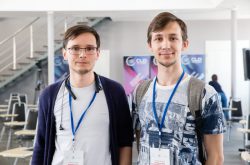
Alexey Vedyakov with a colleague. Photo by Dmitry Grigoryev / ITMO NEWS
How the team works
We don’t build robots; we create control systems for them. For that, we usually use C, C++, and Python, microcontroller software, and the ROS (Robot Operating System) ecosystem. We test developed systems and algorithms using virtual environments; modern robotics is prone to move a significant portion of its development and testing processes into the virtual environment, as working with physical robots comes with certain scalability limitations. To achieve that, we opt for simulation software that can run several simulations at once and therefore test algorithms on various scenarios faster. On the other hand, there are physical robots at ITMO, too. In fact, we have a whole park of robot manipulators, three mobile robots, and even robodogs we got from our partners.
I don’t work exclusively with PhD students. I also have Bachelor’s and Master’s students. After all, I believe the earlier a student starts doing research, the more expertise they will have by the time they start their PhD.
Currently, my team consists of 23 people, including seven PhD students.
We’re open to different projects in the field of technical systems management – from engines to robot groups. For a PhD student, it’s easy and convenient to write a thesis in the field your supervisor has worked in, where they can tell what’s promising and what’s not. But I, on the other hand, strive to keep my horizons open, and I’m glad when students apply my findings to other fields or choose adjacent topics for their research. I believe a supervisor doesn't need to give students ready-made manuals on how to implement a project; instead, they should instill a true research culture in them. I do help students to master organization methods, tell them what questions they should ask in themselves and explain how to set objectives – but I never do the work for them.
Unfortunately, sometimes even by the time students start their PhD program, they still don’t know how to properly set a research objective. They come in and say that they want to build a robot. But this is more of an engineering outcome; for their PhDs, they have to formulate a research task – be that a new method, model, or algorithm. Instead of building a robot, they could propose a new design or control method for robots that they can defend and test on several tasks.
For instance, one of the PhD students supervised by Ivan Borisov, my fellow researcher and a professor at ITMO’s Faculty of Control Systems and Robotics, has designed a flexible robot that can withstand a shock load, retain its energy, and adapt to movement on rough surfaces. This is one example of how a PhD training should ideally work.

Alexey Vedyakov and his team. Photo by Dmitry Grigoryev / ITMO NEWS
How to join the team
To join our team, come work with us during your Master’s – or even better during the second year of your Bachelor’s. We welcome students from different specializations as long as they have general knowledge in mathematics, physics, programming, and automatic control theory. For some tasks, machine learning, deep learning, and computer vision are required, as well.
For prospective PhD students, I’d recommend contacting a supervisor of their choice to discuss the relevance and prospects of their future thesis in advance. If you’d like to be a part of my research team, feel free to email me at vedyakov@itmo.ru.
Read more about PhD admissions at ITMO here.
We offer young scientists much more than just research opportunities: they can also take part – and get hired – in projects with our industrial partners. Working on such projects doesn’t necessarily make writing a thesis easier but it helps you understand why you need new research perspectives, recognize the limits of equipment, master new tools, and test your hypotheses.