ITMO’s AES is not just a training ground for a new generation of engineers, but an ecosystem with a sustainable model of interaction with business and a community of like-minded people working on projects for technological leadership. The school’s main focus is on training engineers for high-tech sectors of the economy who will be able to facilitate rapid technology and product transfer at the school’s partner companies. The school’s strategic partner is Tatneft. Currently, the school offers training within three Master’s programs: Chemistry and Artificial Intelligence, Sustainable Chemistry for Energy Technologies, and Applied Genomics, as well as joint programs in industrial biotechnologies, AI, waveguide photonics, and other fields.
An AES graduate possesses the so-called smart skills – a combination of widely applicable and soft skills related to engineering, data management, team management, technological product development, business analytics, and entrepreneurial thinking. Thanks to these competencies and a strong technical background in chemistry, biotechnology, and IT, the graduates have countless employment opportunities. From among 148 current graduates, 80% have found employment during their studies, 73% were hired by high-tech companies, and 20% were even able to kick off their careers in managerial positions thanks to fast-track initiatives.
“We have successfully built a platform for forward thinkers – leaders capable of taking risks and establishing strategic interaction with the industry. We’ve created a flourishing professional community of young PIs and PEs (principal investigators and principal engineers) who came to AES with their research ambitions and were able to integrate them within the tasks of our partners – this was the main achievement of AES in 2024. This year, our primary objective is to maintain and improve this connection, scale it up, and attract even more young leaders yearning to transform their fields,” says Alexander Vinogradov, the head of ITMO’s AES.

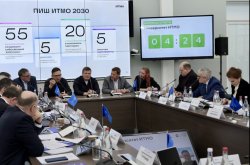
Alexander Vinogradov at the defense. Photo by Sociocenter
In 2024, AES moved into a new 1,200-sq.m. facility that hosts well-equipped lab spaces: the Center for AI in Chemistry, a bioinformatics lab where researchers develop digital interfaces for genomics and genetic screening, special sterile labs for pilot testing of genetic microchips, laboratories for flexible electronics and soft robotics, an industrial center of power electronics, and coworking areas where students can design digital products. Since 2022, the implementation of Advanced Engineering School’s development strategy has resulted in ten new educational spaces: four labs, four interactive facilities for proactive training, a prototype production line, and a digital factory.
These results were achieved thanks to long-term strategic partnership with industrial businesses such as Tatneft, Russian Railways, UPT, and Gazprom Neft. In 2024 alone, their help made it possible to raise more than 425 million rubles in investments towards technological leadership projects. These include:
- Biotechnological platform for production of effective producers of recombinant industrial-purpose enzymes and organic acids. With its help, it may be possible to recycle by-products of natural raw material into high-margin products (such as for the food or oil industries) and provide viable import substitutes.
- Electrochemical conversion of carbon dioxide for effective use of CO2 and alternative energy sources in production of beneficial chemical compounds. Team EnergyChemTech from ITMO’s Advanced Engineering School has developed a flow-type reactor for electrochemical reduction of carbon dioxide. The setup can, in the future, be scaled up for industrial application. Its successful implementation would make it possible to store solar energy in a more stable manner than with existing methods – while also reducing the amount of carbon dioxide in Earth’s atmosphere and producing value-added hydrocarbons.
- Digital twin for oil – a system that can automatically forecast the properties and make-up of oil while it is being extracted; it can also model scenarios for development and operation of oil fields, identify optimal extraction methods, and provide solutions for potential risks – all in real time.
At the same time, AES continues to develop its “lighthouse projects”: Polar Express, a transarctic underwater fiber-optic communications line between Murmansk and Vladivostok, and Genetic Microchips, the first platform for customizable genetic screening.
In the fall of 2024, ITMO’s Advanced Engineering School became the first institution of its type in Russia to have launched its own endowment fund. This is not only a strategic revenue source, but also a centerpoint for a like-minded community that invests in the development of ITMO University. Revenue from the fund is used to sponsor innovative projects, develop infrastructure, create new labs and coworking spaces, as well as support young scientists and attract new talents. ITMO.Engineering Leadership, as the endowment fund has been dubbed, has thus far received investments from 38 benefactors.