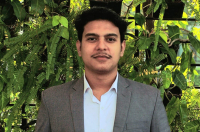
Please tell us a bit about yourself.
I am Elijah Edward Masanga from Mbeya City in Tanzania. Besides being a student at ITMO, I am also the CEO and founder of Damotiva. I am deeply passionate about understanding nature, how things work, how we think, how we imagine, how we dream, and so on.
I believe the human mind is finite, and that an infinite source of knowledge exists beyond it. August Kekulé dreamed of the benzene ring structure. Leonardo da Vinci understood the power of imagination and observation, filling his notebooks with flying machines and anatomical studies long before they were built or understood. And Thomas Edison said, "To invent, you need a good imagination and a pile of junk." Through imagination, each of them believed they could connect to deeper sources of inspiration.
How has your experience in the Foundation Program shaped your academic interests and goals?
The Foundation Program was a great experience, first of all, in understanding Russian culture.
Afterwards, my fear of studying in Russian completely vanished. I found myself feeling like a newborn in Russia, and the Russian people received me well. While learning history, I gained a lot of hope for my startups. I had been thinking that maybe they were not good enough, but then Anastasia Gulyaeva would show us how Microsoft or Apple started from the beginning until today – where they failed, what they did, and how they still exist today.

Elijah with Ekaterina Gurzheeva from the International Students Learning and Support Center. Photo courtesy of the subject
You initially applied for electronics and nano-electronics. What drew you to that field at the time?
I have a list of inventions that I am researching to bring to life, and which require knowledge from many fields. In Tanzania, there are rice pods produced by a company called SIDO (Small Industries Development Organisation). There are many of these rice pods, and I thought we could convert them into timber. But how exactly? That requires physics and chemistry. So, I decided to choose a field that combines physics, chemistry, ICT, and mathematics.
Then I met Vladislav Shein. He shared his PhD thesis, Study of Heat Exchange Processes in a Double-Acting Heat Collector, with us. Thanks to him, I began to see that ICT is already present in physics. I also started to see electronics within physics. That left biology and chemistry. I thought to myself: I should pick a cornerstone and build a foundation on it. Biology and chemistry can follow later, built upon that physics foundation. I appreciated how open Dr. Shein was. He spoke with me and looked at some papers I have already published. I realized that what I truly need for my research to-do list is to succeed is physics. So, I made my choice: to enroll in the Bachelor’s program in physics at the same lovely university – ITMO.
Switching directions is never easy. How did you process that decision personally?
What is life? Life is trying new things. When they don't work the way you expect, you fine-tune until you find the right way. When I first started living away from my parents, while cooking rice in the early days, I found that I had added too much water. The next day, I refined my method, and the results were good. I live by tracking results. If the results are not as I expected, I refine.
What is it about physics that resonates with you more?
I see electronics as a part of physics, not as something separate. In order to understand anything, you have to understand its core. For a computer, that means understanding 0s and 1s. For physics, that means understanding how particles work, and within particles, you find the electron, which then gives birth to electronics.
What areas of physics excite you the most?
I previously studied computer engineering at Mbeya University of Science and Technology (MUST) . There, we had a saying: "God created the world and gave it to an engineer." Now, physics is the history of the principles of nature that have been discovered, but we have not yet discovered all of them. I am excited about understanding the principles of nature that give us the power to control this universe more easily. Consider water and its states. Because we understand the physics of water, we can do many things. We had water and fire, but we lacked understanding. By gaining that understanding, the first steam engine came to life. Similarly, Elon Musk has said, "If AI cannot figure out new physics, it's clearly not equal to humans. Physics is the law; everything else is a recommendation."
Let’s talk about your life in Russia. What is your impression of St. Petersburg?
Great city. Well organized. Beautiful, with many parks. Sometimes I go to different parks just to think. I also love that the police are very kind. One day, I was kind of lost. My phone battery had drained, and I was asking for a taxi, but no one would stop. I asked a police officer for help. They told me, "Here, we don't do that. You won't get a taxi that way. Go to a café, charge your phone while having some tea. When it's on, you can pay for the tea and then use Yandex Go." I did exactly that. At the café, I borrowed a USB charger, charged my phone, paid for my tea, and then found a taxi to the dormitory.

Elijah at ITMO. Photo courtesy of the subject
What are you most looking forward to as an international student in Russia?
I am looking forward to doing more research with international clients and collaborators. One of the beauties of Russia is that you meet people from many different countries. I am excited to learn from them, not only about science and technology, but also about how they see the world, solve problems, and approach challenges. I believe that when people from different backgrounds come together, new ideas are born.
I am also looking forward to immersing myself deeper in Russian culture, improving my Russian language skills, and continuing to explore the rich history and scientific legacy of this country.
Finally, how would you describe this phase of your life in one sentence?
This is a great phase! As of April 10, 2026, some of my international friends and I have already published three papers in Q1 and Q2 journals. With deeper knowledge in physics, I have great hope for my country, Tanzania. I believe that with a better understanding of physics, we can gain more control over our nation's future, because more physics means more control.