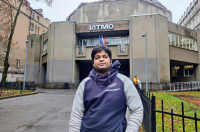
Hi, Juan! How did you decide to come to Russia?
It’s not the most ordinary story. After finishing my Bachelor’s in Colombia, I worked in IT and cybersecurity. One day, my university invited me to give a talk about a major cyberattack. While I was there, I met my ex-girlfriend, and we started talking about our plans. She told me she was applying for a Master’s degree in the US. I told her I was also applying for Master’s programs, which wasn’t actually true at the time!
I don’t like lying, so afterwards I really started looking for programs in cybersecurity. Eventually, I had options in both France and Russia. When I thought about which one would make for a better story, Russia seemed much more unusual and challenging. Everyone goes to France — so I chose Russia.
And why St. Petersburg?
At the embassy, I was asked whether I preferred Moscow or St. Petersburg, but I didn’t know much about either. But I love Dostoevsky. I knew he was closely connected to St. Petersburg, and I had read White Nights, which is set here. I thought: if I’m going to Russia, why not go to the city I already know through his books?
Read also:
What is it you love about Dostoevsky?
My favorite is probably Crime and Punishment, and I’m currently reading The Brothers Karamazov. What I love about Dostoevsky is how real his writing feels.
When you read Crime and Punishment, for example, you can actually feel Raskolnikov’s tension and paranoia. Even when it’s translated into Spanish, you can still feel that weight and emotion. I think that ability to transmit a feeling so powerfully is an incredible skill.
What else do you enjoy doing in your free time?
I read a lot, cook sometimes, and spend time with my friends.
I also run a lot. During my first winter here, many of my friends from the dormitory left for the holidays, so I was quite lonely. I started running by myself. Then, one of my professors told me that her husband was part of a running club. She also mentioned there was free food, and I thought: why not?
That’s how I started running with them. Now we train in different parts of St. Petersburg. We do interval training around Krestovsky Island, run around New Holland, and sometimes combine running with strength exercises. It’sbecome an important part of my life here and a great way to meet people.
Read also:

Photo courtesy of the subject
Let’s talk about your studies. What do you enjoy about information security?
I think cybersecurity education benefits a lot from technically demanding subjects. There are areas like binary exploitation, networks, systems, and cryptographic protocols where you need to know how things actually work. You cannot learn them just by memorizing information.
That’s why I’ve enjoyed the cryptography track. It goes much deeper into particular topics, and I feel like I’ve learned a lot from it. There is a lot of mathematics involved, and you really have to understand what you are doing.
Are there any aspects of cybersecurity education you think could be improved?
I would personally like to see even more emphasis on technical and practical skills. Some areas of cybersecurity can become very focused on regulations and documentation, while in professional work you also need a strong understanding of computers, networks, systems, and security technologies.
For example, knowing how to install Linux or connect through SSH is useful, but at the Master’s level, I think students should have opportunities to go much deeper: understanding how networks actually operate, how cryptographic protocols work, or how vulnerabilities can be exploited and prevented.
I’ve seen students from more software engineering-oriented fields who have very strong technical foundations, and I think cybersecurity students can benefit from the same depth.
Is there anyone at ITMO who particularly influenced your interest in cryptography?
There is a researcher named Andrei Golovanov who gives talks on cryptography, and I really enjoy them. They go into considerable technical depth, and I always learn something new.
One of those talks also helped me connect with someone about potentially working together on research. I’m not necessarily someone who prefers doing research completely on my own, so I’m currently looking for groups where I could work with other people on cryptography-related projects.
Have you started thinking about your Master’s thesis?
I haven’t finalized a topic yet, but I know that I would like to do something connected to cryptography, and I’m trying to find a research group where I could work with other people. I’m also talking to researchers from ITMO’s physics-related fields about potentially joining a project.
Have you participated in other activities on campus?
I’ve taken part in some startup activities, which helped me learn new skills and meet interesting people. I also used to swim through ITMO’s sports sections, and I participated a lot in Just Dance events. One of my friends, Nikita, runs the activity, and that’s actually how we became friends. He is now one of my best friends here.
I don’t participate as often anymore because I have less free time, but it was a really nice way to meet people when I was still adapting to life here.

Photo courtesy of the subject

Photo courtesy of the subject
What has been the best part of studying at ITMO?
The people. There are a lot of very smart people at ITMO, and I really appreciate being surrounded by them.
Coming to Russia has also challenged me personally. Before, I spent much more of my time simply studying and focusing on academic things. Here, I started exercising much more, running, swimming, meeting different kinds of people, and trying things that I probably wouldn’t have done before. So, the experience has been about much more than getting a degree.
Combined with your time in the Foundation Program, you’ve now spent almost three years in Russia. How has living here changed you?
I’ve learned a lot from Russian culture and from the people I’ve met here. There’s a kind of resilience that I’ve encountered here that I really admire.
More importantly, living here taught me that when you move somewhere new, you have to be willing to adapt. You can’t expect the place to adapt completely to you. That doesn’t mean abandoning your own culture. It means being humble enough to understand that you came somewhere different and giving yourself the opportunity to learn from it.
What advice would you give to international students thinking about coming to Russia?
Embrace the experience. I’ve seen people become so focused on recreating their home country here that they don’t really get the chance to experience Russia. Don’t expect everything to be exactly like it is in your home country, whether that means the same food, the same traditions, or only spending time with people from your own country. If you find the right people and really open yourself up to the experience, there is a lot you can learn.
My advice is to be humble when you arrive. Try to understand and adapt to the place – is one of the ways you grow.