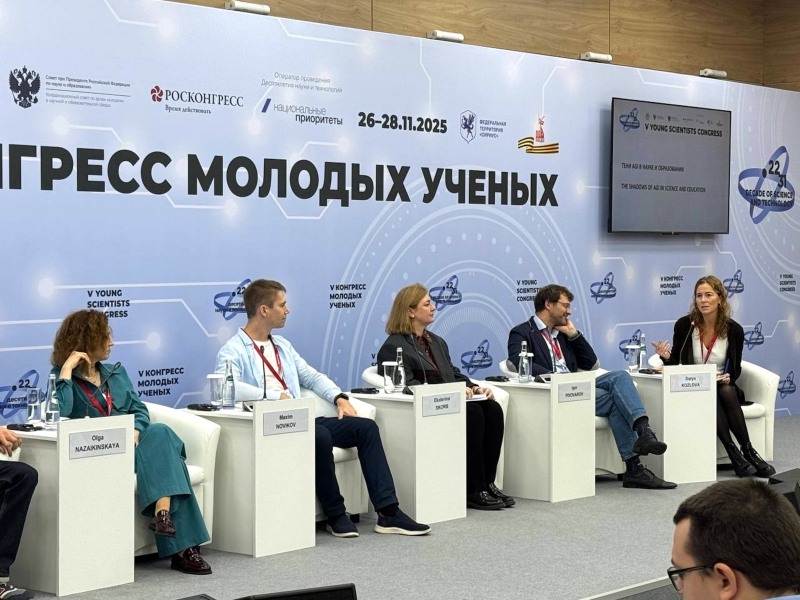
The key topic at the session was the question of how AI is reshaping the educational model “teacher-student-knowledge.” Experts discussed the facets of the future AGI era, essential skills that cannot be substituted by AI, and the changing role of a scientist in AI-assisted research.
As pointed out by Daria Kozlova, the Director for Strategic Development at ITMO, science and education are the starting pathways for AI development, which is a natural bottom-up process. Active usage of AI among students, both at schools and universities, changes the dynamics of new technologies and motivates teachers to change.
“We no longer can turn the clock back or stop using AI; therefore, we should not prohibit, but lead the integration of AI in the classroom. The responsibility for establishing the new practice lies on universities and bigtech companies: they must enable and inspire all participants of the educational process to use AI assistants. However, there’s also the need for global AI literacy among both students and teachers – as a sort of educational hygiene,” notes Daria Kozlova.
Speaking of AI applications, Ekaterina Skorb, the director of ITMO's Infochemistry Scientific Center, shared that her students spent two years training a model that would be interested in growing professionally. It analyzed experimental data and proposed research matrices and further development areas for students – as a result, the model helped accelerate the production of new materials by dozens of times.
“Today, chemistry and materials science have to instantly react to everything that happens in the AI industry. Our students, for instance, code collaborative robots, or cobots: it takes just a couple of days to make one and then it can do lab work on its own. In our country, with its vast territories yet a shortage of specialists, graduates should have 20 to 30 AI agents trained for various tasks. As an educator, my role is to show them which tasks these are and how their assistants can help them earn money – be that in bigtech companies or at major corporations,” says Ekaterina Skorb.
According to Igor Pivovarov, the director for analytics and data at an AI competence center of the National Technological Initiative (NTI) at the Moscow Institute of Physics and Technology, the university’s key role in the AGI-age era is to help form students’ personality and critical thinking. Olga Nazaikinskaya, the director of Skolkovo’s Education Development Center, agreed and expressed that AI is first and foremost an intellectual exoskeleton. Rector of Innopolis University Alexander Gasnikov specified the key competition trend of the future – researchers who got the hold of AI agents are poised to displace those who aren’t ready for them.
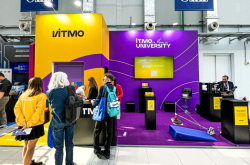
The 5th Congress of Young Scientists took place on November 26-28 at Sirius University of Science and Technology. At the conference, ITMO presented two stands, one for networking and another one for exhibiting the university’s research breakthroughs.
This year, the major science and technology event drew over 8,500 participants from 100 countries. There were more than 250 business, cultural, and sports events. You can find the complete program on the event’s website.