Oreshek Fortress
How to get there: suburban train to Petrokrepost from Finlyandsky Railway station, then a ferry from Shlisselburg to Oreshek Fortress
Entrance tickets: 200 rub for students
Built in 1323, this is one of the oldest fortresses in Russia. Throughout its history the edifice has served various roles, including as a stronghold for the Swedish and Russian empires. After the foundation of Kronstadt, the fortress gradually lost its military importance and was transformed into one of the Russian Empire’s most notorious prisons. Among its famous prisoners were Peter the Great’s sister Maria and his first wife, Evdokiya Lopukhina.
Today, the fortress is part of a UNESCO World Heritage Site and is a branch of the State Museum of the History of St. Petersburg. Visitors can explore not only the ancient defensive walls, but also the remains of older and newer prison cells.

Credit: Karavanov Lev, CC BY-SA 4.0, via Wikimedia Commons
Staraya Ladoga Fortress
How to get there: suburban train to Volhkhov from Moskovsky Railway Station, then the bus 23 to Staraya Ladoga station
Entrance tickets: 500 rub
Now a quiet village, Staraya (Old) Ladoga is sometimes considered the first Russian capital, as one theory suggests that Rurik began his rule here in 862. The stone fortress you see today dates from the 12th-16th centuries, although the earliest wooden fortifications were built in the 9th century. Through the ages, it has eventually lost its strategic importance after the Great Northern War in the early 18th century.
Since then, the fortress has been carefully restored while preserving traces of its past. Inside, visitors can explore old churches, and the towers now house exhibitions dedicated to the site’s history.

Credit: Skydrinker, CC BY-SA 4.0, via Wikimedia Commons
Korela Fortress
How to get there: suburban train to Priozersk from Finlyandsky Railway station
Entrance tickets: 300 rub (600 rub for foreign citizens)
Korela Fortress has changed hands multiple times throughout its history, passing between Russians and Swedes. What we have today is the work of the Swedes from 1680 named Kexholm (“cuckoo’s island”) – that’s why its architecture is so different from the abovementioned sites. Just 30 years later, Peter the Great recaptured the fortress during the Great Northern War. And, to no surprise, it was later repurposed as a prison.
Visitors can walk within the fortress walls and explore a local history museum inside. The exhibitions reflect the region’s past, as shaped by Swedish, Russian, and Finnish influences.

Credit: A.Savin, CC BY-SA 3.0, via Wikimedia Commons
Vyborg Castle
How to get there: suburban train to Vyborg from Finlyandsky Railway station
Entrance tickets: entrance to the island – 100 rub, museum – 250 rub, St. Olaf’s tower – 500 rub
Founded in 1293 by the Swedes, Vyborg Castle is one of the best-preserved medieval fortresses of Western Europe in Russia. Shortly after its construction, forces from Novgorod made an unsuccessful attempt to capture it. The castle remained under Swedish control for centuries until it was taken by (guess who?) Peter the Great during the Great Northern War.
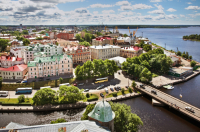
After its recent restoration, the castle has become an even bigger attraction than it used to be. Visitors can climb up St. Olaf’s Tower for a stunning bird's-eye view of the town. Inside the castle grounds, you’ll also find modern exhibitions, a local history museum, and activities that take you back in time: from archery to blacksmithing.