Conventionally, quality control for microscopic products is performed manually by inspectors using micrometers, calipers, and optical microscopes. With the new system developed by ITMO’s International Laboratory “Intelligent Optical Systems,” it’s possible to automate and accelerate this process, while also minimizing any human bias.
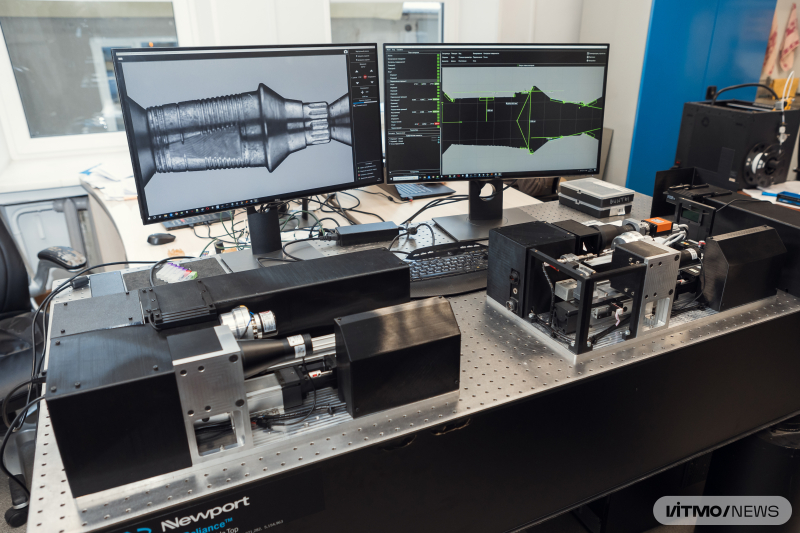
Micrometron includes a precision optical control measuring machine and specialized software, both developed at ITMO. The system is designed for automated high-precision dimensional control, as well as quality control of surface mechanical processing for small-sized (up to 30 millimeters) complex-shaped products.
The new system can find its applications in various production processes: from dental and orthopedic implants to precision parts for engines, turbines, fuel equipment, components for precision instruments, machines, and mechanisms.
“The main purpose of the new software is to conduct dimensional control according to a given plan, comparing the actual linear-angular parameters of a part’s shape to the template. In order to control for complex shaped parts, the machine orients them according to the software instructions using the built-in precision drive. The second task of the software is quality control of surface mechanic processing – defects detection, control for all the necessary design parts and their compliance to the necessary shape. In this process, the system can access template information as a 3D model. The complex is needed to automate control at high-tech productions developing special-purpose devices,” explains Fedor Inochkin, the head of the International Laboratory “Intelligent Optical Systems.”

Fedor Inochkin. Photo by Dmitry Grigoryev / ITMO NEWS
The technological cycle begins with creating a digital “control plan” for the product. An operator specifies the sequence of operations that define the product’s orientation, the parameters to be controlled, and the permissible deviations. This plan becomes a template for subsequent control cycles of products of this type.
Next, a part is inserted in the working area of the software-hardware complex. At the signal, the complex starts the full automated control cycle by scanning the part, alternating between frontal and background lighting to analyze surface processing quality and precisely control the part’s geometric parameters. After that, the software compares the acquired data to that in the digital control plan and the shape of the digital template, visualizing the results of this process. The control cycle is performed in real time, with the possibility to integrate the technology into roboticized production lines.
Among the new system’s analogs are those developed in Europe, Japan, and China. However, these systems are mainly focused either on dimension or surface control. Thus, the advantage of the new system is in combining both precision dimensional control and surface processing quality control within a single cycle. Moreover, the complex is designed in a way that lets it be seamlessly integrated with roboticized production lines and digital twins of analyzed parts. Thanks to the built-in capacity to import 3D models, the software is capable of setting the control procedure even before the production of parts, minimizing the preparation time before the launch of new product types.

The precision control-optical measurement machine of the Micrometron complex. Photo by Dmitry Grigoryev / ITMO NEWS

The precision control-optical measurement machine of the Micrometron complex. Photo by Dmitry Grigoryev / ITMO NEWS
This project was initiated by Lenmiriot, the largest Russian producer of proprietary dental implants; the company has a long history of collaboration with ITMO. At the company’s order, the university’s researchers conducted a study that resulted in two experimental samples of the automated complex, as well as data processing algorithms and software.
Currently, the laboratory’s team is working out the technical solutions for series production of the system.