The tasks for the hackathon were developed by the center’s medical practitioners based on real clinical work. Projects were evaluated based on quality and accuracy. For some challenges, participants used anonymous data from the center’s practice.
Winners presented ideas for three time-consuming tasks in cancer care, the first of them being the processing of histological images. The team Itmoni developed an ML-based system that combines separate images into a single digital slide; the system preserves geometry accuracy and supports the medical formats DICOM and OME-TIFF.
The second task concerned the analysis of data from population-based registries. For that, the team Chai designed a service that predicts morbidity, mortality, and survival rates, as well as helps identify risk factors and plan healthcare resources.
For the third task related to scientific literature, the team SoloWork devised a multiagent AI assistant based on DeepSeek that searches, extracts data from, and evaluates academic papers; it also generates a structured literature review with original links.
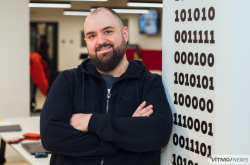
“All cases are inspired by routine tasks that take up a lot of time and effort – yet can be automated. Digital technologies can be used to help reduce workloads of medical staff and increase the time they spend on more complex clinical cases. AI isn’t here to replace human doctors; it’s a way to make their work faster and more efficient,” says Anna Andreychenko, the head of the Master’s track Health Data and the director of ITMO's Digital Technologies in Public Health Laboratory.

Anna Andreychenko. Photo by Dmitry Grigoryev / ITMO NEWS
“The proposed projects will be used as a basis for the center’s in-house services. They will be adapted for use in clinical and research practices, as well as to build more accurate prediction models,” notes Yuri Komarov, the deputy director for organizational and methodological work at the National Medical Research Center of Oncology named after N.N. Petrov.
The hackathon welcomed over 200 students and young specialists from all over Russia. 27 teams, which included medical specialists and IT students, advanced to the final round. Projects were evaluated in two stages: first by an AI assistant and then by the jury board featuring experts from ITMO University and the National Medical Research Center of Oncology named after N.N. Petrov.
The key organizer and coordinator was ITMO’s Center for Science Communication (the new Master’s track Health Data). The technological partner was Yandex Cloud’s Center for Technologies and Society, which provided participants with an environment to develop their solutions.