Contents
- Smart needle that distinguishes tissues
- Transcriber for Cyrillic manuscripts
- CO₂-to-ethylene electrochemical setup
- AR solution for lab classes
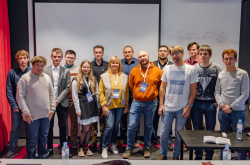
ITMO University hosted the 5th International Young Professionals Conference, one of the key events of which was the exhibition “Science in Action: Young Scientists Showcase Their Developments.” At the display, students presented prototypes and solutions to be used across a variety of fields: from medicine and production to AI and education.
Smart needle that distinguishes tissues
When performing a biopsy, a medical specialist needs to have a clear idea of what type of tissue a needle is inserted into. For that, they typically use ultrasound or X-ray, but if an image lacks clarity, needle guidance during the procedure becomes more complex. Engineers at ITMO’s Higher School of Engineering and Technology (Research Center of Light-Guided Photonics) and St. Petersburg State University’s Pirogov Clinic of High Medical Technologies are developing a technology that can distinguish tissues based on their electrical impedance, i.e., the opposition to alternating current.

Credit: Dmitry Grigoryev / ITMO NEWS
At the core of the technology is a standard 20G biopsy needle that contains two metallic components: an inner notched stylet and an outer cannula. The system measures the electrical response of the tissue between two contacts when an alternating current is applied. Based on these measurements, the surgeon understands what type of tissue it is when they insert the needle. In the longer term, the method can be included in practice and guide doctors in uncertain cases.

Credit: Dmitry Grigoryev / ITMO NEWS
The technology was tested in an experiment that simulates the insertion of a needle into a kidney. Samples used in testing included pork skin, fatty tissues, muscles, and kidneys. The findings demonstrated that electrical responses varied across different tissue types; for the kidney, the results depended on whether the needle touched the tissue or the cavity fluid. The technology is currently an experimental mockup, with studies on biological samples.
Transcriber for Cyrillic manuscripts
Historical manuscripts are often stored only as scanned copies. Linguists, philologists, historians, and other specialists who analyze ancient texts struggle to work with these documents since scanned pages read as single blocks of text – consequently, they cannot be searched for keywords, edited, or analyzed automatically. Although data can be converted into a machine-readable format, the process is time-consuming and might take up to several days.
The team at ITMO’s Institute of Applied Computer Science, led by Andrey Nikishin, has designed Skriptolog – an app that uses computer vision to recognize Cyrillic manuscripts and allows for content to be edited as in a standard text editor.

Credit: Dmitry Grigoryev / ITMO NEWS
It works as follows: a user uploads a scanned copy of a manuscript to the website, and the system generates a transcription – a recognized text that the user can work with via the interface. The software relies on a cascade of computer vision models, with each performing a certain task. First, the system identifies the text area within the image, extracts lines, and establishes their reading order. After that, a separate model recognizes characters, while an algorithm connects them with lines and generates the final text.
A key feature of this software is character-by-character recognition that verifies and corrects the result at the level of individual characters. This is especially crucial for ancient manuscripts – thanks to this approach, historians can see which symbols the model failed to recognize. As noted by Andrey Nikhishin, transcription of written texts used to take a day or two, but with this app, users can correct transcribed manuscripts in 30 minutes or less.
CO₂-to-ethylene electrochemical setup
Industrial enterprises release large amounts of carbon dioxide (CO₂) into the atmosphere, and one way to reuse it is to convert it into a chemical compound that is valuable for the industry. This exact challenge is being addressed by the team of Anna Ponomarets, a student of the Sustainable Chemistry for Energy Technologies program at ITMO’s Advanced Engineering School.

Credit: Dmitry Grigoryev / ITMO NEWS
In the setup, CO₂ flows to a catalytic electrode. Electrical power triggers an electrochemical reaction: CO₂ interacts with the catalyst and forms intermediates, which, following a series of reactions, convert into final products, including ethylene. Ethylene is a key feedstock for the chemical industry, specifically for polyethylene and polymer production.
One of the setup’s key functions is to control reaction selectivity to maximize the production of the target product. By adjusting conditions and properties of the catalyst system, researchers can change the composition of the resulting compound. Therefore, the goal is not just to initiate the reaction, but to increase the share of the target substance in the final mix. Ethylene currently makes up 40% of the final mix.

Credit: Dmitry Grigoryev / ITMO NEWS
In the future, these installations can be integrated into existing capture, purification, and concentration processes at industrial plants. The resulting raw materials will allow the gas to be used as both a by-product and a carbon source for chemical synthesis.
AR solution for lab classes
During chemistry, physics, biology, and other lab classes, students spend a lot of time studying manuals and learning to operate equipment. Lecturers, in turn, have to ensure that the equipment is properly assembled and students perform the experiment correctly. As a result, students have to wait while their instructors perform repetitive routine tasks.
Experts at ITMO’s Infochemistry Scientific Center designed Lab-in-AR to make this process easier. With this technology, students can do lab assignments using AR – no instructor assistance needed. The software is provided by the project’s partner, IKSAR Technologies – a Russian developer of AR solutions for the industry. The ITMO team adapts it for educational purposes.

Credit: Dmitry Grigoryev / ITMO NEWS
A student puts on glasses and launches a training module that is tailored to specific lab equipment and research methods. Step-by-step instructions appear on the screen to help the student complete the assignment. They need to confirm the actions they performed and answer questions; they can also ask an expert for help if needed – lecturers will help the student remotely. The system logs the student’s digital footprint (e.g., task completion time and answers). In the future, the data can be used to build an individual learning path.

Credit: Dmitry Grigoryev / ITMO NEWS
The glasses and developed modules have already been tested in analytical chemistry classes – in particular, during a spectroscopy lab assignment. Second-year students worked with unfamiliar equipment by following the instructions they saw in the AR glasses with no lecturer present in the classroom.
The next step for the team is to evaluate the effectiveness of their method by comparing the results achieved by students using AR and conventional manuals. In the future, the team plans to add AI to make the system analyze images and recognize actions. This way, it will be able to determine whether a student assembled the installation correctly and warn them of errors before they proceed to the experiment.

Credit: Dmitry Grigoryev / ITMO NEWS
Currently, the researchers aim to expand the system’s learning kit and evaluate its performance. Later on, the technology can be adapted for other subjects that involve lab assignments with complex equipment (e.g., physics and biology).