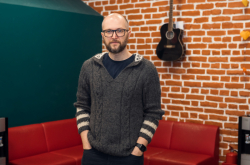
How did you know you wanted to pursue a career in science? How did your career start?
Since my childhood, I’ve enjoyed solving puzzles. Growing up, I realized I could study humanities or natural sciences – and I had a natural tendency towards the latter, so that was what I picked. For my Bachelor’s degree, I was lucky enough to enroll in one of the best universities in our province. I say lucky because the year I was applying, they introduced a qualification exam – and before that, admission was based on your grades. I was a good student, but my grades were not high enough; still, I knew I’d score on the qualification exam, and that’s how I became one of the 120 candidates enrolled in the physics program that year. That was how my scientific journey began.
Your specialization now is photonics with a focus on solar cells. How did you land on this specific topic?
That was an easy decision for me. After studying general physics for my Bachelor’s degree, I realized I preferred practical experiments to theoretical modeling. That’s why for my Master’s studies, I transferred from theory to engineering sciences – I specialized in thermoelectric materials, where heat is converted into electrical energy. For my PhD, however, I decided that I want to specialize in renewable energy. This is a relevant topic: in Pakistan in particular, we have an energy storage problem and generally fossil fuels are limited resources. Specifically, for my PhD at the Institute of Metal Research of the Chinese Academy of Sciences my focus was on perovskite solar cells. I had a great time researching this topic, and it remains my current research interest.

Mustafa Haider. Photo by Dmitry Grigoryev / ITMO NEWS
How has your career progressed since your PhD?
After my defense, I decided to take a short break and visit Pakistan. Before leaving China, however, I secured a postdoc position with a professor at Central South University in Changsha. Unfortunately, as I was about to set out for my postdoc after my break in Pakistan, COVID-19 restrictions hit and I couldn’t leave the country. After struggling for some time, I started as an assistant professor teaching Bachelor’s students at a university in Pakistan. I stayed there for two years, until October 2022, when I was finally able to go to Central South University and start pursuing my postdoc.
During my postdoc, I found myself struggling financially and decided to look for another job in the industry. That’s how I found my current job at Advanced Solar Technology Institute in Xuancheng, specializing in solar cells, including single-junction, tandem devices, perovskite, CIGS, et cetera. I am lucky enough to be a part of shaping this new industry and helping transform research solutions into practically applied devices. We call it commercialization of research or technology transfer. The solar cell industry is a relatively new one; it has picked up around 2010. Now, there is a race among companies that want to conduct this kind of research and bring it to market. We were at the very beginning of this trend and we continue our work in the field.
What would you say is the most important aspect of turning academic research into a commercial product?
In some ways, industrial research is similar to lab research but at a larger scale: in the lab, you manipulate a very small object; for industrial research, you are also doing very precise manipulations, but with very big objects and machines. One crucial difference is, however, that for industrial research you need to control the cost of production: your project has to be feasible on a large scale in order for the technology to be adopted. You need to aim to optimize the cost of the product
Which results of your work – as a scientist or technology transfer expert – do you consider the most impactful?
When I joined Advanced Solar Technology Institute, many solar cell components were already mature, yet a working integration strategy for the 2-terminal (2T) CIGS-perovskite tandem device was still lacking. CIGS (a semiconductor and a type of thin-film solar cells made from copper, indium, gallium, and selenium – Ed.) and perovskite are two separate photovoltaic technologies, and our target was to merge them into a single device. I led experimental efforts to connect these two systems and fulfill this goal. The raw CIGS surface was highly rough, preventing direct integration with perovskite. I modified the CIGS interface using additional functional layers to improve surface compatibility. An ITO film (a thin transparent film of indium tin oxide that conducts electrical current and transmits visible light – Ed.) was then deposited, after which the structure was integrated with the perovskite subcell.
This research represents my most valuable contribution; my solution removed a key barrier and pushed the whole project forward. The technology is progressing towards commercial use, supported by several published research papers and filed patents. The Chinese government also acknowledged this achievement, granting me an award for foreign experts who have made substantial contributions to China’s technological development.

Mustafa Haider. Photo by Dmitry Grigoryev / ITMO NEWS
Congratulations on your achievement! You have a unique role working at the intersection of academia and industry, while many researchers feel they have to choose only one. Have you always known that it was possible?
Yes, it was actually my dream job! I was looking for ways to apply my research since my Bachelor’s degree and now I get to do just that, work on transferring research into industry. I get to stay in touch with laboratories and universities, I collaborate with students and professors on research, while at the same time acting as a research expert for industry. That’s why I believe that actually, there are not two choices, but three: you can stay in academia, work in industry, or find a niche or industry that is currently growing and that would be interested in adopting new ideas from the lab to solve industrial problems. Emerging industries that don’t have fixed solutions yet are an opportunity to combine research with an industrial perspective – and I see it as the third path for those who don’t want to make a choice.
I am sure that will be inspiring to our readers! You are currently doing a Micro Fellowship at ITMO. How does the university come into your work? How do you find yourself here now?
That's a great question. Actually, I met Professor Sergey Makarov back in 2022 when I was looking for a job. We talked, and he invited me to his lab in China to work as a faculty member, but I believed it was important for me to gain industry experience first. We agreed that we’d stay in touch and I promised him we’d collaborate in the future. Meanwhile, we published several papers together. A couple of years later, he invited me for a micro fellowship to explore his lab at ITMO University as part of our common project on nanoparticles to improve the efficiency of tandem solar cells (multilayer photoelectric converters consisting of perovskite and silicon; by absorbing different parts of the light spectrum, they can achieve an efficiency of more than 29% – Ed.). In the future, such solar cells can be used to power AI data centers that are going to need more and more energy – energy that other sources, like oil, won’t be able to produce. So, our topic now is finding a way to integrate AI data centers with solar cells.

Mustafa Haider with his colleagues at ITMO. Photo by Dmitry Grigoryev / ITMO NEWS

Mustafa Haider and Alexandra Furasova. Photo by Dmitry Grigoryev / ITMO NEWS
What do you hope to achieve during your time here?
First of all, I am hoping to get the results of our experiments as quickly as possible. One of ITMO’s PhD students is currently working on them. My second goal is to approach businesses in Russia and establish collaborations with them to work together on solar cells. That’s because without industrial collaborators, integrating solar cells into AI data centers will not be possible. I came here with my technology transfer expertise and a big idea and I am looking for ways to make it happen.
I am also going to deliver two lectures to ITMO students during my stay here. Both lectures will be based on my expertise. I will talk about the technologies we have, what we have developed, and, of course, I will present an unsolved industry problem at the end. That problem is ion migration in perovskite solar cells: under light or heat, the ions in the organic component of perovskite migrate away from the absorber layer. To mitigate this, we are exploring various approaches. For instance, we use passivating additives like rubidium acetate. Another approach is to create UV-blocking protective layers to stabilize the structure and prevent ion movement. I look forward to exchanging ideas with students at these lectures because a solution to this problem will benefit not only solar cells, but also light-emitting diodes, photodetectors, or lasers.
After you complete your fellowship, are you planning to continue working with ITMO?
That's why I came here. We have a big plan that I should be part of ITMO team to explore these opportunities further, to explore how to transfer our lab technology to industry technology. So, I will not only be in touch, but I am planning to come here again and again to expand our collaboration and make it mutually beneficial.
Since you are planning to visit St. Petersburg in the future, would it be true to say you are enjoying your stay here?
I didn’t have time to properly look into the city before coming here, so I was surprised when I arrived. It’s the second-largest city in Russia, and it’s very beautiful, the architecture is very impressive. I was also surprised by the metro – it’s very different in China. Here, every station has its own design. I keep taking pictures of them.
I am also really enjoying the weather. It’s very pleasant and not too warm. ITMO is located right in the city center and there are so many beautiful cafes and interesting spots around, not to mention museums. When I get the chance, I am planning to visit the Hermitage.

Mustafa Haider. Photo by Dmitry Grigoryev / ITMO NEWS
I hope you enjoy your visit! Finally, if you could give one piece of advice to young scientists building their career today, what would it be?
This is a great question. I know that ITMO’s photonics labs, as well as other departments, now offer Master’s programs in collaboration with industrial partners. I believe such educational programs are a good opportunity for students to decide where they want their career to go and learn what kind of challenges there are in the industry of their choice and how they can apply their knowledge to solve them. This will make them into good experts.
And one additional piece of advice is to keep in touch with your peers and professors and learn about the career paths of your seniors. It can help you a lot. They can inspire you or they can even help you find a more direct path in your career. Build connections and network productively, aim to help people in your network. In short, in this machine-centric world, keep being people-centric. You never know what can come out of a connection: if I hadn’t met Prof. Makarov, I would never have come to ITMO, but now I’m here and we are working on an exciting project together.