Optical microresonators are miniature devices that can be compared to a circular mirrored room in which a beam of light repeatedly reflects off the walls, becoming much more intense in the process. Thanks to this property, these “amplifiers” can be used to create miniature lasers, biomedical sensors, and optical markings to protect valuables from counterfeiting.
However, microresonators aren’t widely used yet, as the majority of existing versions have serious drawbacks: they need to be “activated” with a powerful laser – otherwise, they simply won’t hold and amplify light. Moreover, the materials these devices are made of aren’t compatible with biological objects, which means they can’t be used in medical diagnostics.
Researchers from ITMO University have developed a microresonator that doesn’t just contain and amplify light, but also generates it.
At the core of the device are standard microresonators – polystyrol spheres five micrometers in diameter (ten times thinner than a human hair). Their surface is covered with two types of luminophores (glowing particles): nanocrystals made from silver, indium, and sulphur, and carbon dots.
Next, the researchers applied two additional layers: a polymer and gold nanoparticles. The first layer acts as an isolator, preventing the gold from interacting with the lower-layer nanocrystals and dimming their glow. The gold layer acts as an antenna that amplifies the light emitted by the microresonator.
When the microresonator is subjected even to a relatively weak laser, the silver-indium-sulphur nanocrystals and carbon dots on its surface emit light in every direction – with most of this radiation “escaping” the microresonator sporadically, turning into a useless noise signal. However, a smaller part of the radiation lands inside a “trap” within the polystyrol microsphere, where it stays thanks to multiple reflections from its walls, and also “grabs” the radiation from other nanocrystals, thus growing hundreds of times brighter.
“It’s easy to tell apart the noise signal from the ‘trapped’ light: the sporadic noise has a broad and blurred spectrum, while the light locked inside the resonator has sharp, narrow peaks at specific wavelengths. Gold nanoparticles in our microresonators selectively dim this sporadic noise and amplify the part of the radiation inside the sphere, making it brighter and clearer,” shares Anton Tkach, a participant of the project and a research engineer at the International Research and Educational Center for Physics of Nanostructures.

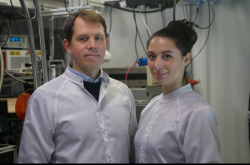
Ksenia Maleeva and Anton Tkach, two of the paper's authors. Photo courtesy of the subjects
The authors have experimentally confirmed the suppression of unwanted signals and a manifold increase in the brightness of the light passing through the microsphere cavity. Moreover, the study showed that by changing the layer-deposition architecture, it is possible to “tune” the emission of luminophores, enabling the creation of microresonators with properties optimized for different applications. Importantly, all the microsphere components are non-toxic, meaning that the technology could be used to analyze biological samples, such as cells and tissues.Earlier, the team developed a material that improves the sensitivity of Raman spectroscopy – a method used to analyze the composition of various solutions – by 10,000 times. Thanks to the new material, the method can now be applied to detect even the minimal concentrations of target molecules in complex media, including blood, bodies of water, petrochemical products, and others.
“In the future, we are planning to combine our earlier research and use these results to create a lab-on-a-chip type structure capable of simultaneously detecting the analyte in the detector and analytical channels. We will also analyze the resilience of hybrid structures in liquid media, their response to complex multicomponent samples, and identify the limits of detection and selectivity of various microsphere architectures on model compounds,” says Kirill Bogdanov, the head of the project and head of the Laboratory of Raman Spectroscopy of Semiconductor and Dielectric Nanostructures of ITMO’s International Research and Educational Center for Physics of Nanostructures.