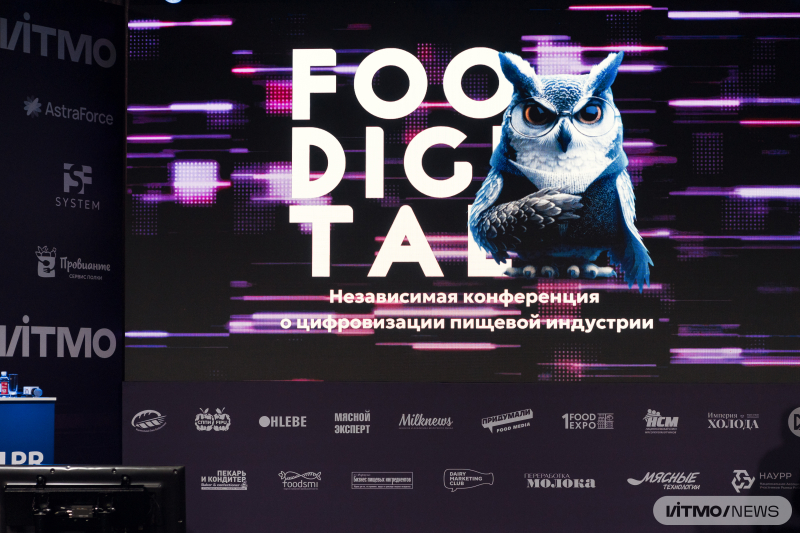
Digitalization isn’t just a trend, it’s a necessity for the food industry. According to the Towards FnB forecasts, the market size of global AI in food manufacturing is expected to increase from $9.51 billion in 2025 to $90.84 billion by 2034. This will happen due to automation, robotics, and machine learning advances, as well as a rising demand for quality, safe foods. Experts from Russia’s major food businesses talked about food innovations at the recent Pischevka3D FooDigital conference that took place at ITMO University.
“The food industry today faces two major challenges. The first one is the transition from foreign to domestic software and process automatization (document workflow, logistics, etc.); the second challenge is optimization, and it’s admittedly more complex as it concerns collection of well-interpreted data. In the future, specialists will use this exact data to form a knowledge base and adopt AI solutions in foodtech,” notes Vladimir Vasilyev, Rector of ITMO University.

Vladimir Vasilyev. Credit: ITMO University
Digital twins in production
Companies lose millions of rubles to defects, shrinkage (the loss of product mass due to moisture evaporations during freezing and storage), formulation inefficiencies, and slow product development. Resource and time depletion entails risks for the brand as the producer can’t guarantee consistent quality of their products.
These problems, as noted by Natalia Komarova, a specialist in FMCG (fast-moving consumer goods), particularly those related to meat and poultry processing, sausage production, semi-finished foods and ready meals, can be solved with digital twins. A digital twin is a virtual replica of a process or system based on real-world data that includes an interface, AI models, and data collected from sensors or at laboratories (e.g., oven temperatures, ground meat’s pH, and pump vibrations.)
Digital twin solutions already help solve different issues in production. For instance, with their help, it was possible to find the perfect formula for frozen cutlets that retains their taste, properties, and texture despite their heating method, as requested by a major manufacturer of canned meat and vegetables. The initial recipe didn’t work well with all cooking methods: cutlets dried out in the oven and tasted rubbery if microwaved. Then, the manufacturers decided to make a digital twin of their product based on a hybrid AI model: they digitalized its structure and composition, simulated different cooking processes, and thus learned to predict any changes concerning its mass, texture, juiciness, and skin crispiness. The result is that the manufacturers found the recipe for the “perfect” cutlet whether it’s cooked in an oven, a microwave, an air fryer, or on a pan.
“Food digitalization promotes the trend of smart food industry, that is the integration of technological advances into production, distribution, and consumption to create a more efficient, stable, personalized, and transparent food system. This field is studied and developed at ITMO: the university has laboratories and centers that specialize in AI, computer vision, big data analysis, and automation. These technologies can be used to optimize food manufacturing processes: the production of personalized foods and functional ingredients, thorough monitoring of product quality, demand forecasting, and supply chain management,” says Olga Orlova, the director of and a senior researcher at ITMO’s Research and Educational Center for Nutrition.

Olga Orlova. Photo by Dmitry Grigoryev / ITMO NEWS

Natalia Komarova. Photo by Dmitry Grigoryev / ITMO NEWS
How to make a “wow” product with AI
What’s the secret to standing out from your competitors and becoming a market leader? The answer could be AI and digitalization. Dmitry Dokin, a chairman of the board of directors at Shin-Line, shared his experience in applying AI in their ice-cream production. Here are some of the tasks performed by AI at the company.
Formula selection. Assisted by the Puratos company, the Food Union holding was able to introduce unusual flavor combinations – for instance, pistachio and blueberry – for their ice cream. The AI solution they used detects chemical molecules of aromatic substances in products and determines the dominant ones via gas chromatography and mass spectrometry. The system analyzes and selects ingredients with common flavor components that work well together. Thanks to this system, the typical development time for a new product was reduced from six to two months.
Promotion. AI can find the best places for your advertisements, distribute budgets for marketing campaigns, and define your target audience for targeted advertising. For instance, the company used neural networks to set up its targeted campaigns and boost its visibility: now, when adding retail buyer contacts, users see the company’s banners on their social media, thus increasing its presence among potential clients and partners.
Digital logistics. The company is currently testing a program for ordering intercity and international transport: bots send standard-form requests and receive a response within several minutes. Drivers from dozens of client companies use this software to quickly confirm transport requests. For the inventory of products on-board, companies use another service that informs the main office about product availability so that it could send any goods that are missing.

Dmitry Dokin. Photo by Dmitry Grigoryev / ITMO NEWS
A mobile app for monitoring product quality
ITMO produces AI solutions for the food industry, too. One of the pressing problems that can be solved with technologies concerns food fraud. For instance, the most counterfeited dairy product on the Russian market is butter; milk fats are often replaced with vegetable fats in imitation products. Olga Freinkman, a student at ITMO’s Center for Molecular and Biological Technologies, presented her solution that can combat counterfeiting and ensure a product meets the standard.
At the core of the solution is a luminescence-based express method. It works as follows: a user places a product sample into a device where it will be exposed to ultraviolet light, then takes a picture of it with a smartphone, and loads it into the program. As a result, the program reports if there are vegetable fats in the product. The service is compatible with smartphones and requires no bulky equipment or software, unlike existing analogs.
The app is still a work in progress. But as noted by the developer, it will be useful for food enterprises that deal with dairy products, distributors, and retailers for the purpose of controlling the quality of supplied products, and regulatory authorities – for quick analysis on the spot.
The FooDigital conference. Photo by Dmitry Grigoryev / ITMO NEWS The FooDigital conference. Photo by Dmitry Grigoryev / ITMO NEWS The FooDigital conference. Photo by Dmitry Grigoryev / ITMO NEWS