RobotChallenge is one of the world’s largest robotics competitions that has run every year since 2004, originally in Vienna and now in Beijing. The contest features a great many categories: from thrilling RoboSumo cyborg fights and high-speed Line Follower races to Air Race drone races and sprints of humanoid robots (Humanoid Sprint).
ITMO students regularly compete in the Freestyle category. The track offers immense creative freedom for developers who build robots that don’t fit the criteria of other competition categories.
Guided by the veteran coach Igor Lositskiy, the head of ITMO’s Youth Robotics Lab, the team has earned three gold medals over the four times they have been at the tournament. The lineup this year included Alexander Syrkovsky and Stepan Muravyov, first-year students at the Faculty of Control Systems and Robotics, and Mikhail Olevsky, a musician and school student; the team was also assisted by Evgeny Zavarin who works at the laboratory.
Over their history at the tournament, the ITMO team has showcased several robots: robot saxophonist Fantastic Robby Brown and robot musician Robert Robotecky that performs musical pieces on the concertina while balancing on an electric gyro scooter. That being said, according to Igor Lositskiy, the team designed their most advanced robot yet this season.
At the contest, the team presented a new member of their musical band in the making – the violinist EMMA. The team wanted the robot to play the violin because they thought it was the most challenging instrument in the orchestra. Their EMMA is voice-controlled and can play the instrument, as well as reproduce melodies performed by human players. What’s more, EMMA can tune the violin herself, leaving no chance for playing off-key.

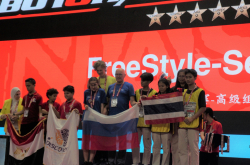
ITMO's team at RobotChallenge 2026. Credit: RobotChallenge

ITMO's team at RobotChallenge 2026. Credit: RobotChallenge

ITMO's team at RobotChallenge 2026. Credit: RobotChallenge
The Freestyle category is held in two rounds: a day-long poster presentation and a project defense. The jury board includes three experts. Each team has about 20 minutes to present their robot and answer questions. Criteria include innovation, originality, technical complexity, applicability, and presentation.
“This year, 46 teams competed in our category – it’s way more than usual. I can’t imagine how they coped. Three teams climbed up the podium: one finished first and two others shared the same score. The gold and silver medals went to teams from Azerbaijan. By the way, the winners said our robot was their number one and I believe it turned out great. Everyone who saw it was impressed,” notes Igor Lositskiy, the team’s coach.

Igor Lositskiy at RobotChallenge 2026. Photo courtesy of the subject
Another achievement for the team was that Igor Lositskiy was included in the RobotChallenge Hall of Fame. “It’s a major competition with lots of coaches – yet just a few get recognized, so it means a lot to get such high praise,” he commented.