The center covers the end-to-end cycle of drone production: from design and 3D modeling to prototyping and testing. As their primary task, students will develop computer vision algorithms for autonomous navigation and data processing, as well as produce next-gen technological solutions for small spacecraft. They may also choose to study generative design. With the help of this approach, students will be able to automatically generate accurate 3D models of parts based on a text description and the general geometry of a future assembly and thus significantly accelerate the process of evaluating design configurations for drones and aircraft components.
Students of varied specializations and levels of education will be organized into project groups to perform one of the company’s industrial tasks: for instance, to develop an autonomous navigation algorithm, build drone elements, or process payload data. Those with little experience will be taught the basic principles of design, while more skilled students will act like mentors.

Students at the Youth Construction Bureau Geoscan-ITMO. Photo by Dmitry Grigoryev / ITMO NEWS
“ITMO is known for its high-impact research, but in today's world, science needs to be grounded into existing market products. Geoscan boasts a range of such solutions, which means that students can apply the theoretical base they obtain at the university to the products provided by the partner company. So far, these include different types of drones – and later, perhaps, small satellites, as well as ground, surface, and underwater robotic systems – negotiations are underway,” explains Andrey Zhivitskii, the head of the Youth Construction Bureau Geoscan-ITMO.

Andrey Zhivitskii. Photo by Dmitry Grigoryev / ITMO NEWS
Students will be mentored by experts from Geoscan and ITMO’s Faculty of Control Systems and Robotics. Apart from working on projects at the center, they will also be able to complete internships and practical training and participate in research and R&D projects at the partner company. Moreover, work at the center will be counted as engineering, design, or research practical training.
The first cohort of students have already started their three-month training at the center. In total, the center received 70 applications from students, 28 of whom were accepted. Among the participants are students from Russia, as well as Vietnam and Syria.
“High-tech and booming industries are posing growing expectations to job candidates. That’s why we want someone who can start working from day one without any additional onboarding, and this exact form of training can help us reach that goal. It benefits students, too: they obtain hands-on experience and therefore feel more confident in the workspace,” says Alexey Yuretsky, CEO of Geoscan.

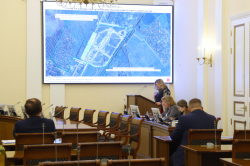
The opening of the Youth Construction Bureau Geoscan-ITMO. Photo by Dmitry Grigoryev / ITMO NEWS

The opening of the Youth Construction Bureau Geoscan-ITMO. Photo by Dmitry Grigoryev / ITMO NEWS
Geoscan is a Russian group of technological companies that develop and produce unmanned aircraft systems (UAS), small spacecraft, avionics, wireless communication equipment, and sensors for UAS. Its products and services are exported to over 50 countries worldwide. The company also specializes in large-scale drone shows and educational solutions for STEAM (science, technology, engineering, arts, and mathematics) training and robotics competitions.