Building a tech corporation
In her opening speech, ITMO’s Director for Strategic Development Daria Kozlova described the university’s journey over the past four years. ITMO set course to become a technological corporation and enter the market with its own technologies and products. At the same time, the university was solving unusual tasks: how to work outside campus, determine its share in new companies, and manage intellectual property.
“We moved on from one-time short-term contracts to long-term industry interaction and searched for a win-win model in terms of investing in applied research and development. At ITMO CONF today, we are sharing not our plans, but the results we’ve achieved. In industry terms, these are releases of our products and projects,” said Daria Kozlova.

Daria Kozlova. Credit: Dmitry Grigoryev / ITMO NEWS
In the coming academic year, ITMO is launching several educational AI products. Among them is a course for first-years on learning in partnership with AI, where students will discuss the boundaries of using AI and learn to create assistants for routine tasks, as well as a course in AI ethics. ITMO staff and students can also access an AI assistant that will take on part of service and information tasks. Additionally, in collaboration with the Moscow School of Management Skolkovo, ITMO is launching a program for business executives on AI transformation; the university is also opening two engineering centers – in biotech with Tatneft anf in infochemistry with Sibur.
How teams go from hypotheses to market products
Sometimes, products appear not from a single idea, but from years of experience. In 20 years, the team of Denis Nasonov, an associate professor at ITMO’s Artificial Intelligence Technologies Faculty and CTO of Exepto, completed over 30 projects with 13 partners, including Gazprom Neft, Tatneft, Siemens, and Yandex. Each project gave a tech basis, a team ready to be responsible for the result, an experience in industrial implementation, and applied research. This experience led to the creation of TSEKH, a platform that takes a business idea through every stage – from a specification to a ready software product built into a company’s infrastructure. ITMO played a special role in the story: it allowed the team to see the task earlier than the market did.
“At the university, we can spot an interesting task before the market thanks to academic experience, competencies, and knowledge. However, it’s important for such ideas to always reach something that can be implemented. The secret here is in the resonance of four components: a laboratory with an accumulated portfolio of assets, business development, product partnership, and team. By working at the lab and completing projects for our partners, we implement the same logic as founders and entrepreneurs: each project can give an impulse for further development, distribution, and scaling. It’s important to remember that and create your own assets,” explained Denis Nasonov.

Denis Nasonov. Credit: Dmitry Grigoryev / ITMO NEWS
Industrial partners expect understandable commercial results within two-three years, not in the long term. That’s why it’s important to select the fields that are in-demand on the market. Thus, Eduard Samsonov, the head of ITMO’s Center for Design of Integrated Photonics Devices, and Fedor Kiselev, the center’s chief technology officer, shared that integrated photonics, a field bridging optics and microelectronics, according to market projections, will occupy up to 85% of data center market by 2035.
“We focused on an optical switch – a device that routes data streams within a data center without relying on expensive, energy-intensive electronic processors. We thought that after all this work the most logical next step would be the device’s development. But there was a catch: this happened 18 months ago. We felt in a way like a harmonic oscillator: we moved closer to the deal then further away from it and back again. Over this time, we realised that actually the work on a project doesn’t start when you receive investments. It starts much earlier,” added Eduard Samsonov.

Eduard Samsonov and Fedor Kiselev. Credit: Dmitry Grigoryev / ITMO NEWS
You can start developing a product even without a vision for the final device: the lack of ideas at the start is the space for hypotheses. It’s important for teams to try many novel ideas and keep developing them, even if there isn’t space for them in the industry, believes Stanislav Glybovski, the head of ITMO’s Scientific and Educational Center of Radiophysics and a senior researcher at ITMO’s Faculty of Physics. His team was developing metamaterials and looking for structures with unusual electromagnetic properties. At a certain point, the researchers got inspired by Chanel’s logo and created a metaatom in an unusual shape. This structure made it possible to transmit the wave without reflection and give it the desired propagation angle at the output – that is, to control the signal’s direction without loss.

Stanislav Glybovski. Credit: Dmitry Grigoryev / ITMO NEWS
From these metaatoms, ITMO PhD student Andrey Sayanskiy developed a metasurface that confirmed its electromagnetic properties in an experiment. But for a long time there wasn’t a practical application for the structure. The researchers kept the idea and in time it found its use in satellite communication, where antennas needed just the properties demonstrated by the metasurface. The device had to be improved but the concept remained the same.
There are cases when partners don’t have a task ready – that was the case for the team of Alexey Vedyakov, the deputy dean of ITMO’s Faculty of Control Systems and Robotics. Their partner had an understanding of the product, but figuring our what needed to be done was a joint task. Such projects often get more scale than planned: in the process, researchers come up with new hypotheses, the requirements get more specific, and the initial number of tasks grows several fold: from three technical tasks to six and from a dozen of equipment units to forty.

Alexey Vedyakov's talk. Credit: Dmitry Grigoryev / ITMO NEWS
In this case, the team didn’t simplify the project – instead, they assembled a separate group for each task: management, machine vision, and equipment development. Now, the project includes over 100 researchers, the majority of whom are Bachelor’s students. In this format, the teams don’t have an exact technical task with clear demands; instead, they appear in the process. Often, one group’s task depends on what’s being done by the neighboring group and vice versa.
Neurobiology of a product decision

Vladimir Alipov. Credit: Dmitry Grigoryev / ITMO NEWS
ITMO CONF concluded with a talk by Vladimir Alipov, a clinician, neurobiologist, and science communicator. He offered an unusual perspective on product logic: through the prism of music and the brain. Dr. Alipov explained that our brains are constantly trying to predict what’s coming next – including when we are listening to music. We try to predict which chord comes next and then react when reality is different from our prediction. It is precisely in this gap between expectation and reality that surprise, tension, and pleasure arise. The same mechanism is at work in product development: it start with a hypothesis on what comes next followed by a test of how it really is.

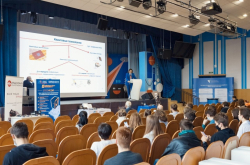
ITMO CONF 2026. Credit: Dmitry Grigoryev / ITMO NEWS

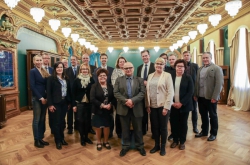
ITMO CONF 2026. Credit: Dmitry Grigoryev / ITMO NEWS

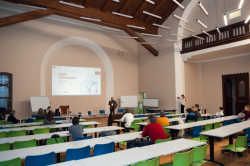
ITMO CONF 2026. Credit: Dmitry Grigoryev / ITMO NEWS
Today, ITMO houses over 30 laboratories in various fields: from photonics and robotics to AI and radiophysics. They actively collaborate wit industrial partners, including major tech companies: Sberbank, Yandex, Gazprom Neft, Arrival Robotics, and others. These teams welcome Bachelor’s students who can combine their studies with real-world projects, complete practical training, develop industrial solutions, and get paid for their work. Find out more about these opportunities in this story about the team of Vladislav Gromov building autonomous robots or this story about the Laboratory of Embodied Intelligence in Robotics where researchers create systems that enable robots to see and act without an operator. Discover the university’s main achievements in the 2025-2026 academic year here (in Russian).

Credit: ITMO's press office