Verkhoyansk
- Population: 745
- Area: 25 km2
Perhaps unsurprisingly, the smallest town in Russia by population is located in one of the country’s coldest regions, Republic of Sakha (Yakutia). In fact, it competes for the title of the Pole of Cold in the Northern Hemisphere with Oymyakon, the coldest Russian city. Verkhoyansk also holds the Guinness world record for the most extreme temperature range on Earth – 105.6 C between its summer and winter temperatures. Founded in 1638, Verkhoyansk used to be an important trade and cultural center in the Arctic Circle. Now, the city is actively developed as a tourist center for those not afraid of the cold.
Read also: Where Bananas Become Hammers: Coldest Places in Russia
Chekalin
- Population: 935
- Area: 5.42 km2
A bird’s eye view of Chekalin. Credit: kkv1970 / WIkimedia Commons / CC BY-SA 3.0
Another small town with a long history, Chekalin was first mentioned in historical records back during the reign of Ivan the Terrible, in 1565, under its former name, Likhvin. It’s located in the Tula Oblast, on the shore of the Oka river, and around 15% of the town is taken up by forest vegetation. It used to be a trade-heavy town that gradually declined over the 20th century, as major railways passed it by. Chekalin still mostly retains the city plan created in 1776, with some 18-19th-century buildings remaining on its streets. In the 2020s, the town’s authorities suggested losing the town status to become a village – to the great displeasure of the citizens; it was decided that Chekalin officially remains a town, though a quaint, green one, for those who wish to escape the hustle and bustle of its bigger counterparts.
Discover the arts of the Tula Oblast: The Diverse and Colorful World of Russia’s Ancient Crafts, Part I: Toys
Kurilsk
- Population: 2,537
- Area: 3 km2

A view of Kurilsk. Credit: Vera.vvo / Wikimedia Commons / CC BY-SA 4.0
The administrative center of Iturup, the largest of the Kuril Islands, this town traces its history to the 18th century, when it was founded by Russian explorers. Originally, the island was inhabited by the Ainu, an ethnic group now mostly represented in Japan. These days, Kurilsk is a town focused on the fishing industry; close by it is also a weather station, a seismic and tsunami alarm station, and a local history museum. A journey to the island will undoubtedly be a great adventure, though probably not for the faint of heart.
Read also: 4 Unique Nature Spots to Visit in Russia
Vysotsk
- Population: 1,122
- Area: 39.81 km2

The Vysotsk port. Credit: Dmitriy Alekseenkoff / Wikimedia Commons / CC BY-SA 3.0
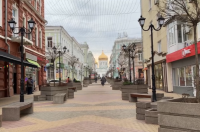
Located close to Vyborg, the port town of Vysotsk traces its history to at least the 17th century. Back then, it was known as Trångsund, Swedish for “narrow strait.” In 1721, after the Northern War, the town went to Russia, and Peter the Great ordered for the Trångsund fortress to be built there. Its remains can still be viewed if you visit the town (reachable from Vyborg). After it’d been acquired by Peter the Great, the town used to be a part of the Grand Duchy of Finland (part of the Russian Empire) and back then it was known as Uuras; all of its previous names still remain in some of the town’s landmarks. It is still an active port city that may make for an interesting day trip off the beaten track.
Read also: The 5 Railway Terminals of St. Petersburg
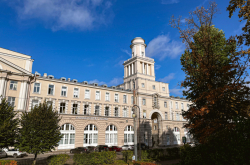
Innopolis
- Population: 3,955
- Area: 12 km2

Innopolis Technopark. Credit: Lesya Polyakova / Innopolis Media / Wikimedia Commons / CC BY-SA 4.0
The youngest city on our list, Innopolis was founded in 2012 as a naukograd, or “science city,” within the Kazan metropolitan area. One of the few post-Soviet era cities built from the ground up, Innopolis was designed as a cradle for innovation and high-tech solutions. The city was made part of a special economic zone in order to promote business investments and attract residents – currently, among them are major Russian tech companies, including Yandex, Alfa-Bank, Cognitive Technologies, and others. Also located in the science city is Innopolis University, one of ITMO’s active partners; for instance, the universities collaborate with other institutions and companies on the coveted AI360: ML Native Bachelor’s program.
Read also: How to Enter One of Russia’s Most Prestigious AI Programs: Tips from Two-Time NTO Winner