Vavilov-Cherenkov radiation occurs when a charged particle moves through a medium at a speed exceeding the speed of light in that medium. As it passes through the material, the particle polarizes its atoms and molecules, causing them to emit light. The waves generated at different points along the particle’s trajectory interfere constructively at a specific angle, so Cherenkov radiation propagates as a characteristic cone of light. To visualize it, you can think of a supersonic aircraft exceeding the speed of sound and generating a shock wave. Vavilov-Cherenkov radiation is similar to this shock wave, but in the form of light.
This study continues the team’s previous work, in which they predicted new ultrafast quantum processes in Vavilov-Cherenkov radiation and demonstrated that this radiation has a complex spatio-temporal structure. Whereas earlier the physicists considered the radiation’s temporal characteristics, in this study they have for the first time considered the effect of material dispersion – that is, the dependency of the refractive index on the frequency of light. The scientists have studied the shape of the Vavilov-Cherenkov radiation field at all stages of its evolution: from a photon’s birth to its propagation in space. The new method can be used to describe not only the result but the process that precedes it.
Previously, the quantum theory of radiation mainly allowed calculation of the probability of detecting an electron and a photon in the final state with specific energies and momenta. For many tasks, this is sufficient. However, this approach effectively compares only the “before” and “after” states.
To solve this problem, the scientists used the Wigner function, which allows the simultaneous description of a quantum object in the position and momentum spaces. This step made it possible to visualise the photon field in space and time, trace its propagation in the near zone, and study how the material’s properties affect the formation of radiation.
The suggested theory shows that the characteristics of the radiation strongly depend on the material’s dispersion and the quantum properties of the momentum. Moreover, it makes it possible to describe not only the probability of photon emission, but also its spatial structure, shape, and propagation dynamics. Using this theory, scientists can also determine how long the Cherenkov flash lasts, when the photon reaches a given point, and how the radiation is formed. Another result is a description of the photonic field in the near zone, where the radiation is just being formed. In this region, its distribution is related to the distribution of the electron.
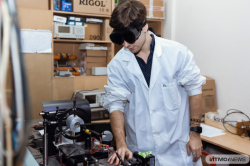
“This way, we get something like a ‘snapshot’ of the electron’s wave function. We can use it to learn the size and spatial coherence of a source. By using the length of a Cherenkov pulse, we can determine the longitudinal size of the signal,” says Alexander Shchepkin, one of the paper’s authors and an engineer at ITMO’s Faculty of Physics.

Alexander Shchepkin. Photo courtesy of the subject
This information can be used to study fundamental quantum properties that cannot be described conventionally. The theory also predicts a number of new effects that occur due to material dispersion and the end radiation formation time.
At the same time, due to quantum mechanical properties, it is difficult to see the process of photon formation in an experiment. Once the photon lands in a detector, it disappears, which is why it’s impossible to measure it more than once. However, a photon’s Wigner function can be reconstructed using quantum particle tomography, an approach already used with photons in quantum informatics.
“Theoretically, we can try and extrapolate this method to systems combining different particles – photons and electrons. For instance, we can expand our knowledge of a state by simultaneously measuring different variables for the photon and the electron that cannot be measured for the same particle due to Heisenberg's indeterminacy principle,” adds Alexander Shchepkin.
The suggested method can be used to analyze radiation processes in accelerator physics, electron microscopy, quantum optics, and sources of ultrashort light pulses. Considering material dispersion and radiation’s spatio-temporal structure can be important in fields where Vavilov-Cherenkov radiation is used for diagnostics: in particle detectors, accelerators, and experiments studying ultrashort quantum processes. This is also a powerful impulse for further development of quantum tomography methods.
This study was supported by the Russian Science Foundation (grant No. 23-62-10026) and the Ministry of Science and Higher Education (project No. FSER-2025-0012).