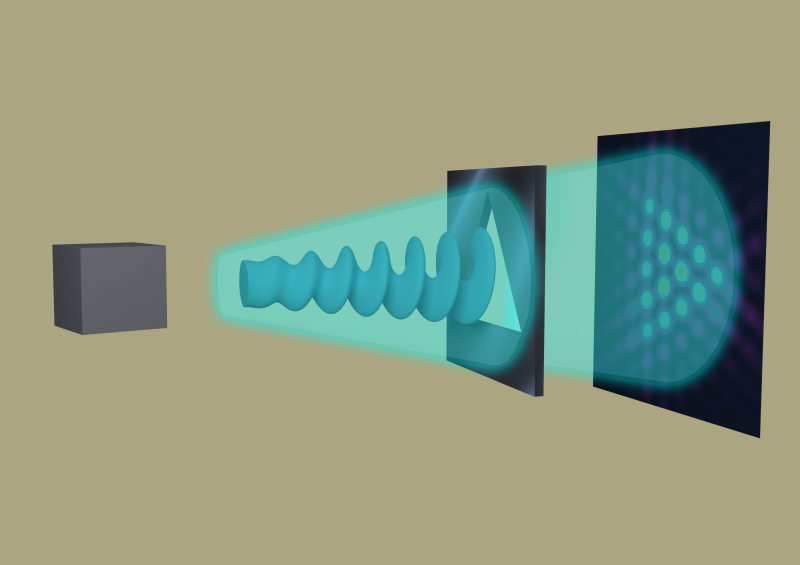
The study of quantum particles with an angular momentum is an emerging field in physics. In such states, beams demonstrate a specific profile and are called “twisted” beams. They have a spiral form and are characterized by the integer ℓ; its module defines the twist angle and sign +ℓ or −ℓ – the direction. These particles may play a vital role in quantum computing, lithography, and precision diagnostics of substances – namely, the analysis of their composition, structure, and properties. Existing diagnostics methods have been so far used in low energies exclusively and are poorly adapted for high-energy (relativistic) beams in accelerators.
Dmitry Karlovets, the head of a research team at ITMO’s Faculty of Physics, came up with the idea to use the wave property of particles, i.e. diffraction. For instance, if a twisted particle is passed through a circular microscopic aperture, the image on the screen will bear a “fingerprint” of the particle's properties – symmetrical concentric rings. This, however, can be used to determine the twist angle, but not its direction.
Instead, the team opted for a different solution – a triangular diffraction. Due to its shape, it breaks the image’s axial symmetry and as a result, the screen shows a detailed pattern of bright points, resembling a triangular lattice. By analyzing the pattern’s displacement and structure, specialists can calculate both the twist angle and its direction.
The researchers conducted a comprehensive modeling study that proved the efficiency of the method for both ideal Bessel beams and physical Laguerre-Gaussian beams with a screw-like structure. As a result, the team prepared guidelines and formulas for setting up an experimental installation at the Dzhelepov Laboratory of Nuclear Problems; specifically, they calculated the optimal size of the triangular aperture, the distance to the detector, and the required resolution of the equipment depending on the type of particles (electrons or light ions) and their energy.
“As for the novelty of our work, we were the first to propose a detection method for twisted electrons and ions that’s applicable with high (relativistic) energies. Although scientists actively worked on similar approaches for light – photons, or low-energy electrons, these couldn’t be used to determine the parameters of particles in modern-day accelerators. Our method fills that void. We characterized high-energy beams, the production of which in itself is a challenge,” says Maksim Maksimov, an engineer at ITMO’s Faculty of Physics and a student of the Advanced Quantum and Nanophotonic Systems Master’s program.

Maksim Maksimov. Photo by Dmitry Grigoryev / ITMO NEWS
The method is quite easy to apply: it requires apertures with different geometries (devices with apertures), rather than complex active components, and twist parameters can be “read” from the diffraction pattern itself. Moreover, the paper features ready-made worksheets for scientists to modify the approach as needed.
The team will soon start testing a new approach for preliminary diagnostics in their experiment on generating twisted beams. In the long run, the method may become an essential tool for online monitoring of beams in accelerator complexes and for studying magnetic properties of materials for the needs of electron and ion microscopy.