Starting from November 2026, Vladimir Vasilyev will take on the role of scientific supervisor and chief design officer. He will be responsible for the technological core of the corporation: bringing solutions to joint enterprises and new legal entities, IP, interaction with state corporations and key partners, as well as campus infrastructure and development. Dr. Vasilyev will head the Council of Design Officers, a collective that will include the heads of ITMO’s key tech fields.
“My sincere hope is for ITMO University to evolve steadfastly in accordance with emerging challenges while staying true to its foundational principles – to dare to experiment, to bring all endeavors to completion, and to preserve intergenerational continuity, as that is what keeps any intellectual corporation strong,” commented Valery Falkov, the Minister of Science and Higher Education.

Valery Falkov. Credit: Dmitry Grugoryev / ITMO NEWS
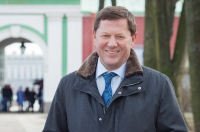
“Dr. Vasilyev has been leading the university since 1996. He has always remained open-minded and strategy-oriented. As one of the key IT ideologists in Russia, he turned ITMO into a world-class university with a great team of like-minded professionals. He has created a unique environment that encouraged initiative and independence and that fostered a new generation of researchers and specialists who think creatively and can take on any task. Under his guidance, ITMO has redesigned its approach to interacting with partners, adopting a more product-oriented focus. Now we have an even more ambitious task: to fill the ITMO tech corporation with promising companies and projects whose technological solutions will determine the market’s demands and align with the country’s objectives. Dr. Vasilyev will rightfully continue this work,” says Sergey Kulikov, the head of ITMO’s Supervisory Council and chairman of the management board at Rosnano.

Sergey Kulikov. Credit: Dmitry Grugoryev / ITMO NEWS
The acting rector’s title will go to Prof. Alexey Bobtsov, an ITMO alumnus and head of the School of Computer Technologies and Control. He will be responsible for interaction with other universities, the Russian Academy of Sciences, and scientific foundations; he will also curate ITMO Highpark and the development of mathematics as a continuous strategically significant field, and represent the university in front of state administration and the scientific community.
“By becoming a corporation, ITMO acquires new tools. An academic foundation, research schools, and scientific reputation make the grounds for a technological corporation: without them, there will be no solutions and no people capable of turning them into products. Our task as a university is to grow this foundation, while keeping its collaboration with the state, universities, and academic community strong. ITMO Highpark offers a physical platform for this, while developing math as a cross-cutting field ensures the intellectual foundation in the age of AI,” shares Alexey Bobtsov.

Alexey Bobtsov. Credit: Dmitry Grugoryev / ITMO NEWS
In the new model, Daria Kozlova, ITMO’s Director for Strategic Development, is responsible for ITMO’s Development Strategy, higher and additional education, international activity, human capital, and digitalization. She also leads the design of ITMO as a technological corporation and coordinates the work of the university’s Academic and Supervisory Councils.
“ITMO is an attractor of talent, a trend-setting university, a team of experimenters who aren’t afraid of taking risks, who work at the frontier and take on the most ambitious tasks, looking for unconventional solutions. Apart from our key fields, such as IT, AI, photonics, and robotics, ITMO has grown its potential in chemistry, biotechnologies, engineering, and many interdisciplinary fields. Today, we strive to go beyond the university’s objectives and develop not specific fields, but an environment where teams mix to solve real-world tasks for business and society,” says Daria Kozlova.

Daria Kozlova. Credit: Dmitry Grugoryev / ITMO NEWS
Dr. Vladimir Nikiforov, Vice Rector for Research, will continue to develop fundamental and applied research, young science, and training of highly qualified professionals. Andrey Ivanov, Chief Financial Officer, retains his position as head of finance, while Evgeny Raskin, Vice Rector for Youth Policy, will retain his position, leading the university’s youth policy and student services.
The Development Strategy sets an ambitious task for ITMO: to produce breakthrough research that will have an impact on the economy and the lives of people and society. Such changes are impossible without a continuous search for new forms, including those of internal structure and management. The corporate model is the answer to the question of who is responsible for bringing a technology from the laboratory to the market.
“I am proud that we were able to create such a tight team of professionals at the university. They are ready to take on the responsibility and the risks, they have a vision for ITMO in 10-20 years, and they know how to make it happen. In the new management system suggested by our young team, Alexey Bobtsov is the university’s support in the scientific and academic society. His success in leading one of ITMO’s biggest schools and collaboration with the world’s leading research centers will help us reach a synergy of science and education in the interests of society. Dr. Kozlova is the heart of ITMO, the mind behind all our key projects. I don’t think there is a single change at ITMO that she didn’t directly participate in. Her professionalism and reputation is recognized by her colleagues at the university, as well as in higher education in Russia and internationally,” adds Vladimir Vasilyev.

Vladimir Vasilyev. Credit: Dmitry Grugoryev / ITMO NEWS
This isn’t ITMO’s first major change. From a classic engineering university it grew into a research university with a strong entrepreneurial culture, and now a technological corporation that has the university as its core but isn’t limited by it. Each of these steps called for a new agenda and a new organizational structure: content changes before form does, and sooner or later the form can no longer accommodate it – which is why the management model must evolve ahead of the curve.