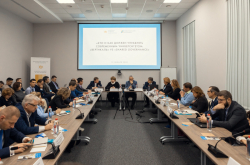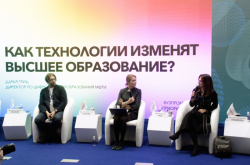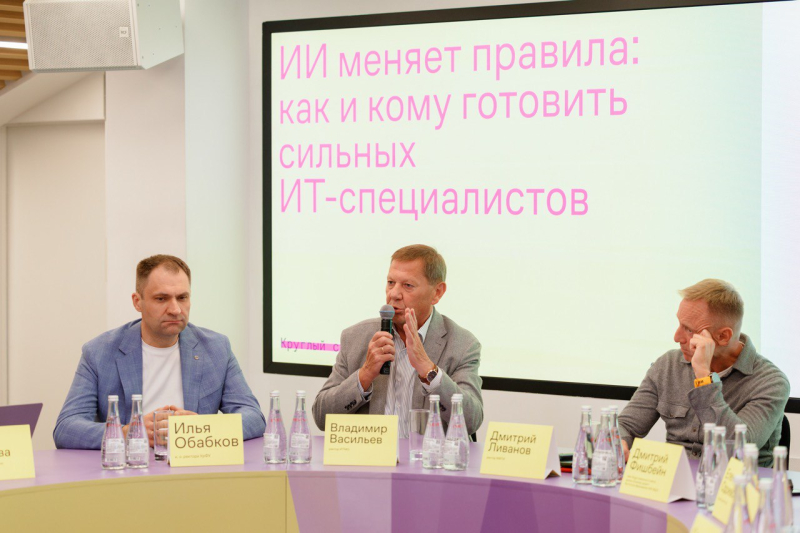
At the event, Daria Kozlova, the conference’s moderator, the Director for Education at Yandex, and the Director for Strategic Development at ITMO University, sparked a discussion that highlighted the need for a fresh perspective on the use of AI in the educational process and training of IT specialists. The reason for this is the massive transformation of higher education in Russia.
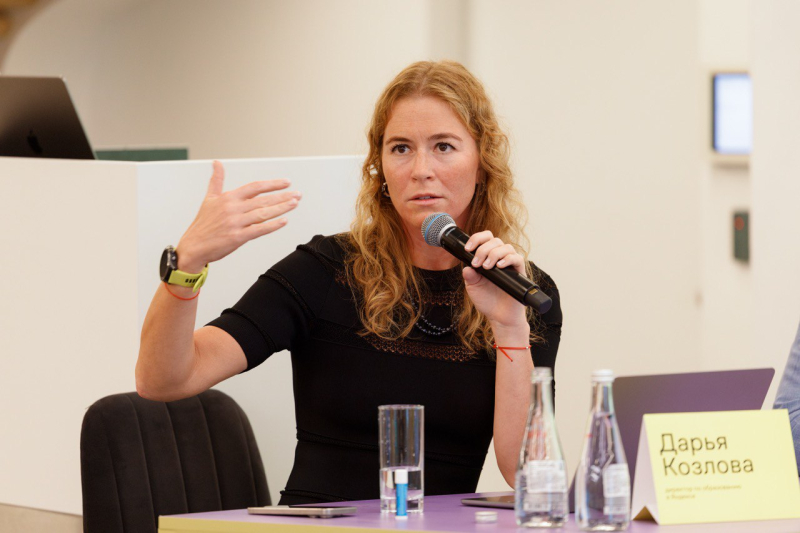
Daria Kozlova. Photo by Alexey Shabanov / Yandex Education
Vladimir Vasilyev, the Rector of ITMO University, proposed a practical approach to the problem. In his view, universities need to experiment with areas of growth in which students and lecturers could potentially achieve higher results using AI assistants and at the same time focus on the qualitative – rather than quantitative – aspect of successful cases. But globally speaking, the Rector believes that it is crucial for universities to reform their approach altogether – a tool for this can be the new training model for AI and IT specialists.
“A new era of AI calls for brand-new training approaches. To address these challenges, we’ve come up with and are already testing a new role-based competency model at ITMO University; a key feature of it is to shift from conventional academic fields to specific professional roles. As a result, first-year students understand what they want to be in the future, what they will do, and which competencies they need to acquire to thrive in the field of their choice. In order to succeed, this model, however, requires close ties with future employees to help students gain relevant practical skills that will give them a solid start as junior- or mid-level specialists,” emphasizes Vladimir Vasilyev, the Rector of ITMO University.

Vladimir Vasilyev. Photo by Alexey Shabanov / Yandex Education
Universities do not fear that the need for junior specialists who have just graduated will disappear due to the boom of AI on the IT market, says Dmitry Livanov, the Rector of MIPT. In his view, today’s students become junior specialists early on – as they start to intern at big tech companies in their very first year at the university. Meanwhile, AI assistants will prove useful in reducing routine intellectual tasks and freeing up time for professional development and improving soft skills
According to Ilya Obabkov, the Acting Rector of UrFU, junior-level specialists should not overuse vibe coding if they want to be successful in their early careers. Companies have to spend resources on additional training for newcomers who rely largely on AI when developing their products. Talented students who maintain a reasonable balance when working with AI are competent enough to take on genuine cases. Thus, the leading university in Yekaterinburg is looking for students who can tackle unconventional tasks at industrial productions. In this, they receive help from their partners who start to actively collaborate with prospective students while they are still at school.
At this exact stage, students should also be trained to have a more conscious approach to AI. One of the key tasks for teachers is to let their students use AI to shape their own individual learning tracks, believes Dmitry Fishbein, an associate professor at the Institute of Education at the HSE University and the former director of the Skolka school and the university’s lyceum. According to him, it is important to educate schools about what benefits AI offers – for instance, it can be used to prepare and evaluate assignments and make training materials and practices more personalized. This transformation should start with school administrations and teachers. If implemented wisely, schools will still need to develop emotional intelligence, critical and creative thinking in their students.
Face-to-face communication and soft skills are priority areas for universities, as well. For example, the representatives of HSE University noted that AI assistants would never eliminate the need for live communication among the different participants of the educational process. As noted by Elena Odoevskaya, the Vice-Rector of HSE University, a university’s strength lies in AI ethics.
The demand for AI and IT specialists is changing rapidly; today, businesses seek juniors with fresh ideas and perspectives, notes Olga Tsukanova, the executive director of Sberbank's Academic Partnerships. First-year students are less likely to be offered an internship because they still need to adapt to the student life and acquire fundamental knowledge, while senior students are applying for full-time positions. The situation requires a new internship model that will allow companies to work with first-year students in a new format, and that’s the task Sberbank is currently working on. VK accepts first- and second-year students but the company considers the ability of a student to integrate into their business environment, if they have the required flexibility and maturity, and can quickly solve problems. This was reported by Anna Stepanova, the deputy Vice-President for Educational Projects at VK.
The Yandex Education conference, which was focused on the new rules and approaches to training highly-skilled IT professionals, highlighted the key task for universities, businesses, and the government – to inspire students and lecturers to use AI technologies. The participants believe that this will be one of the priority areas of development for higher education institutions in the 2025-2026 academic year.