According to a recent study by the Russian job aggregator hh.ru, over the past decade the demand for data analysis and machine learning experts has grown by 30 times. At the same time, the greatest demand was noticed in the last four years, when the number of open positions grew by 2.5 times. Among the highest-paying jobs in 2024 were ML engineer (median monthly salary 590,000 rubles), data analyst (470,000 rubles), and highload systems security engineer (400,000 rubles).
Companies are still actively searching for candidates with skills at the intersection of data science and DevOps. As AI becomes more popular, MLOps/AIOps specialists are needed in public services and industry, at research centers and startups – anywhere where there is a need to support, monitor, and ensure the security of AI services. Thanks to the work of such specialists, streaming platforms have precise recommendation systems, banking apps detect suspicious operations and block them, and voice assistants get better at understanding users.
That’s why this year ITMO launches a Bachelor’s program that will train full-cycle engineers capable of anything from training neural networks to introducing them into products.
“Many universities are launching similar programs, including those in Russia. ITMO’s main advantage is that our students will be diving into three fields at once: MLOps – AI system use and support practices; AI security; and fintech. At other universities, the subject of systems support is sometimes missing altogether. Without these engineering skills – software development, architecture, databases, infrastructure, and cloud technologies – it will be difficult to bring an AI product to the market,” shares Artem Beresnev, a deputy dean of the Faculty of Applied Informatics.
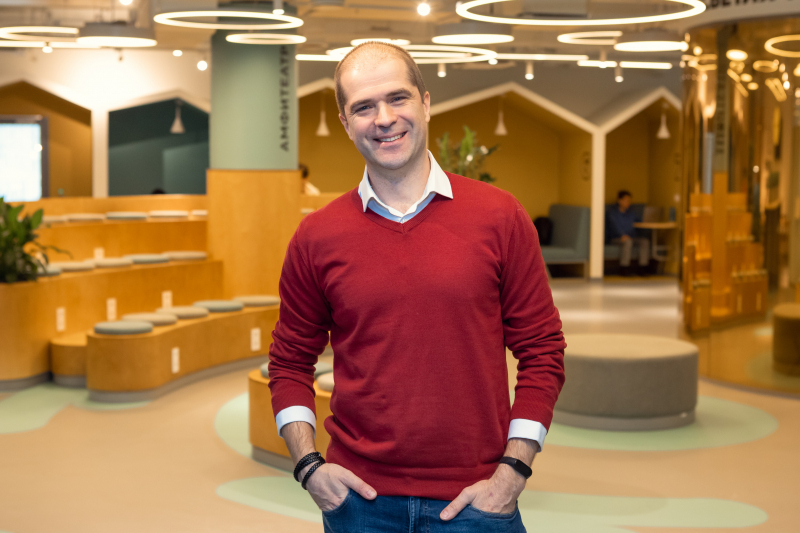
Artem Beresnev. Photo by Dmitry Grigoryev / ITMO NEWS
The program’s curriculum is built to gradually immerse students in their future career. In the first two years, they will acquire skills that are foundational for all AI specialists: fundamental and special math (analysis, statistics, probability theory, and discrete math), machine learning methods, algorithms and data structures, programming, and database design. Moreover, the program includes general courses – foreign language, history, philosophy, social skills, and entrepreneurship – in order to teach graduates to think in systems, understand business demands, and work with international companies.
In the third and fourth years, the program will focus on professional specialization. Students will start studying DevOps practices – platform management, monitoring, and CI/CD (software development tools). Next, they will transition into MLOps: data pipeline automation, model version management, and ML security. A separate block of the program will cover IT project and product management; this will teach graduates to manage teams, build AI product strategies, and evaluate the results of their work.
There are two tracks in the program:
Task assignment decision support system (TADS) in AI: a track focused on developing infrastructure for neural networks (servers, cloud platforms). In this track, students will design data centers, learn to gauge computing power, and ensure reliable operation of services.
Fintech and AI: this track focuses on applied AI solutions for financial organizations and markets. Students will delve into finance management, security demands, and market analysis tools. Graduates will be able to develop algorithms for credit scoring, fraud detection, and AI consulting.
Students will be able to choose their track in their third year based on their career ambitions. The first track will suit those interested in diving deeper into AI systems and building a career at tech companies, cloud providers, and research centers. The second track is a fit for those who want to apply AI in finance; its graduates will be in demand at fintech companies, banks, investment foundations, and insurance organizations. Students of both tracks will receive MLOps training in ML automation and support.
Within the program, ITMO collaborates with several industrial partners, including Selectel, Ozon Bank, Cian, and Croc. Industry experts contribute to course curriculum and act as lecturers. Selectel will also grant students access to their servers: GPU clusters for training neural networks, software environments, and cloud storage for working with big data. Moreover, the partner companies will accept junior students for internships in order to introduce them to internal processes as early as possible. Up to 80% of the program's students may end up completing such internships – and receive job offers upon their successful completion.
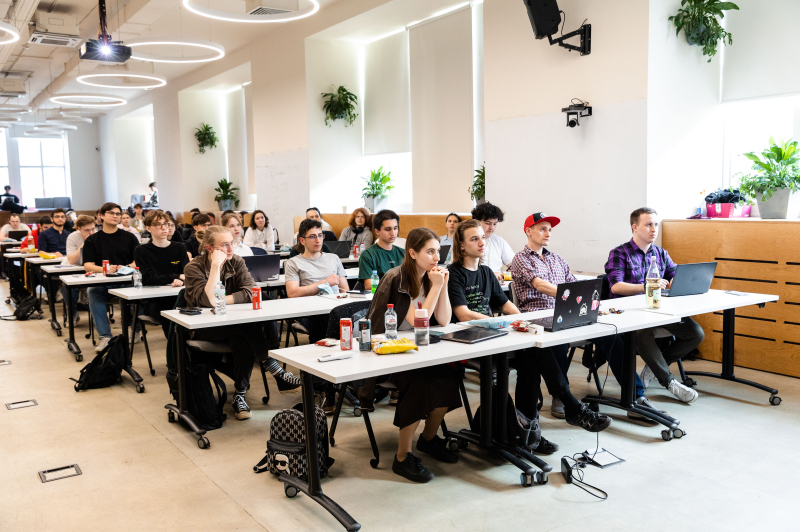
Photo by Maria Bakina / ITMO Mediaportal
“Among our faculty are PhD and DSc holders, who lead foundational courses in math, IT, and data structures. Development and professional courses will be delivered by engineers from our industrial partners, which is a practice we are planning to lean into. This balance will provide students with fundamental training that will help them to adapt to technological development, as well as relevant skills that are popular in the industry right now,” says Artem Beresnev.
The program will welcome applicants interested in math and computer science. The perfect candidates are graduates of schools with a focus on math, physics, or IT, and contest participants. Applicants will need to provide Unified State Exam (USE) scores in math, informatics, and Russian; the threshold score for tuition-free positions is 280 points for three subjects. International applicants will need to pass internal entrance exams similar to USE.
Graduates will be able to find employment as AI solution engineers who deploy and scale AI models and automate CI/CD, as well as ML engineers who develop models and integrate them into apps. Moreover, graduates will be able to work as AI infrastructure automation engineers, who monitor service stability, track model quality, and optimize computational resources. Such specialists are in demand at banks, where there is a need to ensure that credit-scoring systems work properly while evaluating millions of applications. In retail, engineers ensure the work of algorithms for demand predictions, and in medicine – implement neural networks that detect pathologies on scans quicker and more accurately than humans.