March
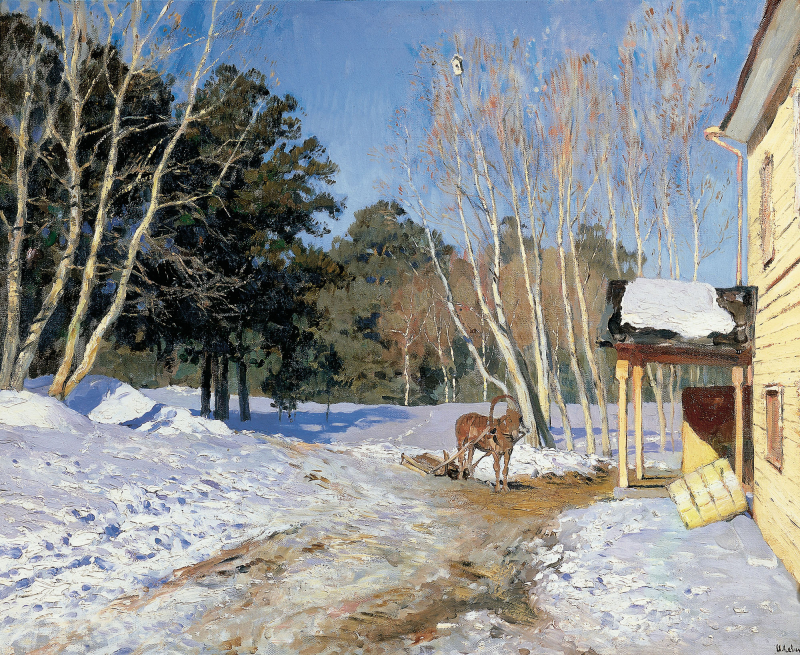
March by Isaaс Levitan, 1895, State Tretyakov Gallery (Moscow, Russia). Credit: State Tretyakov Gallery / Wikimedia Commons / CC-PD-Mark
Artist: Isaaс Levitan
Year of creation: 1895
Owned by: State Tretyakov Gallery (Moscow, Russia)
Among all of Levitan’s works, his March is one of the most life-affirming and optimistic; it depicts spring in its in-between state – sun-kissed pathways and soft, melting snow – when one can feel the coming season in the air, even if not on the ground yet. Some of his famous landscapes, including this one, were sketched and painted during his trips to Tver Oblast. It was done en plein air and in just a few sessions.
The Rooks Have Returned
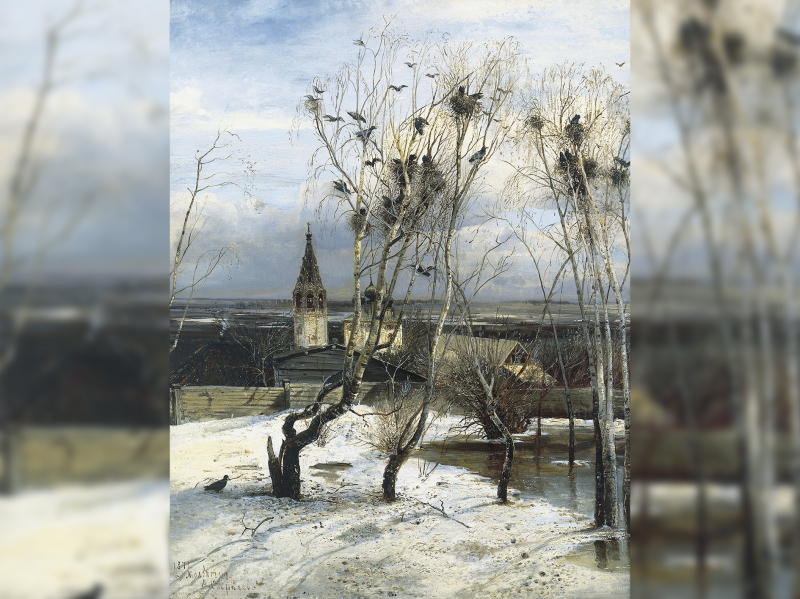
The Rooks Have Returned by Alexei Savrasov, 1871, State Tretyakov Gallery (Moscow, Russia). Credit: john_petrov / Wikimedia Commons / CC-PD-Mark
Artist: Alexei Savrasov
Year of creation: 1871
Owned by: State Tretyakov Gallery (Moscow, Russia)
This Savrasov piece is the essential Russian spring landscape. His painting illustrates the early signs of spring somewhere in the Russian province; he started it in Yaroslavl, then continued in Kostroma, and completed the work in Moscow. When first exhibited in 1871, the painting caused a sensation – it marked the birth of the lyrical landscape in Russian art.
Forest. In Spring
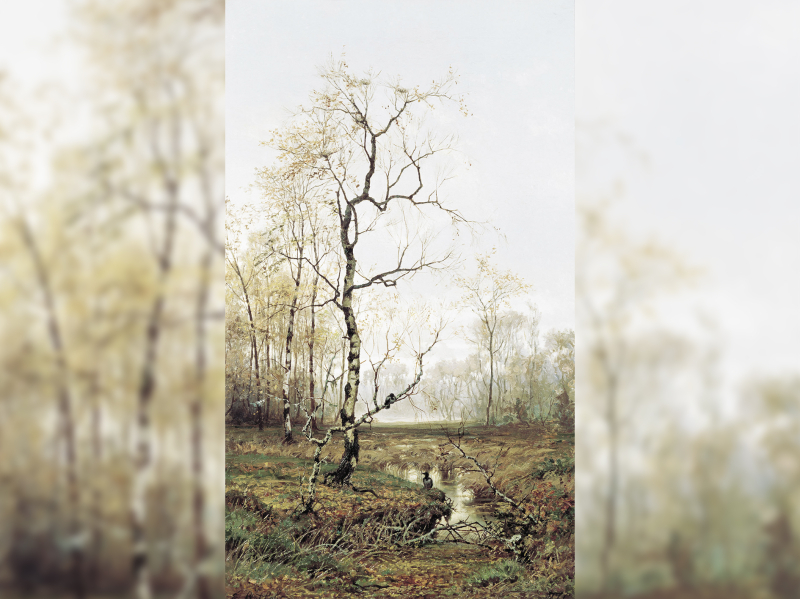
Forest. In Spring by Yefim Volkov, 1877, State Museum of Fine Arts (Kazan, Russia). Credit: Wikimedia Commons / CC-PD-Mark
Artist: Yefim Volkov
Year of creation: 1877
Owned by: State Museum of Fine Arts (Kazan, Russia)
Another early-spring landscape, the painting demonstrates scrupulous attention to detail: finely-drawn vegetation, muted, soft tones, and spring mist in the back. The author was part of the Wanderers – just as Savrasov (a founding member) and Levitan – who set themselves against the academically-accurate art and claimed to be people’s artists. A frequent “hero” of Volkov’s landscapes was central Russia, away from bustling cities and closer to rural settlements.
Spring
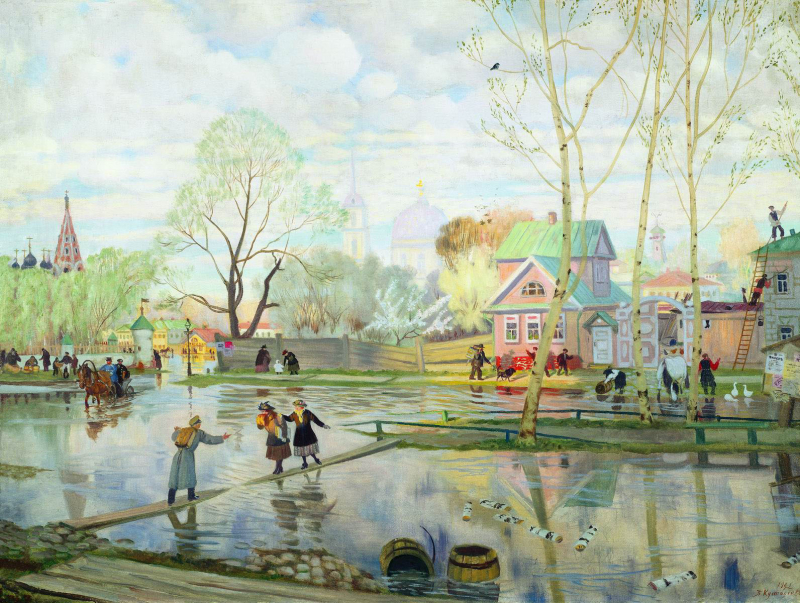
Spring by Boris Kustodiev, 1921, private collection. Credit: Wikimedia Commons
Artist: Boris Kustodiev
Year of creation: 1921
Owned by: private collection
A jack of all colors, Boris Kustodiev is best known for his masterful and colorful depictions of Russian life. Despite a serious condition leaving him immobilized for the last decade of his short life, the artist stayed committed to his craft, frequently drawing inspiration from his own memories. One of his notable late-life works, Spring, features a small Russian town in the season of spring floods. Flowing water might not be the most enjoyable manifestation of the season, yet the painting radiates light, color, and optimism.
Spring
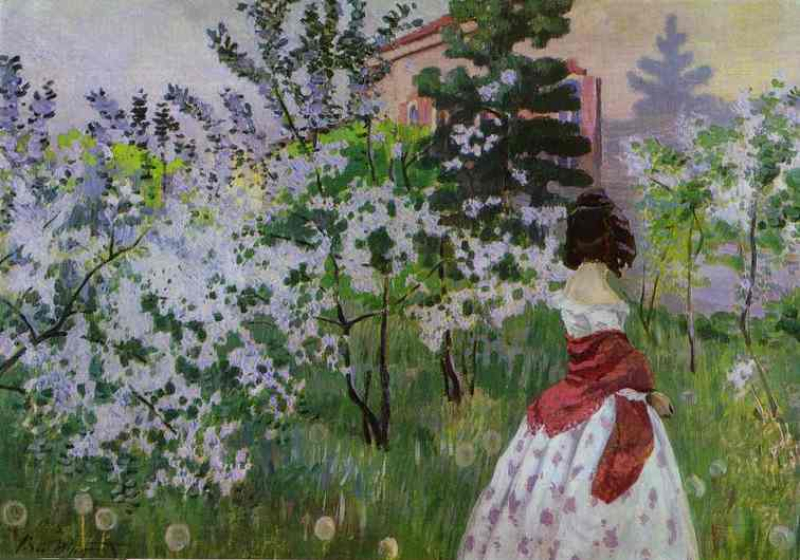
Spring by Victor Borisov-Musatov, с. 1898-1901, State Russian Museum (St. Petersburg, Russia). Credit: Wikimedia Commons / CC-PD-Mark
Artist: Victor Borisov-Musatov
Year of creation: с. 1898-1901
Owned by: State Russian Museum (St. Petersburg, Russia)
When realism started to give way to symbolism, Borisov-Musatov painted Spring – one of his standout artworks in which the focus shifts from the objective present to subjective emotions and ideas. The piece features the artist's signature style and palette, but, unlike his previous works, it doesn’t necessarily track a clear plot: all eyes are on a young girl who strolls against the dreamy background of trees and flowers in bloom.
Craving more? Keep exploring different seasons, holidays, and more through Russian art with our ongoing Five Paintings series.