To evaluate the taste of new products and monitor their quality, manufacturers use an “electronic tongue.” This sensor device can produce a more objective result compared to a human expert. However, these “tongues” process taste as a set of data and cannot tell exactly how humans will perceive and discern between flavors.
The thing is, one product can contain several million various ligands (chemical substances) and ions responsible for the sweet, bitter, sour, salty, and umami flavors. In general, scientists are aware of how ligands connect to each taste’s receptors and thus transmit information to the brain. But the same molecule – take, for instance, catechin, can interact with receptors of both bitterness and umami. These become harder to discern when the flavors are combined and, thus, a dish may taste more bitter than it really is. This is why it’s important to find out where ligands are located in space relative to each other, whether they mix or stay apart, and how they interact with various receptors.
Researchers from ITMO University, the V. M. Gorbatov Federal Research Center of Food Systems, and the University of Wisconsin-Milwaukee (USA) have developed a 3D spatial map for the bitter and umami flavors. First and foremost, the scientists wanted to learn how flavor receptors interact with their corresponding ligands: how the different molecules bond to receptors and which signals occur during that time, how the strength and length of perception changes, and what is the bond energy of a ligand and a receptor. The lower that energy value is, the more stable their interaction – and therefore the longer and stronger our sensation of a specific flavor.
The scientists focused on several known ligands: the bitter polyphenols (catechin, epicatechin, and flavan-3-ol) and glutamate, which produces the umami flavor. Some of these compounds are typically found in wine, which is why it was used as a convenient modeling system. With the help of computer modeling, researchers calculated the bond energy of each ligand with a receptor and then used that data to produce a matrix of the bitter and umami flavors.
“We considered flavor in spatial terms, quite like an RGB color palette – with coordinates denoting a specific point in space. I suggested a flavor matrix focused on affinity, which is the ability of ligands and taste receptors to interact, in order to show the strength of their ‘kinship.’ Since there are many types of taste receptors and they double for each other, the matrix can contain linearly-dependent rows and columns. For that reason, it was important to understand how many spatial dimensions are needed to describe bitterness and umami. Turns out, the number is three. Bitterness can be placed on a 2D plane, as humans have many bitterness receptors and they mostly function alike. Umami is perceived through other receptors and is quite independent, so it added a third dimension to our matrix and became perpendicular to bitterness. This means that these two flavors are independent, hence our ability to perceive both at once,” explains Michael Nosonovsky, one of the authors of the study, a senior researcher at ITMO’s Laboratory for Intelligent Technologies in Infochemistry, and a professor at the University of Wisconsin-Milwaukee.
Michael Nosonovsky. Photo by Dmitry Grigoryev / ITMO NEWS
The 3D flavor map will be useful in the development of “electronic tongues” capable of discerning delicate combinations of bitter and umami and predicting the taste of new products. It will also come in handy for the development of AI algorithm-based digital twins of food products, which are intended to accelerate the development of new foods and accurately model a desired flavor before the product has ever been made.
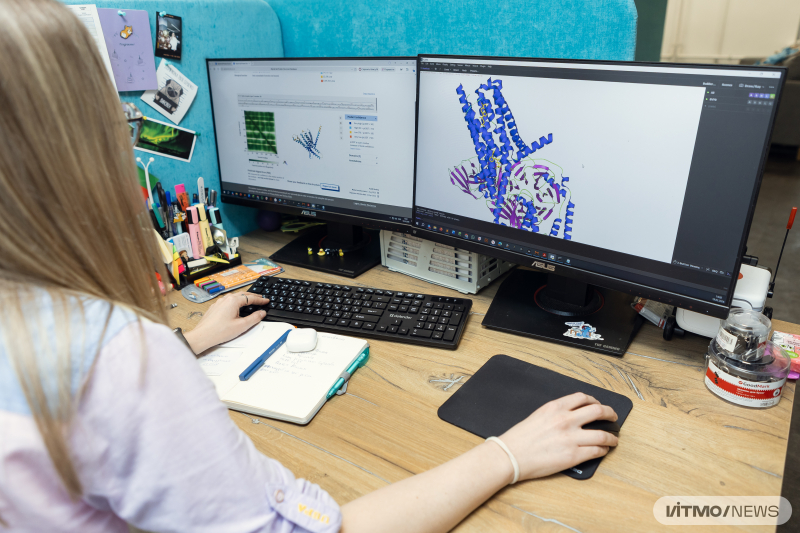
“Digital twins of food products are relevant to the restaurant industry. Usually, chefs spend around three months developing a new dish and still risk not matching their clients’ tastes, as they develop these dishes based on their own experience. With this tech, you wouldn’t need to blindly guess flavor combinations – the AI will suggest which molecules to add and in which amount so as to produce the right flavor. Digital twins can also help with developing food for people with taste disorders or just medicine in general. Oftentimes, medical products contain beneficial but bitter additives. By knowing the molecular makeup of a product, we can associate specific molecules to receptors and forecast the bitterness, its potential thresholds, and the ways to compensate for it,” comments Mariia Ashikhmina, one of the study’s authors and a researcher at ITMO’s Infochemistry Scientific Center.
Mariia Ashikhmina. Photo by Dmitry Grigoryev / ITMO NEWS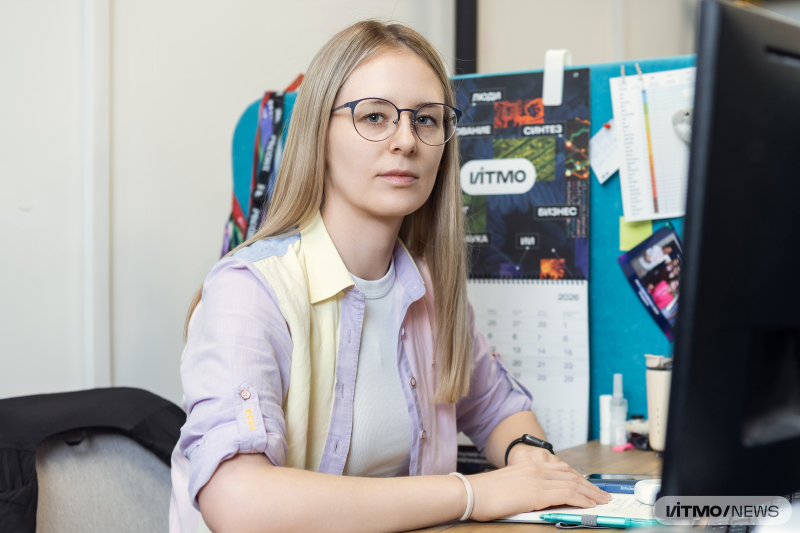
In the future, the scientists plan to study new ligands and receptors, including ones responsible for sweetness. To that end, they will gather data from global databases and scientific publications, conduct new calculations, and verify their predictions using both computer modeling (in silico) and test tubes with actual receptors (in vitro).
The described study was supported by grant No. 075-15-2024-483 of the Russian Ministry of Science and Higher Education.