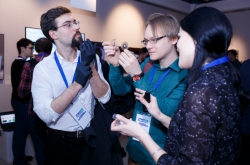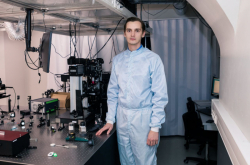
This was the third ReNew school and the first one hosted by ITMO University. The workshop was held as part of Clover, a photonics partnership by ITMO, MIPT, and Skoltech established in 2023 to promote cooperative research. The school’s program focused on current nanophotonic breakthroughs such as carbon nanostructures for light emission, innovative 2D optical materials, optical metasurfaces, quantum nanophotonics, and semiconductor lasers. ReNew’s mission is to introduce young researchers and students to the most recent advances in nanophotonics, while also creating favorable conditions for learning and exchanging ideas.
The workshop was attended by 85 students and researchers from ITMO University, Samara University, Peter the Great St. Petersburg Polytechnic University (SPbPU), Moscow Institute of Physics and Technology (MIPT), Skoltech, Lomonosov Moscow State University (MSU), Belarusian State University, and many others.
Over the course of three days, participants attended lectures by 30 renowned scientists, including corresponding members of the Russian Academy of Sciences Mikhail Glazov (Ioffe Institute) and Alexey Zhukov (Higher School of Economics), Anton Ikonnikov and Tatyana Dolgova (MSU), Anvar Baimuratov and Irina Martynenko (Skoltech), Alexander Chernov and Alexey Bolshakov (MIPT), etc.
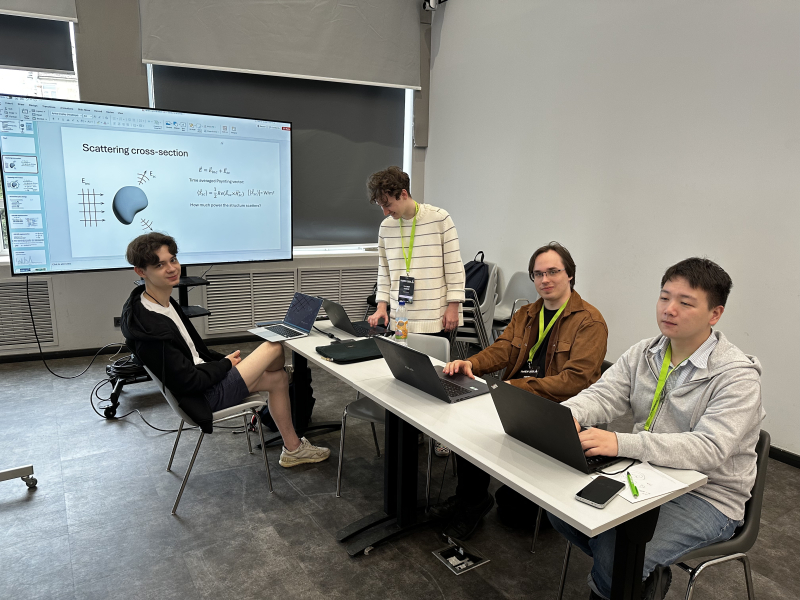
During the last two days of the school, participants attended a workshop on the modeling of resonant nanophotonic systems. There, they mastered numerical analysis, learned to design optical nanosystems accounting for multiphysical processes (thermo-optical and nonlinear effects), improved their COMSOL Multiphysics skills, and tried their hand at developing computational tools based on the Fourier Modal Method and other approaches.
The theoretical part was followed by curated project development. Project tasks were provided by QuantCad, among others, – a manufacturer of integrated photonic systems and optoelectronic devices. For their projects, participants developed resonant structures using mode coupling, designed photonic crystal resonators, and investigated the effects of optical nonlinearity in metasurfaces. The developed solutions will be deployed in real-world photonic integrated circuits.
Project presentations took place on the final day of the school. The project Dark Modes in Photonic Crystals by researchers from ITMO University, the Harbin Institute of Technology, and Belarusian State University was named best.
“What our students learned at the school they can use to perform optical computing and develop diffractive neural networks, integrated optics platforms, and in particular photonic integrated circuits – one of the most promising advances in nanophotonics. These technologies will be helpful in building a photonic computer; they can also be deployed in telecommunication systems, optical sensors for molecule detection, and flat optics systems for the creation of ultracompact optical lenses for signal transmission,” notes Mikhail Petrov, an organizer of the seminar and a senior researcher at ITMO’s Faculty of Physics.
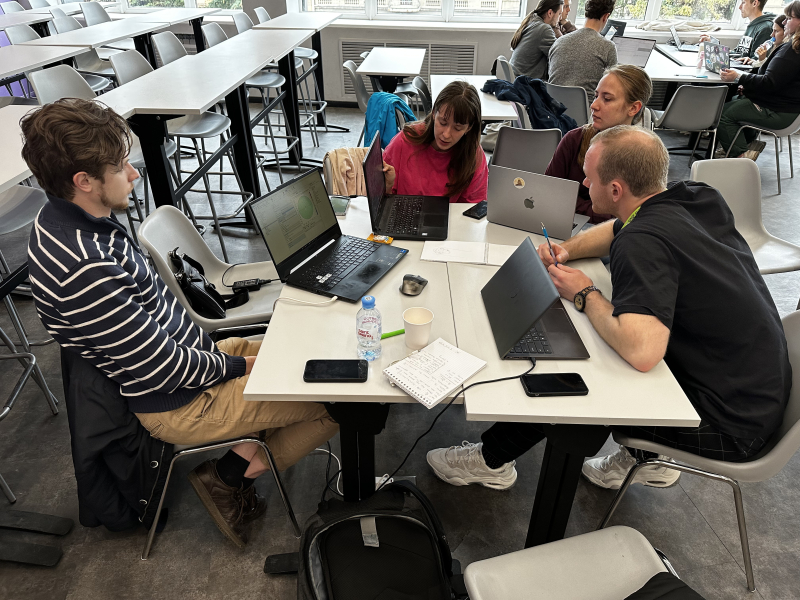
Resonant Nanophotonics Educational Workshop. Photo by Anastasiya Panyuta
Among the school’s sponsors are Scientific Devices and Systems and August Coffee Roasters.
The school is supported within the project No. 925066 of the national program Priority 2030.